Showing posts with label Discipline. Show all posts

Saturday, September 5, 2020

The PhD: Article publication, grant applications, promotion requests, and dealing with rejection

by Pat Thomson, Patter: https://patthomson.net/2020/08/31/dealing-with-rejection/

This is a guest post from Dan Cleather. Dan is a strength coach, educator, scientist and anarchist. His latest book,  “Subvert! A philosophical guide for the 21st century scientist”, was published in May.

Being an academic requires a thick skin. Very thick. Part of the job is dealing with a constant stream of rejections – on journal articles, grant applications, speaker applications, promotion requests … Rejection is always disappointing. However, over time we grow to understand that rejections often have little to do with the quality of the work. This helps us to protect our self-esteem – at least most of the time.

Experience is an important teacher in developing your thick skin. Once you have shepherded a few papers through a series of rejections and then ultimately into print, you can have confidence that your work is good, and put rejections down to editorial considerations or the vagaries of the peer review process.

But what if you are a student or an early career researcher? In this case you don’t have this experience, and each rejection can badly rock your self-confidence. I believe that rejections are a key factor in the growth of imposter syndrome in academia.

When one of my students first submits their work to an academic journal I always walk a weird tightrope in giving encouragement and managing expectations. On the one hand, I want to tell the student how good their work is. On the other, I need to prepare them for the fact that rejection is a very possible, and often likely, outcome. This post is the blog form of that conversation.

1. Appreciate The Statistics (Listen To The Horror Stories)

It is normal for excellent articles to get rejected. Some of the reasons for this are described later in this post. Everyone will have their own horror stories. Mine is that the first article from my PhD was rejected from 5 journals before I managed to get it accepted. It now has 41 citations.

It is also normal (but not right) for the peer review process to be a long, frustrating and unpredictable affair. One of the best students I ever worked with had to wait for 2 years to get her  first article into print – it broke my heart, as the work was fantastic. One of my favourite articles took 16 months to get through peer review (at the same journal), and despite the fact that I think it is some of my best work it never gets cited.

Applying for grants is even worse. The process is highly competitive, and so a lot of good proposals don’t get funded. The image here is a summary of my own grant applications over the last 10 years. Weeks of work went into each of these failed applications. It is a story with a happy ending, but this is only because of a recent success.

The take home message here is that, in academia, everyone gets rejected, all the time. When you are starting out you need to fight hard to believe this. Rejections are always disappointing, but at least if you appreciate the statistics you can reassure yourself that they are normal. 

2. Understand Editorial Considerations

A key part of an editor’s role is to ensure that the content in their journal is of interest to their readers. Often, if you experience a desk rejection – that is your work is rejected without being sent out for review – it is because the editor has decided that your article is not appropriate for their journal, or they have other articles that they think their readers will find more interesting. Again, it needs to be emphasised that this has nothing to do with the quality of the work – you are unlikely to get an article about lung disease into a cardiac journal, no matter how good it is. Of course, you might disagree with the editor – you probably sent the article to the journal because you wanted to reach that specific audience. However, it is up to the editor to steer the direction of a journal – ultimately the articles published in a journal will largely reflect the editor’s tastes. If they don’t favour your work it is important to bear in mind that this is just one person’s opinion.

Another part of an editor’s role is to act as custodian of the journal’s status. Many editors will be interested in the impact factor of their journal – i.e. how many times the articles in the journal are cited by external sources. This is a pretty awful way of judging a journal’s quality, but unfortunately is part of the current academic environment. For this reason, some editors will also reject articles that they don’t think will garner lots of citations. Again, just because an article doesn’t get cited does not mean it is not a good piece of work. Similarly, it is pretty difficult to predict this (even if you wanted to), and editors get it wrong all the time. Of the articles I have been involved with,  the most highly cited one with 59 citations, was rejected from at least two journals (as I remember) before it was accepted.

The point here is that the quality of the work is only one of a number of competing factors that are used in decision making – and sometimes not even the most important one. Many excellent articles are rejected (rightly or wrongly) based upon the editor’s prerogative. Often, success is predicated on getting your work in front of the right person, someone who knows enough about it to appreciate its importance.

3. Be Critical Of The Peer Review Process

Peer review is a notoriously fickle process, and it is helpful to a have a healthy scepticism as to its efficacy. However, many academics don’t, viewing peer review as a sacred cow that protects the integrity of the academic literature. This is demonstrably false – there are plenty of high profile examples that show that peer review often doesn’t even detect cases of academic misconduct.

There is evidence that supports the contention that peer review is a fickle process. For instance, one study showed that the rate of agreement between reviewers at the Journal of General Internal Medicine was little better than would be produced by chance. Similar findings have been found in the peer review of grant applications (e.g. in Australia and the  US). Every reasonably experienced academic will be able to relate examples of conflicting peer reviews that they have received.

What is the point of peer review if it is such a random process? Well, in many cases, peer review will improve the quality of an article, and it does provide some (imperfect) form of quality control. However, from the point of view of this blog post, you should recognise that a positive or negative recommendation is to some degree a matter of chance, and that you shouldn’t invest too much of your self-esteem in an academic flip of the coin.

4. Recognise Reviewer 2

Reviewer 2 is the person who sticks their hand up at the end of a presentation and asks the presenter why they didn’t do the study in an entirely different way.

Peer review is supposed to be a critical evaluation of your work. Ironically, sometimes peer reviewers are horribly uncritical. In particular, when performing a peer review, you should judge the article on its own merits – not list a plethora of alternative things that could have been done.

Peer reviewers are human too. You are often dealing with competitors, who have their own egos, and may have conflicting ideas as to how research should be done. If it seems to you that a reviewer is being unreasonable, then they probably are – and that sucks. It may even result in a rejection. To protect your self-esteem you need to recognise when your work is being rejected by Reviewer 2, and again, not take it is a reflection of your ability.

5. Back Yourself

Peer review is a process that will tend to reward work that conforms with the status quo, but that will tend to penalise potentially transformative research that breaks the mould. Peer review processes that improve the overall standard of research also result in more exceptional work being rejected, and papers that challenge the status quo undergo more changes during peer review. This is possibly best illustrated by the number of Nobel prize winning studies that were initially  rejected for publication.

Of course, if you receive a rejection you should consider the feedback carefully and try to learn from it. However, rejections should not make you feel that your ideas don’t have merit. The history of science is one of new ideas replacing old ones. Yes, we should expose our ideas to outside tests, and we should have the intellectual honesty to properly weigh up counter-arguments and consider that we might be wrong. However, if we believe that our ideas stand up to these tests, we need to have the confidence to back ourselves.

Where does this all leave us?

There is no doubt that rejection sucks. However, it is part and parcel of academic life. It is important that you are critical of the evaluative processes that are a part of academia, and that you don’t buy into them too fully. Celebrate the successes, but don’t pay too much attention to the rejections.

Wednesday, March 27, 2019

Why Incompetent People Think They’re Amazing: An Animated Lesson from David Dunning (of the Famous “Dunning-Kruger Effect”)

by Josh Jones, Open Culture: http://www.openculture.com/2017/12/why-incompetent-people-think-theyre-amazing.html

The business world has long had special jargon for the Kafkaesque incompetence bedeviling the ranks of upper management. There is “the Peter principle,” first described in a satirical book of the same name in 1968. More recently, we have the positive notion of “failing upward.” The concept has inspired a mantra, “fail harder, fail faster,” as well as popular books like The Gift of Failure. Famed research professor, author, and TED talker BrenĂ© Brown has called TED “the failure conference," and indeed, a “FailCon” does exist, “in over a dozen cities on 6 continents around the globe.”
The candor about this most unavoidable of human phenomena may prove a boon to public health, lowering levels of hypertension by a significant margin. But is there a danger in praising failure too fervently? (Samuel Beckett’s  quote on the matter, beloved by many a 21st century thought leader, proves decidedly more ambiguous in context). Might it present an even greater opportunity for people to “rise to their level of incompetence”? Given the prevalence of the “Dunning-Kruger Effect,” a cognitive bias explained by John Cleese in a previous post, we may not be well-placed to know whether our efforts constitute success or failure, or whether we actually have the skills we think we do.

First described by social psychologists David Dunning  (University of Michigan) and Justin Kruger (N.Y.U.) in 1999, the effect “suggests that we’re not very good at evaluating ourselves accurately.” So says the narrator of the TED-Ed lesson above, scripted by Dunning and offering a sober reminder of the human propensity for self-delusion. “We frequently overestimate our own abilities,” resulting in widespread “illusory superiority” that makes “incompetent people think they’re amazing.” The effect greatly intensifies at the lower end of the scale; it is often “those with the least ability who are most likely to overrate their skills to the greatest extent.” Or as Cleese plainly puts it, some people “are so stupid, they have no idea how stupid they are.”
Combine this with the converse effect—the tendency of skilled individuals to underrate themselves—and we have the preconditions for an epidemic of mismatched skill sets and positions. But while impostor syndrome can produce tragic personal results and deprive the world of talent, the Dunning-Kruger effect’s worst casualties affect us all adversely. People “measurably poor at logical reasoning, grammar, financial knowledge, math, emotional intelligence, running medical lab tests, and chess all tend to rate their expertise almost as favorably as actual experts do.” When such people get promoted up the chain, they can unwittingly do a great deal of harm.
While arrogant self-importance plays its role in fostering delusions of expertise, Dunning and Kruger found that most of us are subject to the effect in some area of our lives simply because we lack the skills to understand how bad we are at certain things. We don't know the rules well enough to successfully, creatively break them. Until we have some basic understanding of what constitutes competence in a particular endeavor, we cannot even understand that we’ve failed.
Real experts, on the other hand, tend to assume their skills are ordinary and unremarkable. “The result is that people, whether they’re inept or highly skilled, are often caught in a bubble of inaccurate self-perception." How can we get out? The answers won’t surprise you. Listen to constructive feedback and never stop learning, behavior that can require a good deal of vulnerability and humility.

Wednesday, February 20, 2019

VIDEOS: Hear Hours of Lectures by Michel Foucault: Recorded in English and French Between 1961 and 1983

by Josh Jones, Open Culture: http://www.openculture.com/2018/01/hear-hours-of-lectures-by-michel-foucault.html

Tucked in the afterword of the second 1982 edition of Hubert Dreyfus and Paul Rabinow’s Michel Foucault: Beyond Structuralism and Hermeneutics, we find an important, but little-known essay by Foucault himself titled “The Subject and Power.” Here, the French theorist offers what he construes as a summary of his life’s work: spanning 1961’s Madness and Civilization up to his three-volume, unfinished History of Sexuality, still in progress at the time of his death in 1984. He begins by telling us that he has not been, primarily, concerned with power, despite the word’s appearance in his essay’s title, its arguments, and in nearly everything else he has written. Instead, he has sought to discover the “modes of objectification which transform human beings into subjects.”

This distinction may seem abstruse, a needlessly wordy matter of semantics. It is not so for Foucault. In key critical difference lies the originality of his project, in all its various stages of development. “Power,” as an abstraction, an objective relation of dominance, is static and conceptual, the image of a tyrant on a coin, of Thomas Hobbes’ Leviathan seated on his throne.

Subjection, subjectification, objectivizing, individualizing, on the other hand—critical terms in Foucault’s vocabulary—are active processes, disciplines and practices, relationships between individuals and institutions that determine the character of both. These relationships can be located in history, as Foucault does in example after example, and they can also be critically studied in the present, and thus, perhaps, resisted and changed in what he terms “anarchistic struggles.”


Foucault calls for a “new economy of power relations,” and a critical theory that takes “forms of resistance against different forms of power as a starting point.” For example, in approaching the carceral state, we must examine the processes that divide “the criminals and the ‘good boys,’” processes that function independently of reason. How is it that a system can create classes of people who belong in cages and people who don’t, when the standard rational justification—the protection of society from violence—fails spectacularly to apply in millions of cases? From such excesses, Foucault writes, come two “’diseases of power’—fascism and Stalinism.” Despite the “inner madness” of these “pathological forms” of state power, “they used to a large extent the ideas and the devices of our political rationality.”

People come to accept that mass incarceration, or invasive medical technologies, or economic deprivation, or mass surveillance and over-policing, are necessary and rational. They do so through the agency of what Foucault calls “pastoral power,” the secularization of religious authority as integral to the Western state.
This form of power cannot be exercised without knowing the inside of people’s minds, without exploring their souls, without making them reveal their innermost secrets. It implies a knowledge of the conscience and an ability to direct it.
In the last years of Foucault’s life, he shifted his focus from institutional discourses and mechanisms—psychiatric, carceral, medical—to disciplinary practices of self-control and the governing of others by “pastoral” means. Rather than ignoring individuality, the modern state, he writes, developed “as a very sophisticated structure, in which individuals can be integrated, under one condition: that this individuality would be shaped in a new form and submitted to a set of very specific patterns.” While writing his monumental History of Sexuality, he gave a series of lectures at Berkeley that explore the modern policing of the self.


In his lectures on "Truth and Subjectivity" (1980), Foucault looks at forms of interrogation and various “truth therapies” that function as subtle forms of coercion. Foucault returned to Berkeley in 1983 and delivered the lecture “Discourse and Truth,” which explores the concept of parrhesia, the Greek term meaning “free speech,” or as he calls it, “truth-telling as an activity.” Through analysis of the tragedies of Euripides and contemporary democratic crises, he reveals the practice of speaking truth to power as a kind of tightly controlled performance. Finally, in his lecture series “The Culture of the Self,” Foucault discusses ancient and modern practices of “self care” or “the care of the self” as technologies designed to produce certain kinds of tightly bounded subjectivities.
You can hear parts of these lectures above or visit our posts with full audio above. Also, over at Ubuweb, download the lectures as mp3s, and hear several earlier talks from Foucault in French, dating all the way back to 1961.
When he began his final series of talks in 1980, the philosopher was asked in an interview with the Daily Californian about the motivations for his critical examinations of power and subjectivity. His reply speaks to both his practical concern for resistance and his almost utopian belief in the limitless potential for human freedom. “No aspect of reality should be allowed to become a definitive and inhuman law for us,” Foucault says.
We have to rise up against all forms of power—but not just power in the narrow sense of the word, referring to the power of a government or of one social group over another: these are only a few particular instances of power.
Power is anything that tends to render immobile and untouchable those things that are offered to us as real, as true, as good.
Read Foucault’s statement of intent, his essay “The Subject and Power,” and learn more about his life and work in the 1993 documentary below.
Foucault's lecture series will be added to our collection, 1,300 Free Online Courses from Top Universities.
Related Content:
Josh Jones is a writer and musician based in Durham, NC. Follow him at @jdmagness

Sunday, February 3, 2019

Leonardo da Vinci: 500 Years After His Death, His Genius Shines as Bright as Ever

by Gabriele Neher, University of Nottingham, The Conversation: https://theconversation.com/leonardo-da-vinci-500-years-after-his-death-his-genius-shines-as-bright-as-ever-111011

File 20190201 75085 1mor4cs.png?ixlib=rb 1.1

Is there no end to his talent? A self-portrait of Leonardo da Vinci.

Old masters rarely come more venerable (and venerated) and instantly recognisable than Leonardo da Vinci. But to think of Leonardo as an Old Master – with all its connotations of being staid, traditional, somehow old-fashioned and boring – is to do this extraordinary man a grave injustice. There is nothing stale or predictable about a man whose personal foibles irritated and frustrated contemporaries as much as his brilliance and creativity dazzled and awed them. One thing is for sure: whatever Leonardo was, old and boring he was not.

May 2 2019 marks the 500th anniversary of Leonardo’s death in Amboise in France, and this milestone is celebrated in flurry of activity including – in the UK – a brilliant and imaginative series of 12 simultaneous exhibitions around the country, each comprising 12 drawings by Leonardo da Vinci drawn from the Royal Collection at Windsor.

Drawing provides an insight into how this pioneer, who defied all expectations, saw the world around him – so there is no more fitting celebration of his life than putting 144 of Leonardos’s images on display.

It would be fun to engage in a bit of Leonardo exhibition tourism as each of the 12 exhibitions focuses on a specific theme.
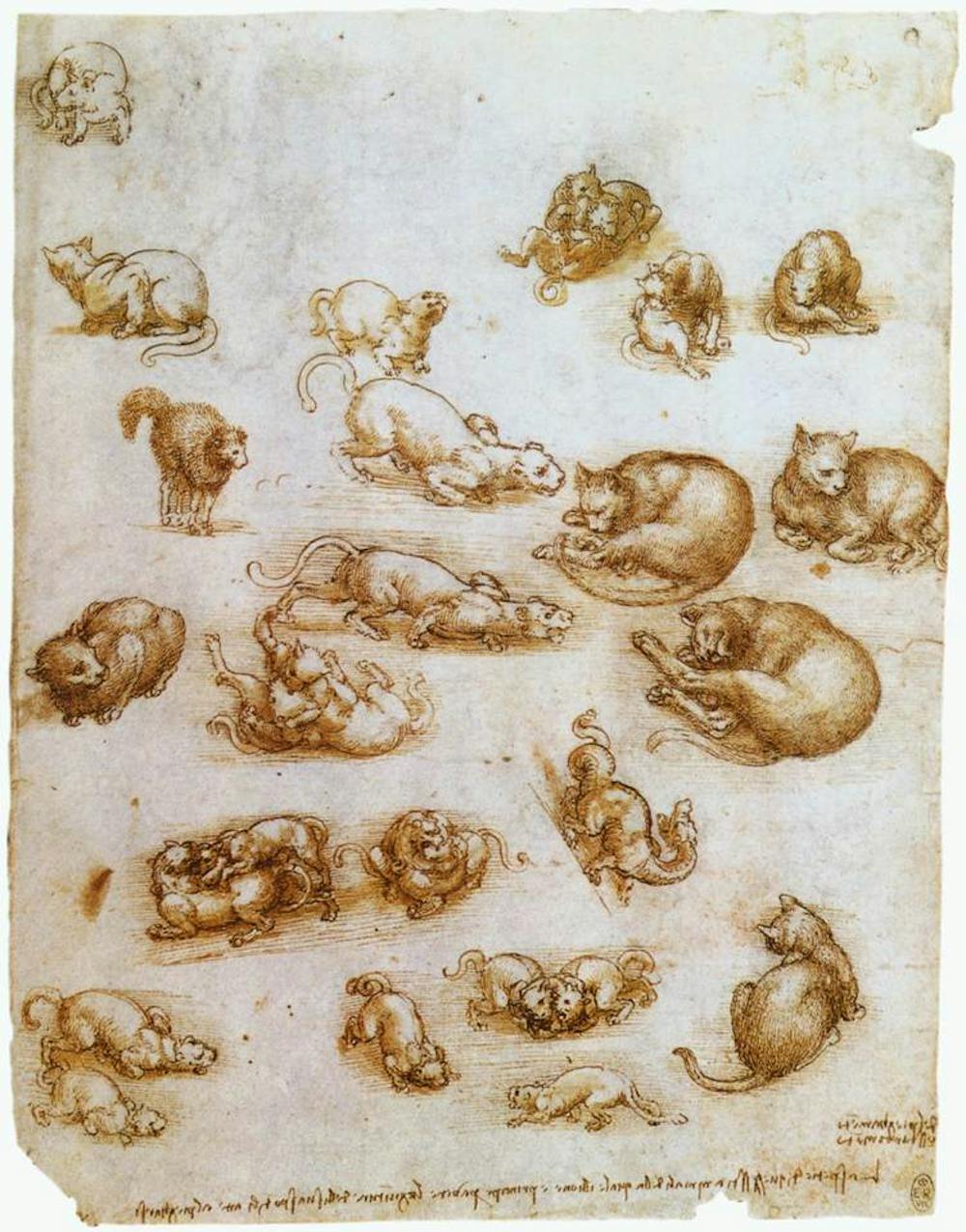
Cats, lions and a dragon, c.1517-18, black chalk, pen and ink, wash. Royal Collection Trust / (c) Her Majesty Queen Elizabeth II 2018

Bristol Museum and Art Gallery, for example, houses the drawings relating to animals and their movements including the truly beguiling Cats, lions and a dragon (ca 1513-18) which should finally put any suggestions to rest about Leonardo’s status as a staid old master.

Leonardo is watching a cat grooming – but eventually, what he records is no longer a cat but the most enchanting little dragon whose sinous curves mirror those of the cats on the same sheet of paper. Leonardo’s mind never stood still and it is through his drawings that you can see the mind of an artist at work who could paint the majestic Last Supper and derive as much fun from doodling cats.

Workshop apprentice

Leonardo’s beginnings as an artist followed the traditional route of indenture in an established master’s workshop, in this case, the studio of Andrea del Verrochio, a very successful artist in the orbit of the Medici family who was as accomplished a business man as he was an artist.

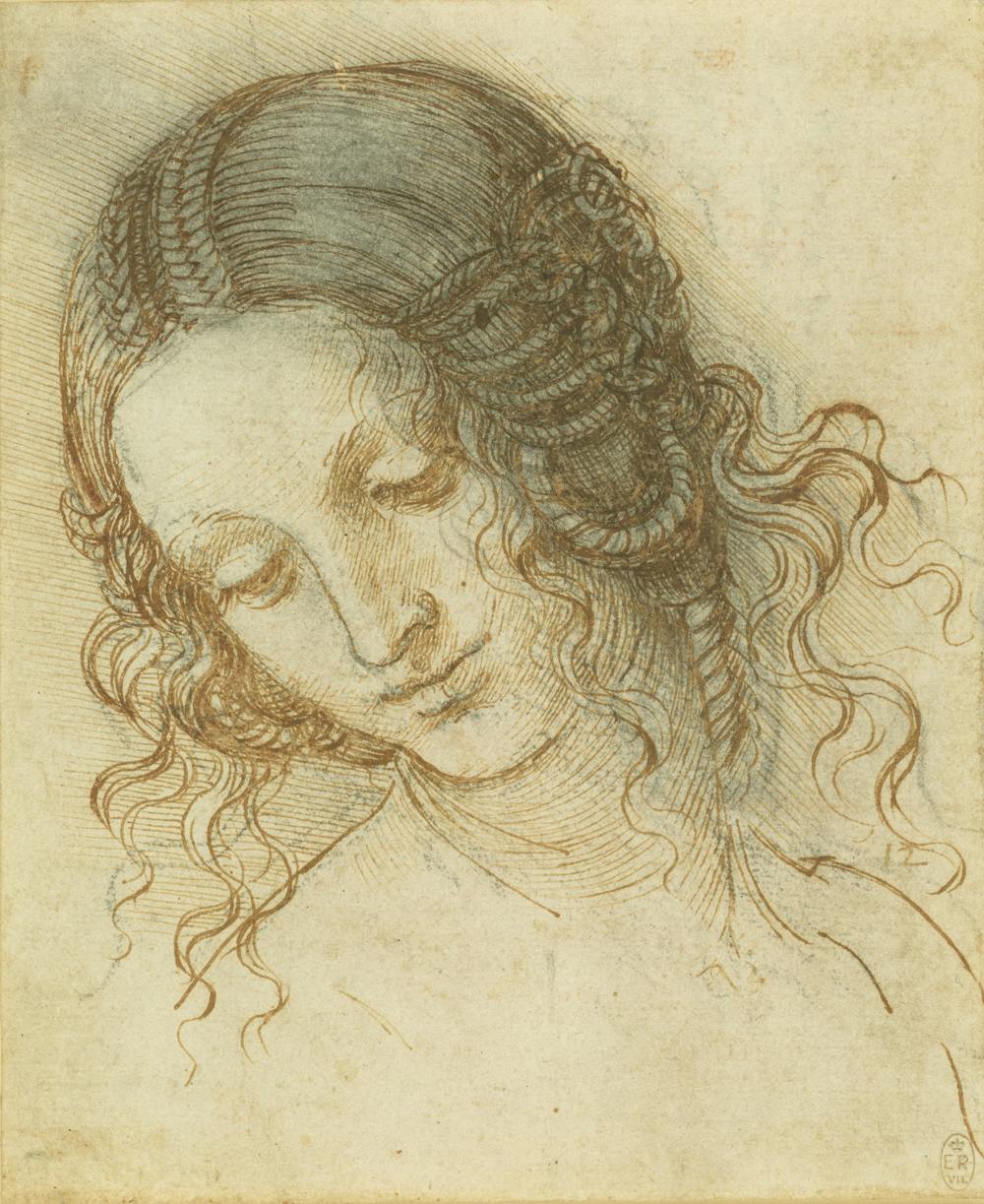
The head of Leda, c.1505-8, black chalk, pen and ink. Royal Collection Trust / Ă‚© Her Majesty Queen Elizabeth II 2018

The Renaissance workshop fostered a multitude of talents – at any one time a workshop might be executing bespoke images for a wealthy patron while at the same time collaborating with another workshop on large-scale fresco decorations or structural work or designing and producing ephemeral, gilded papier-mĂ¢chĂ© decorations for a banquet.

Artists were expected to be able to produce exquisite designs for jewellery, clothing and animal livery for the well-heeled merchants of Renaissance Florence. Meanwhile they would also churn out the popular birth trays presented to mothers in celebration of the delivery of a child and panel paintings for a cheaper market, copy heraldic designs and sketch maps.

Renaissance workshops thrived because of the variety of skills brought together under one roof by a master such as Verrochio – the team was stronger than the sum of its individual parts, and it sustained itself through its apprentices. Leonardo though stood out as a master of all trades, as the artist who excelled not at one art but all of them.

Court artist

Leonardo was quite aware of his extraordinary talents and value to patrons and spelled this out in a letter seeking employment at one of Europe’s most lavishly spending Court, that of Ludovico il Moro Sforza, Duke of Milan.

He speaks of expertise in the design and construction of effectively field artillery and bailey bridges; outlines his skills in sapping walls and landscaping; his expertise as an architect and sculptor and also promises that he can do “in painting whatever may be done as well as any other, be he who he may”.

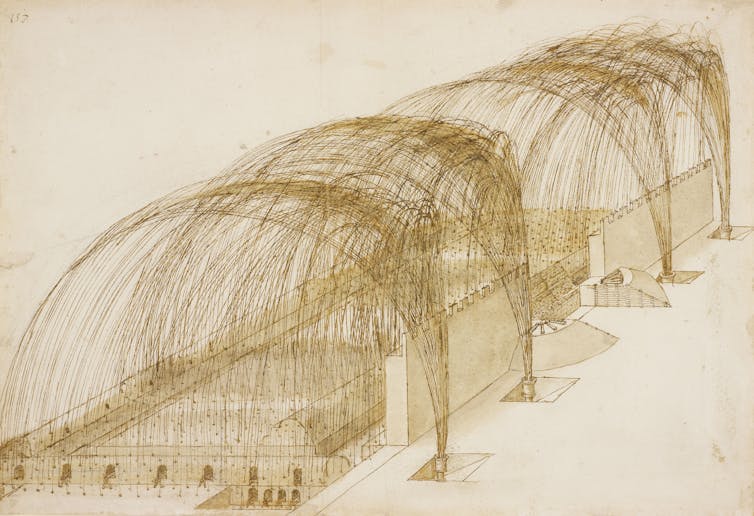
Mortars firing into a fortress, c.1503-4, black chalk, pen and ink, wash. Royal Collection Trust / (c) Her Majesty Queen Elizabeth II 2018

The Duke of Milan duly appointed Leonardo to his court and it was at Sforza’s court that Leonardo, at the age of almost 30, was to spend the next two decades painting his best-known works (the Mona Lisa, The Last Supper, The Madonna of the Rocks, the enchanting Lady with the Ermine). All the while he was working towards the one commission closest to his patron’s heart – the casting of a life-sized equestrian statue celebrating Sforza’s father.

Leonardo as an artist did not measure himself against his contemporaries alone, but his true competition were the great masters of classical antiquity. And the only way in which he could achieve lasting fame through his work, was to ensure that his works – especially the Sforza monument – became exemplars. These were intended as unsurpassable demonstrations of his skills and knowledge.

The greatest legacy Leonardo left from his Milanese years are his notebooks and drawings (including some of the ones now on show), and one of the reasons behind these drawings was his quest to master everything he might need in order to best execute that monument.

A design for an equestrian monument, c.1485-8, metalpoint on blue prepared paper. Royal Collection Trust / (c) Her Majesty Queen Elizabeth II 2018

He needed to understand the anatomy of the animal and its rider – his notebooks show the most extraordinary studies of human and animal anatomy, movement and expression, with Leonardo returning again and again to the same motif, endlessly working on minute variations.

In order to cast the great monument, he would need to understand the behaviour of metals, fire and minerals – as well as the mechanical processes of casting and hoisting the monument. So he studied machines, drew existing ones, improved on old designs and invented new ones. Leonardo wanted to know about the minutiae of textures but also needed to understand a landscape holistically.

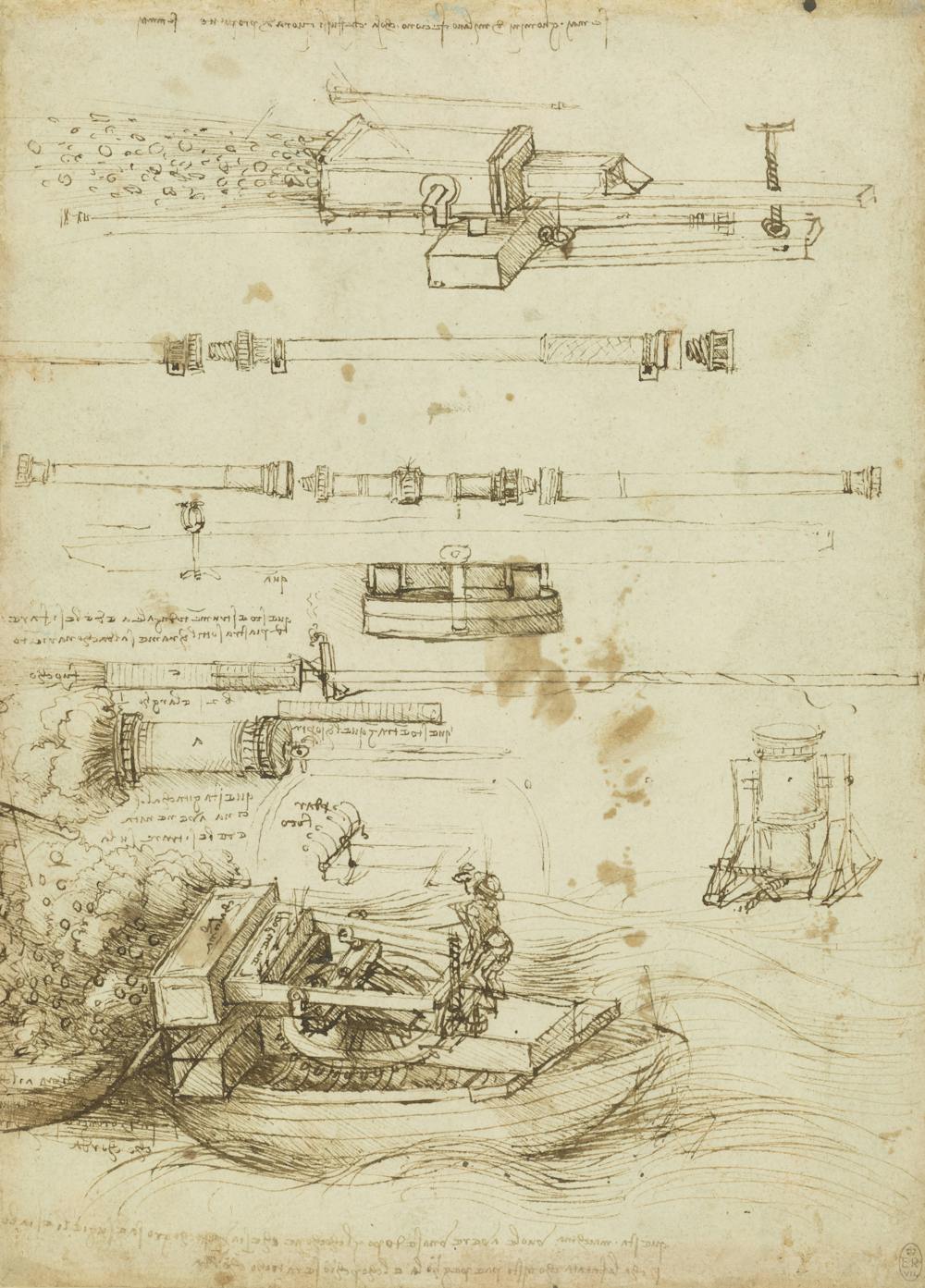
Designs for gun-barrels and mortars, c.1485, pen and ink. Royal Collection Trust / (c) Her Majesty Queen Elizabeth II 2018

The notebooks are encyclopaedic in their topics, and breathtaking in their intricacy and beauty. It is the ceaselessness of his drawing that provides the key to understanding the timeless appeal of this greatest of artists.
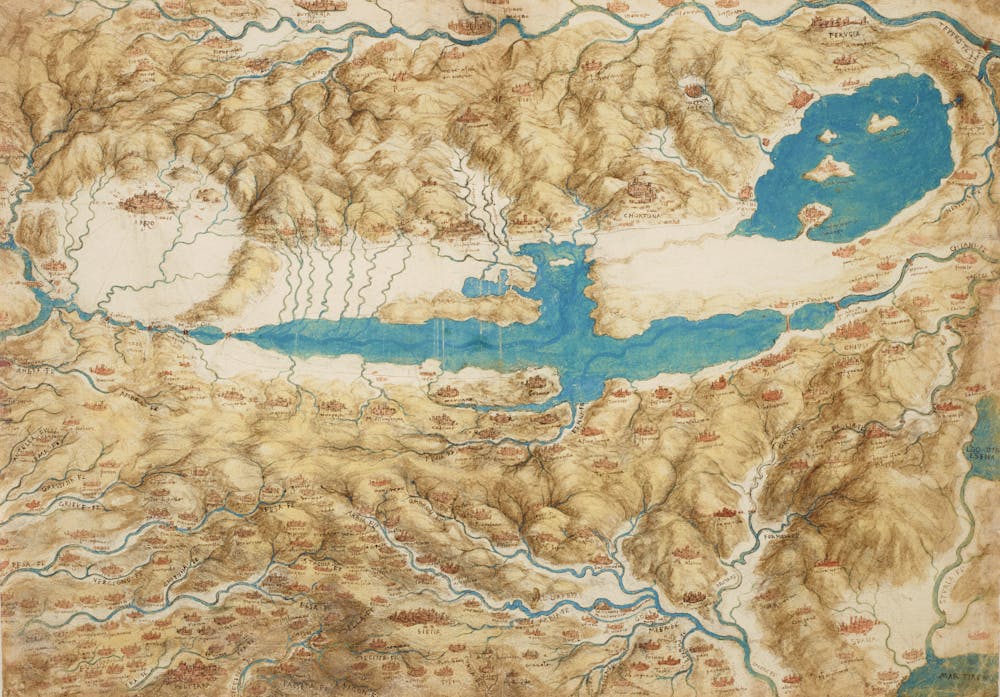
Leonardo died 500 years ago at Amboise, at the Court of Francis I, where he retired after working for some of the greatest patrons of the early 16th century. He travelled with Cesare Borgia’s army and drew some very early bird’s-eye-view maps.

Map of the Valdichiana, c.1503-4, watercolour, pen and ink, ink wash over black chalk. Royal Collection Trust / (c) Her Majesty Queen Elizabeth II 2018

He stayed at the Papal Court of Leo X (Giovanni de’ Medici) experimenting with mechanical clockwork devices and increasingly focused on his study of meteorological phenomena such as clouds and deluges, yet the one constant was drawing.

So enjoy these drawings that have come down through 500 years of art history and appreciate that you are looking inside the mind of the greatest “Renaissance Man” of them all.The Conversation

Gabriele Neher, Associate Professor in History of Art, University of Nottingham

This article is republished from The Conversation under a Creative Commons license. Read the original article.

Friday, February 1, 2019

Digitally Tracking Student Behaviour in the Classroom Encourages Compliance, Not Learning

by Jamie Manolev, University of South Australia; Anna Sullivan, University of South Australia, and Roger Slee, University of South Australia: https://theconversation.com/digitally-tracking-student-behaviour-in-the-classroom-encourages-compliance-not-learning-110181

File 20190129 108364 qanre3.jpg?ixlib=rb 1.1

ClassDojo is an app used by teachers across the world to manage behaviour in the classroom. www.shutterstock.com

ClassDojo is one of the most popular classroom communication apps in the world. It claims to assist teachers to create happier classrooms and bills itself as “the simple way to build an amazing classroom community”.

Since it was released in 2011, it has rapidly spread to be used in more than 180 countries worldwide and over half of Australian primary schools. But new research looks beneath ClassDojo’s friendly exterior to carefully consider the implications of tracking student data on discipline and behaviour.


Read more: Teachers shouldn't have to manage behaviour issues by themselves – schools need to support them


It’s important teachers, parents and school leaders look more closely at how it works, especially because its use of surveillance, competition and long-lasting behaviour records influence classroom learning and students.

Why is ClassDojo so popular with teachers?

Teachers use ClassDojo to manage classrooms and student behaviour, and as a platform to communicate with parents. It’s colourful, friendly and easy to use. And it’s free.


How does the behaviour component of ClassDojo work?

The ClassDojo feedback feature works like a traditional classroom points system, but records more information and is done using a computer, iPad or smart-phone. It is an electronic way of tracking student behaviours and providing immediate feedback to students and parents.

Teachers can award positive or negative points to students for displaying a range of behaviours. They can use ClassDojo to provide visual and audio cues to students that reflect the positive and negative feedback.

“Positive” feedback is coloured green and arrives with a pleasant ding sound. “Needs work” feedback is coloured red and arrives with a harsh buzz sound. These cues can be used publicly so the whole class is made aware feedback has been given.


Read more: Are Australian classrooms really the most disruptive in the world? Not if you look at the whole picture


Over time, points accumulate to produce a personal behaviour score. ClassDojo automatically tracks and stores every piece of student feedback data. This allows teachers to create reports on students that show data on:
  • details of the behaviour or skill points are awarded for
  • the time and date when points were awarded
  • number of accumulated “positive” points
  • number of accumulated “needs work” points.
Reports provide a green and red donut chart and percentages of “positive” and “needs work” points awarded. These behaviour reports can be easily shared with parents.

Why should we be concerned?

ClassDojo encourages surveillance. For example, its surveillance techniques include:
  • teachers monitoring students constantly to award points, positive or negative
  • public displays of class points on large classroom screens making each student’s behaviour score visible to anybody in the class
  • building student behaviour profiles that can be viewed by teachers, parents and school leaders throughout their schooling
  • parents can be notified via text message whenever their child receives behaviour feedback in the form of points
  • registered parents are reminded via a weekly email to check their child’s behaviour profile report.

Too much surveillance is not good for students. from www.shutterstock.com

Surveillance

Too much surveillance is not good for kids. This level of surveillance used to monitor and influence student behaviour focuses on controlling them to behave in certain ways. It’s a way of promoting compliance and conformity.

Having control in the classroom is important, but this is different to controlling students. Controlled students get little chance to learn how to make sensible decisions about their own behaviour. They rely on others to tell them.

Experts argue surveillance erodes trust and has a chilling effect on creativity. They also indicate students take fewer risks because their mistakes might count against them.

Encouraging risk-taking is important and improves students’ learning. And, negative student data profiles can influence the way teachers regard their students.

Competition

Points systems and rankings promote competitive environments. These are fine in some circumstances, such as in competitive sports, but not as the main way of supporting students in classrooms.

Competitive environments create conflict and unease, particularly for students who find themselves regularly at the bottom. And when positive and negative ClassDojo points are publicly announced it can humiliate or shame students. This affects students’ attitudes to learning.

Long lasting behaviour records

The creation of digital behaviour profiles on students could have a long-lasting impact. Old fashioned points systems such as star charts were temporary, had a short life, and weren’t terribly effective. ClassDojo collects and retains all recorded data on students.

Star charts were temporary, but not very effective. from www.shutterstock.com

Concerns have been raised over who owns this behaviour data and how it might be used in the future. There is potential for behavioural data profiles to follow students through school. It’s too early to tell how they might be used in the future and what problems this might present.

What should schools do?

Teachers should approach school discipline in an educational manner. They should see behaviour in a similar way to curriculum – something that can be taught.

Teachers should understand the ways their teaching and the curriculum influence student behaviour. They should seriously reconsider using technology to monitor behaviour because of the negative impact it could have on students.

Schools need to create safe and secure environments that are orderly and allow learning to happen. This doesn’t mean students need to be controlled though constant surveillance. Simply controlling student behaviour has little educational value. This approach provides a disservice to our students.


Read more: How teachers are taught to discipline a classroom might not be the best way


School discipline should be about building respectful relationships and educating students about how, why and when certain behaviours are appropriate. This will support students to become successful, independent learners and citizens.

This educational approach is supported by classroom management and school discipline research which says schools should focus on relational aspects of schooling based on respect, dignity and caring. Schools should also make sure their approach to discipline is learning-oriented and seeks to develop self-regulation and trust.The Conversation

Jamie Manolev, Research assistant, University of South Australia; Anna Sullivan, Associate Professor of Education, University of South Australia, and Roger Slee, Professor of Inclusive Education, University of South Australia

This article is republished from The Conversation under a Creative Commons license. Read the original article.