Showing posts with label Inspiring Creativity. Show all posts

Wednesday, January 27, 2021

The Five Characteristics of Creativity

by Dr Robert Muller, Medium:  https://medium.com/@DrRobertMuller/the-five-characteristics-of-creativity-a872a333fb48

Creativity — a necessary prerequisite for success, or an over-rated concept that cannot be learnt? The debate rages on. However, in my work as an academic and in community-building, I have been fortunate enough to work with students and community activists who are truly gifted in terms of creativity.

So, what characteristics do they have that make them stand out from the rest of the population? From my observations (although I have not tested these assertions), there are five key characteristics of creative people that they use to plan, construct, implement, and maintain whatever it is that they have chosen to do. These characteristics are outlined below.

Flexibility

This is a key characteristic because it involves a mindset that suggests that there may be more than a single answer or solution to any particular issue or problem. Flexible thinkers are not hemmed in by being overly-focused on one way of doing things and tend to be open to innovation. They also have the capacity to understand when something is not working and then to change to an alternative solution/approach.


Image for post

(image: blogs.psychcentral.com)

A sense of intense curiosity

Creative thinkers are fascinated with the world around them. They ask lots of questions, and tend to develop a very intense focus that takes them into almost a reverie as they try to discover how something works, or the detail of a beautiful structure, or anything else they set their mind on.


Image for post

(image: bigquestionsonline.com)

Positive attitude

A positive attitude is essential for thinking creatively as it is this positivity that spurs the mind on to seek detail, wonder, and, indeed, solutions. This is linked strongly to my previous point about intense curiosity. A person who thinks negatively tends to block out possibilities, and not look at the world around them with such detailed wonder.


Image for post

(image: readersareleadersngn.net)

Strong motivation and determination

This is where the hard work of the creative comes in. So, we can all have creative thoughts — but what use is creativity if it doesn’t actually show itself to the world in an act of construction or creation? From creating software solutions for major problems, through to creating social capital through community building, or painting a work of art, creativity requires the follow-through that can only come from strong motivation and determination. Without this, creative ideas will only reside within the mind of the individual without having the opportunity to influence society and/or the community.


Image for post

(image: commonswikimedia.org)

Fearlessness

This is an interesting characteristic because highly creative people tend to believe in the VALUE of the ideas they come up with. Remember, they are also flexible, so they are willing to change; however, they do not seem to be worried about whether their idea is right or wrong because they believe that their idea brings value to the field in which it resides, even if it may later be debunked.

Whether you work in the realm of the arts, or in business, or in community capacity building, it is important to recognise the creative people in your team, but also to cultivate these characteristics, because creativity can be learned.

Friday, May 17, 2019

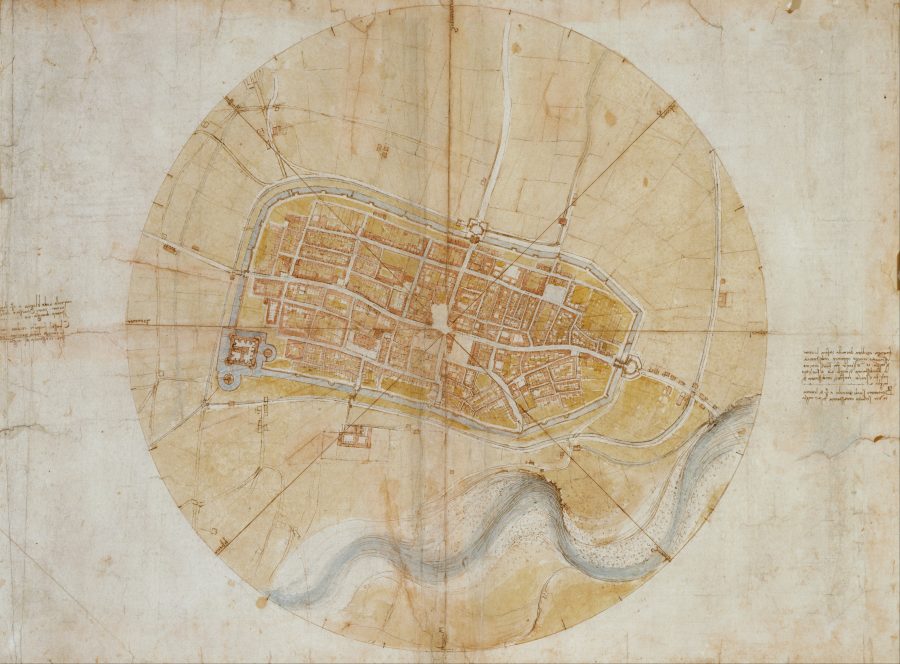
How Leonardo da Vinci Drew an Accurate Satellite Map of an Italian City (1502)

by Josh Jones, Open Culture: http://www.openculture.com/2019/04/how-leonardo-da-vinci-drew-an-accurate-satellite-map-of-an-italian-city-1502.html

When I look at maps from centuries ago, I wonder how they could have been of any use. Not only were they filled with mythological monsters and mythological places, but the perspectives mostly served an aesthetic design rather than a practical one. Of course, accuracy was hard to come by without the many mapping tools we take for granted—some of them just in their infancy during the Renaissance, and many more that would have seemed like outlandish magic to nearly everyone in 15th century Europe.

Everyone, it sometimes seems, but Leonardo da Vinci, who anticipated and sometimes steered the direction of futuristic public works technology. None of his flying machines worked, and he could hardly have seen images taken from outer space. But he clearly saw the problem with contemporary maps. The necessity of fixing them led to a 1502 aerial image of Imola, Italy, drawn almost as accurately as if he had been peering at the city through a Google satellite camera.

“Leonardo,” says the narrator of the Vox video above, “needed to show Imola as an ichnographic map,” a term coined by ancient Roman engineer Vitruvius to describe ground plan-style cartography. No streets or buildings are obscured, as they are in the maps drawn from the oblique perspective of a hilltop or mountain. Leonardo undertook the project while employed as Cesare Borgia’s military engineer. “He was charged with helping Borgia become more aware of the town’s layout.” For this visual aid turned cartographic marvel, he drew from the same source that inspired the elegant Vitruvian Man.
While the visionary Roman builder could imagine a god's eye view, it took someone with Leonardo’s extraordinary perspicacity and skill to actually draw one, in a startlingly accurate way. Did he do it with grit and moxie? Did he astral project thousands of miles above the city? Was he in contact with ancient aliens? No, he used geometry, and a compass, the same means and instruments that allowed ancient scientists like Eratosthenes to calculate the circumference of the earth, to within 200 miles, over 2000 years ago.
Leonardo probably also used an instrument called a bussola, a device that measures degrees inside a circle—like the one that surrounds his city map. Painstakingly recording the angles of each turn and intersection in the town and measuring their distance from each other would have given him the data he needed to recreate the city as seen from above, using the bussola to maintain proper scale. Other methods would have been involved, all of them commonly available to surveyors, builders, city planners, and cartographers at the time. Leonardo trusted the math, even though he could never verify it, but like the best mapmakers, he also wanted to make something beautiful.
It may be difficult for historians to determine which inaccuracies are due to miscalculation and which to deliberate distortion for some artistic purpose. But license or mistakes aside, Leonardo’s map remains an astonishing feat, marking a seismic shift from the geography of “myth and perception” to one of “information, drawn plainly.” There’s no telling if the archetypal Renaissance man would have liked where this path led, but if he lived in the 21st century, he'd already have his mind trained on ideas that anticipate technology hundreds of years in our future.
Related Content:
Josh Jones is a writer and musician based in Durham, NC. Follow him at @jdmagness

Sunday, April 7, 2019

What Makes a School Good? It's About More Than Just Test Results

by Jen Jackson and Stephen Lamb, The Conversation: https://theconversation.com/what-makes-a-school-good-its-about-more-than-just-test-results-114372

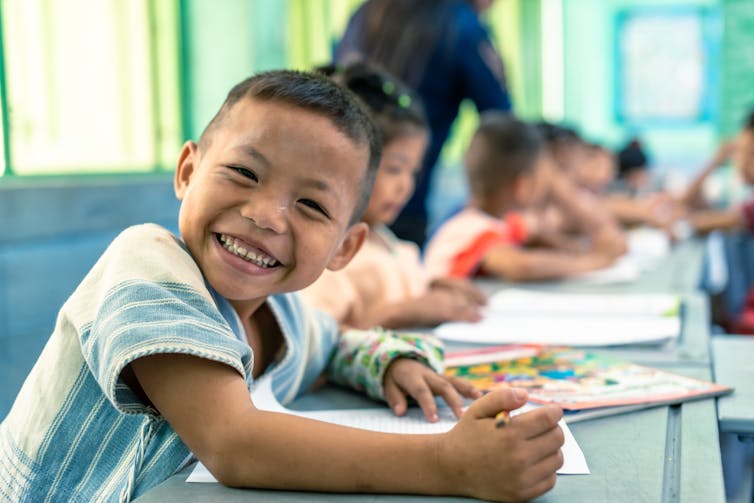
File 20190402 177193 ir7qso.jpg?ixlib=rb 1.1

A successful school isn’t necessarily one that gets high test scores. from shutterstock.com

One of the more elusive goals of education research is answering the question: what makes one school perform better than another? The evidence base is growing, but so far the answer is: it depends.

School success depends on context. What works for one group of students and teachers might not work for another. Teachers themselves may vary in their effectiveness depending on the students they teach.

Some schools improve their performance by attracting more affluent and/or high achieving students. This strategy may lift performance in one school, but risks “residualising” neighbouring schools, leaving them to cope with increasing concentrations of disadvantage.

The socio-economic status of students is a major factor in school performance. It is harder for a school to achieve high academic performance with large numbers of students facing risk factors such as low family income, or parents with limited education who may struggle to provide support for learning. Many disadvantaged schools across Australia achieve results more than one year behind the national average.

But just because schools in poorer areas may achieve lower results, it doesn’t mean these schools are “unsuccessful”, and schools in wealthier suburbs with higher average scores are “successful”. Schools in poorer areas can make a significant impact on their students’ lives. And lifting outcomes for disadvantaged students can transform lives and communities, across generations.

There are three key ways that schools in disadvantaged contexts achieve success that other schools can learn from.

1. Success is more than test scores

The most effective schools aren’t necessarily the highest academic performers. They are schools that yield better-than-anticipated results, bringing the best out of every student regardless of background.

Measures of school performance, including MySchool, typically take into account the socio-economic profile of the student community for this reason. This draws on established research about schools’ value-add – their success in lifting student outcomes.

A successful school fosters broader dimensions of learning critical to students’ overall success. These include social and emotional development, creativity and innovation, positive attitudes to learning, and citizenship.

Some Australian governments actually include measures of student well-being and sense of connectedness to school in assessments of school performance. Schools themselves often point to the value of their work in shaping student aspirations, behaviours, and values – not just academic achievement.

Disadvantaged schools may succeed in these areas, even more highly than schools whose focus is academic achievement.

2. Students need to learn how to learn

Effective teaching practice will have little impact if students are not equipped to learn. Students from advantaged backgrounds typically inherit knowledge about how to learn, and why. Students from disadvantaged backgrounds rely more heavily on schools to build their skills for learning, and to help them to see themselves as capable and motivated learners.

Students from more advantaged households typically inherit understanding about how to learn, and why, from their parents. from shutterstock.com

High-performing lower socio-economic status schools routinely provide targeted support for students within and outside the traditional school day. This may include small-group and individual tutoring, self-paced interventions using technology, one-on-one academic advising and coaching, homework support, and additional assessment time.

Evaluations of school reforms and intervention programs for schools with high concentrations of disadvantaged students have revealed the importance of establishing a shared understanding around teaching and learning, and school goals.

For example, one school established playgroups and a parent café to work with parents as partners in the learning process. This meant more students came to school motivated and ready to learn, and teachers could do their jobs more effectively.

3. Extra funding matters and must be put to good use

Needs-based school funding – as recommended in the first Gonski review – goes some way towards combating the downward pressure student disadvantage places on school performance. Yet the effects of school funding on learning outcomes are mixed.

Achieving better outcomes requires changing the way you practise and using the extra money to enact the change. This is because learning outcomes are driven by a complexity of factors, especially in communities experiencing a number of challenges.

A recent evaluation of the impact of additional school funding shows that a stable teaching and school leadership team is essential to enable schools to make good use of additional funding. One school, which had seen four principals come and go in five years, invested in building the executive leadership team, including mentoring and leadership training.
Although gains in test scores remain a work-in-progress, the professional climate and teaching practice have notably improved.

Schools with many disadvantaged students can face other challenges besides a high turnover of staff. Addressing these challenges requires school leaders to examine the many facets of school performance, not only student achievement, to identify where the best opportunities are for improvement.
Additional funding is needed, but continuity, stability, and evidence-based planning are essential for it to have maximum effect.

Applying knowledge across contexts

Schools that achieve success for the most disadvantaged students have much to contribute to our knowledge of what makes a good school. They are at the frontline of engagement with the enduring equity gap in Australian education, and living proof it can be narrowed.

Their potential contribution is illustrated by the example of a school partnership in Victoria, involving a highly advantaged and highly disadvantaged school. The partnership was successful because knowledge flowed both ways.

While the advantaged school focused on high achievement, the disadvantaged school helped the more advantaged school understand the influence of home and family context on learning, and adopt tailored strategies so their least advantaged learners would not fall through the cracks.

This kind of understanding not only leads to successful schools: it is the foundation of a successful system.The Conversation

Jen Jackson, Education Policy Lead, Mitchell Institute, Victoria University and Stephen Lamb, Research Chair in Education and Director of the Centre for International Research on Education Systems, Victoria University

This article is republished from The Conversation under a Creative Commons license. Read the original article.

Monday, March 18, 2019

Philosophers Name the Best Philosophy Books: From Stoicism and Existentialism, to Metaphysics & Ethics for Artificial Intelligence

by Josh Jones, Open Culture:  http://www.openculture.com/2018/10/philosophers-name-the-best-philosophy-books.html


As an English major undergrad in the 90s, I had a keen side interest in reading philosophy of all kinds. But I had little sense of what I should be reading. I browsed the library shelves, picking out what caught my attention. Not a bad way to make unusual discoveries, but if you want to get a focused, not to mention current, view of a particular field, you need to have a knowledgeable guide.

Back in those days, the internet was, as they say, in its infancy. How much better I would have fared if something like Five Books had existed! The site's general idea, as it trumpets on its homepage, is to recommend “the best books on everything.” Argue amongst yourselves about whether any one resource can deliver on that promise, but let’s keep our focus on the excellent space of their Philosophy section, curated by freelance philosopher-at-large Nigel Warburton.

You may know Dr. Warburton from his many forays in public philosophy. Whether it’s the Philosophy Bites podcast, or its spin-offs Free Speech Bites and Ethics Bites, or his work on the BBC’s animated history of ideas series, or any one of his books, he has a rare knack for bringing the obscure and often difficult concepts of academic philosophy to light with both conversational good humor and intellectual rigor. Most of that work takes place in dialogue, the original form of classical philosophy.

The Five Books forum is no exception. In the latest post, Warburton interviews University of Sheffield’s Keith Frankish on the five best books on Philosophy of Mind. What is “Philosophy of Mind”? Read Frankish’s answer to that question here. What are his five picks? See below:

A Materialist Theory of the Mind, by D.M. Armstrong

Consciousness Explained, by Daniel C. Dennett

Varieties of Meaning: The 2002 Jean Nicod Lectures, by Ruth Garrett Milikan

The Architecture of the Mind, by Peter Carruthers

Supersizing the Mind: Embodiment, Action, and Cognitive Extension, by Andy Clark

What about the best books on Ethics for Artificial Intelligence? It's a far more pressing question than it was when Arthur C. Clarke published 2001: A Space Odyssey, which happens to be one of the books on Oxford academic  Paula Boddington’s list. In his interview with Boddington, Warburton asks for, and receives, a clarification of the phrase ethics for artificial intelligence.” In her choice of books, Boddington recommends those below. You may not find some of them shelved in philosophy sections, but when it comes to our sci-fi present, it seems, we may need to expand our categories of thought.

Heartificial Intelligence: Embracing Our Humanity to Maximize Machines, by John Havens

The Technological Singularity, by Murray Shanahan

Weapons of Math Destruction: How Big Data Increases Inequality and Threatens Democracy, by Cathy O’Neil

Moral Machines: Teaching Robots Right from Wrong, by Wendell Wallach and Colin Allen

2001: A Space Odyssey, by Arthur C. Clarke

There are dozens more enlightening interviews and lists of five best books—on Nietzsche, Marx, and Hegel, on  Existentialism, Stoicism, Consciousness, Chinese Philosophy ... too many to directly quote here. There are lists from Warburton himself, on the best philosophy books from 2017, and best introductions to philosophy. 

The whole experience is a little like visiting, virtually, a couple dozen or so highly-regarded philosophers in every field, listening in on an informative chat, and getting a booklist from every one. You’ve still got to find and buy the books yourself (and read and talk about them), but this kind of guidance from living philosophers currently working in the field has never before been so widely and freely available outside of academia.
Related Content:
Josh Jones is a writer and musician based in Durham, NC. Follow him at @jdmagness

Wednesday, February 27, 2019

What Is ‘Indoctrination’? And How Do We Avoid It in Class?


When I was a kid, my father used to tell me that most politics came down to the rich turning the poor against the smart. I was reminded once again that he was probably right when I read Kim Phillips-Fein’s recent essay in The Chronicle on the history of right-wing attacks on higher education. She details a century’s worth of accusations and scapegoating, showing that today’s right-wing provocateurs are carrying on a tradition nearly as old as the American university itself.
One of the most persistent accusations against academics is that we are guilty of indoctrination. Phillips-Fein quotes Jordan Peterson accusing professors of "indoctrinating young minds with their resentment-laden ideology." Last year in her book The Diversity Delusion, Heather Mac Donald accused colleges and universities of producing graduates who "bring their high-theory indoctrination with them into the federal and state bureaucracies and into newsrooms." A Google search of "indoctrination universities" brings up countless right-wing sites pushing similar claims.
I quote those critics not because I think they paint an accurate picture — on the contrary, I think it’s a fanciful caricature — but because the accusation reflects the fact that seemingly everyone, of all political persuasions, agrees that instructors should avoid indoctrinating their students. But what exactly is indoctrination? And how do we avoid it?
Indoctrination and education used to be synonymous. Webster’s 1913 dictionary defines indoctrination as "instruction in the rudiments and principles of any science or system of belief." It was well into the 20th century before the word widely took on negative connotations. Today, although we know that indoctrination is bad, the concept is often fuzzily defined.
Back in 2017, seeking to better define the instructor’s mission, I drew some guidelines for handling political issues in the classroom. "It’s not our job to change our students’ beliefs," I wrote. But it’s clear that we do try to influence our students’ beliefs, all the time — and quite rightly. What if they believe gravity doesn’t apply to short people? Or that electrons weigh more than protons? Surely one goal of education is to help students’ beliefs conform better to reality.
Writing in 2009, the philosophers Eamonn Callan and Dylan Arena noted that indoctrination "as the name for a species of morally objectionable teaching, has no more than rough conceptual boundaries." Since then, a number of philosophers of education have attempted to draw those boundaries more sharply and a broad consensus has emerged. To indoctrinate students in a classroom, Rebecca M. Taylor writes, requires two essential conditions:
  • First, that we use our authority.
  • And second, that we promote closed-minded adoption of a belief.
As professors, we have both intellectual authority (students’ perception that we are experts) and practical authority (the power — by virtue of our position — to set grades, enforce rules, etc.). There is no question that we have that power, to varying degrees. We cannot escape the fact of our authority; we can only choose how to use it. To avoid indoctrination requires that we remain aware of our authority over students, lest we abuse our power and infringe upon their autonomy.
Indoctrination is not just the promotion of certain beliefs in our students; it’s an effort to change their beliefs and instill a fear or reluctance to consider conflicting evidence. Indoctrination, Taylor writes, produces students who lack the motivation to pursue knowledge for themselves. They become "closed-minded agents," either because they’re intellectually arrogant (they downplay the potential that they could ever be wrong) or intellectually servile (they distrust their own intellectual capacities, and therefore defer to and rely on another authority).
Clearly, either outcome is bad. As instructors, we are looking to help students be more confident, competent, and informed. Arrogance and servility work against those goals.
So how do we guard against indoctrination? How do we make sure we are not encouraging closed-mindedness?
By focusing on its opposite — open-mindedness and intellectual humility — and modeling those intellectual virtues ourselves. If we admit when we’re wrong, discuss our failures, and let students know when we’re unsure about something, we can guard against closed-mindedness in two ways:
  • First, by modeling the kind of humility that we hope students will adopt, we encourage them to aspire to be something other than intellectually arrogant. We show that the best way to approach any academic activity is with an open mind.
  • Second, by knocking ourselves down a peg or two, we discourage students from seeing us as an all-knowing authority, someone to defer to at all times. As the Loyola Marymount philosophy professor Jason Baehr writes in his guide to teaching the intellectual virtues, "The ‘stronger’ we are, the weaker they can feel, and therefore the more reluctant they can be to take the kinds of intellectual risks or to engage in ways that are crucial to their own intellectual development." Instead, by admitting in the classroom that we don’t have all the answers, we can help students develop the confidence to admit when they are unsure, and the autonomy to do something about that uncertainty.
The next step: Provide opportunities in class for students to practice open-mindedness. Regularly expose them to multiple perspectives, even those with which you disagree. In that vein, Baehr organizes class debates in which students argue, as convincingly as possible, against the view they actually hold. That kind of role-playing exercise shows students that their own view is just one of many, and that everyone has reasons for believing what they do.
But isn’t that kind of exposure to multiple perspectives a recipe for bothsidesism — the idea that all sides of a debate are equally viable? Doesn’t it teach students that there’s no way to sort out the truth? That some people think this way, and others think that way, and that’s as much as we can establish?
I don’t think it has to. We’re not looking to teach students that every possible perspective on an issue is equally true. Rather we need to teach them how to base their conclusions on argument and evidence — even if that evidence conflicts with their prior beliefs.
Teaching inductively — that is, by having students engage in problem-solving or case studies and asking them to induce general principles from what they learn — can help them practice this crucial skill. If you teach argumentative writing, stress that a thesis statement should change as the evidence does. If you teach the history of science, highlight those moments when our understanding of the world shifted because the evidence did.
The opposite of closed-mindedness is not a postmodern void in which there’s no such thing as truth. No, the opposite of closed-mindedness is open-mindedness — in which we seek the truth yet recognize that we could be wrong.
Emphasizing open-mindedness and intellectual humility can help ensure you won’t indoctrinate students, even on subjects you feel strongly about. Of course you have political views, and students know that. You can tell your students, as I do mine, that you will work to ensure that your views do not influence your evaluation of their progress in the course.
But it’s also important to tell them — and show them — that the content of their beliefs is far less important to you than the process they took to arrive at those beliefs. I tell my students that, technically, I don’t care what they think; I just care how they think.
Find him on Twitter at @dgooblar.

Sunday, February 3, 2019

Leonardo da Vinci: 500 Years After His Death, His Genius Shines as Bright as Ever

by Gabriele Neher, University of Nottingham, The Conversation: https://theconversation.com/leonardo-da-vinci-500-years-after-his-death-his-genius-shines-as-bright-as-ever-111011

File 20190201 75085 1mor4cs.png?ixlib=rb 1.1

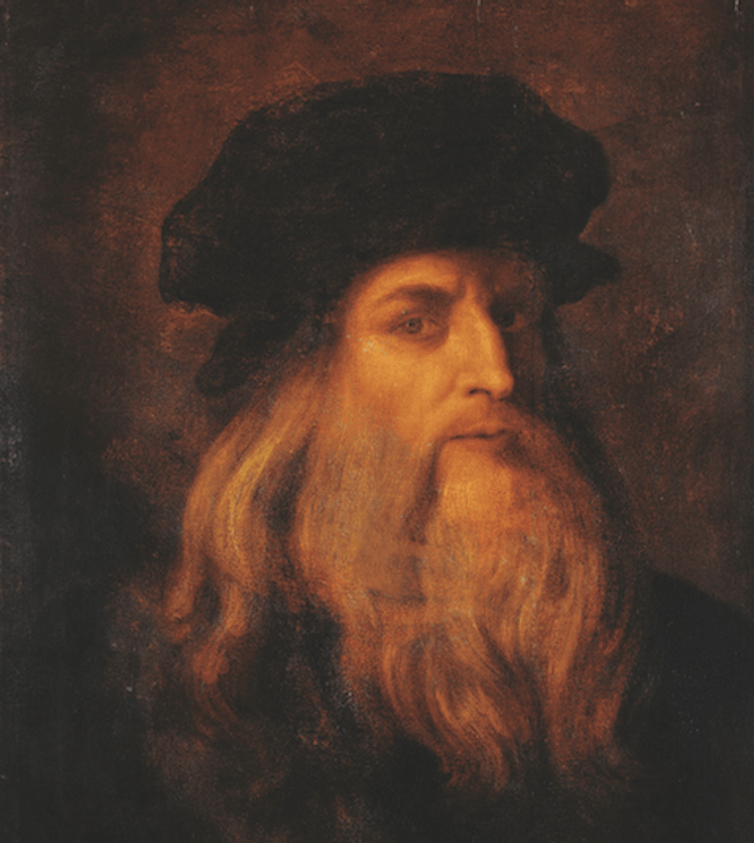
Is there no end to his talent? A self-portrait of Leonardo da Vinci.

Old masters rarely come more venerable (and venerated) and instantly recognisable than Leonardo da Vinci. But to think of Leonardo as an Old Master – with all its connotations of being staid, traditional, somehow old-fashioned and boring – is to do this extraordinary man a grave injustice. There is nothing stale or predictable about a man whose personal foibles irritated and frustrated contemporaries as much as his brilliance and creativity dazzled and awed them. One thing is for sure: whatever Leonardo was, old and boring he was not.

May 2 2019 marks the 500th anniversary of Leonardo’s death in Amboise in France, and this milestone is celebrated in flurry of activity including – in the UK – a brilliant and imaginative series of 12 simultaneous exhibitions around the country, each comprising 12 drawings by Leonardo da Vinci drawn from the Royal Collection at Windsor.

Drawing provides an insight into how this pioneer, who defied all expectations, saw the world around him – so there is no more fitting celebration of his life than putting 144 of Leonardos’s images on display.

It would be fun to engage in a bit of Leonardo exhibition tourism as each of the 12 exhibitions focuses on a specific theme.
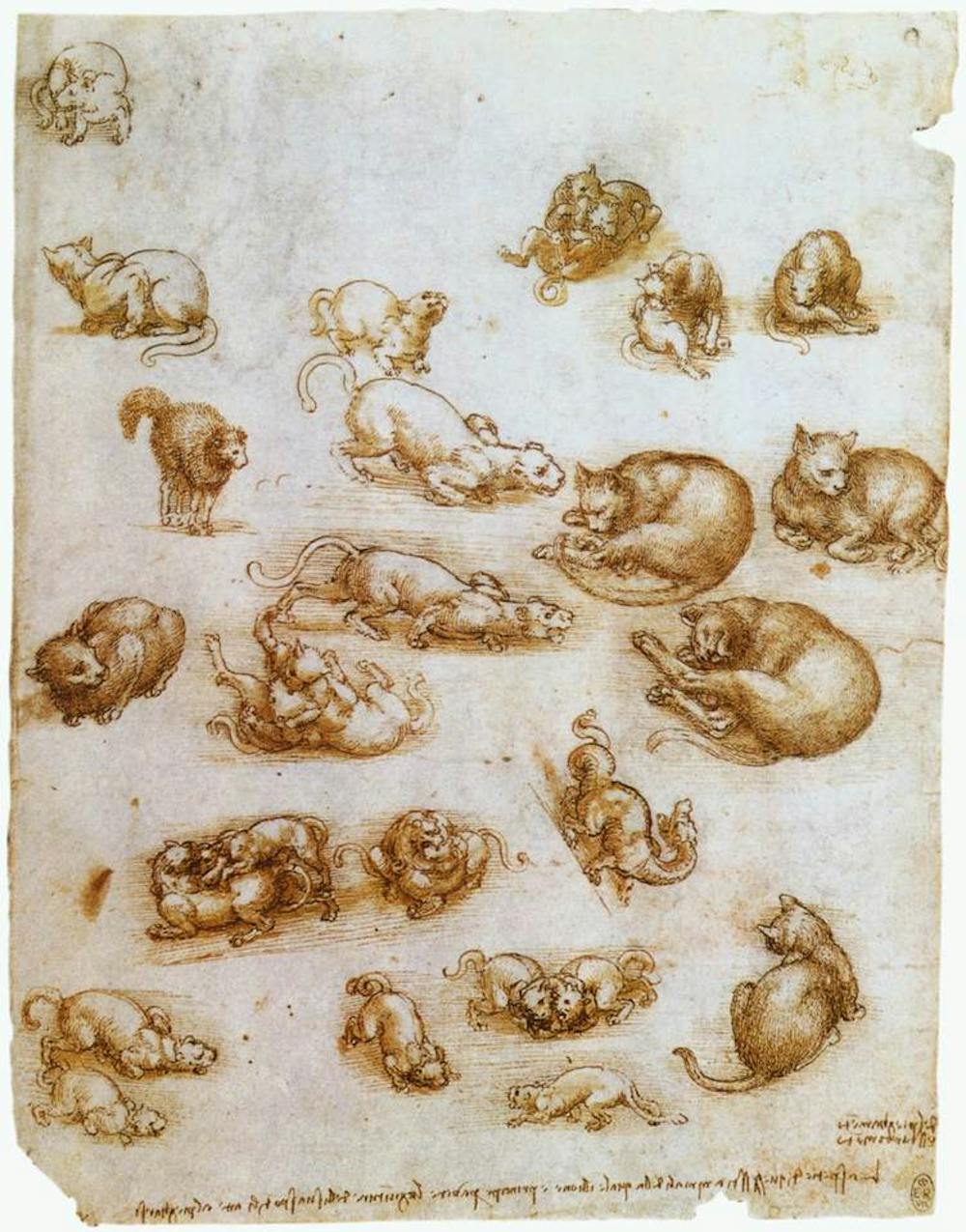
Cats, lions and a dragon, c.1517-18, black chalk, pen and ink, wash. Royal Collection Trust / (c) Her Majesty Queen Elizabeth II 2018

Bristol Museum and Art Gallery, for example, houses the drawings relating to animals and their movements including the truly beguiling Cats, lions and a dragon (ca 1513-18) which should finally put any suggestions to rest about Leonardo’s status as a staid old master.

Leonardo is watching a cat grooming – but eventually, what he records is no longer a cat but the most enchanting little dragon whose sinous curves mirror those of the cats on the same sheet of paper. Leonardo’s mind never stood still and it is through his drawings that you can see the mind of an artist at work who could paint the majestic Last Supper and derive as much fun from doodling cats.

Workshop apprentice

Leonardo’s beginnings as an artist followed the traditional route of indenture in an established master’s workshop, in this case, the studio of Andrea del Verrochio, a very successful artist in the orbit of the Medici family who was as accomplished a business man as he was an artist.

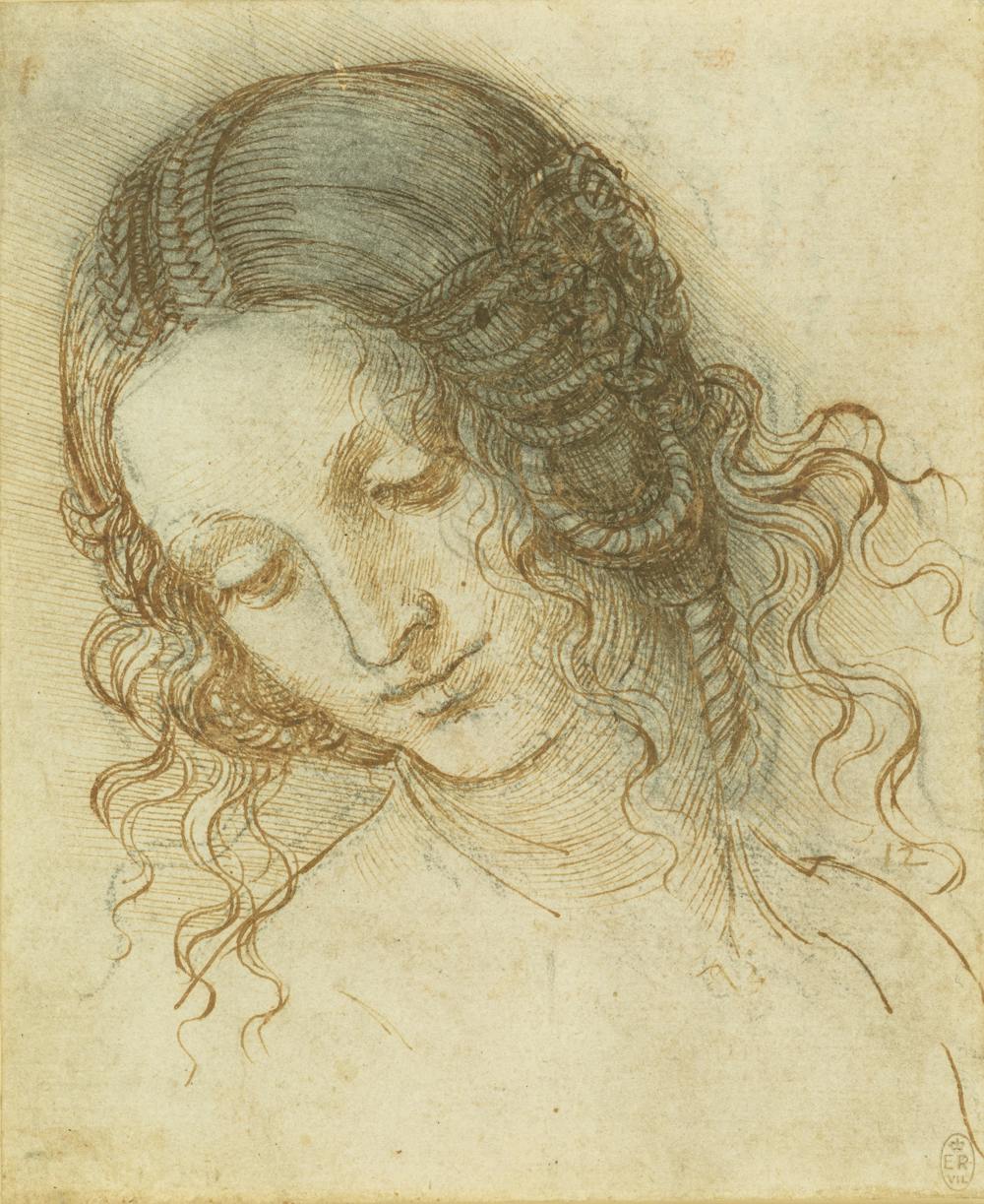
The head of Leda, c.1505-8, black chalk, pen and ink. Royal Collection Trust / © Her Majesty Queen Elizabeth II 2018

The Renaissance workshop fostered a multitude of talents – at any one time a workshop might be executing bespoke images for a wealthy patron while at the same time collaborating with another workshop on large-scale fresco decorations or structural work or designing and producing ephemeral, gilded papier-mâché decorations for a banquet.

Artists were expected to be able to produce exquisite designs for jewellery, clothing and animal livery for the well-heeled merchants of Renaissance Florence. Meanwhile they would also churn out the popular birth trays presented to mothers in celebration of the delivery of a child and panel paintings for a cheaper market, copy heraldic designs and sketch maps.

Renaissance workshops thrived because of the variety of skills brought together under one roof by a master such as Verrochio – the team was stronger than the sum of its individual parts, and it sustained itself through its apprentices. Leonardo though stood out as a master of all trades, as the artist who excelled not at one art but all of them.

Court artist

Leonardo was quite aware of his extraordinary talents and value to patrons and spelled this out in a letter seeking employment at one of Europe’s most lavishly spending Court, that of Ludovico il Moro Sforza, Duke of Milan.

He speaks of expertise in the design and construction of effectively field artillery and bailey bridges; outlines his skills in sapping walls and landscaping; his expertise as an architect and sculptor and also promises that he can do “in painting whatever may be done as well as any other, be he who he may”.

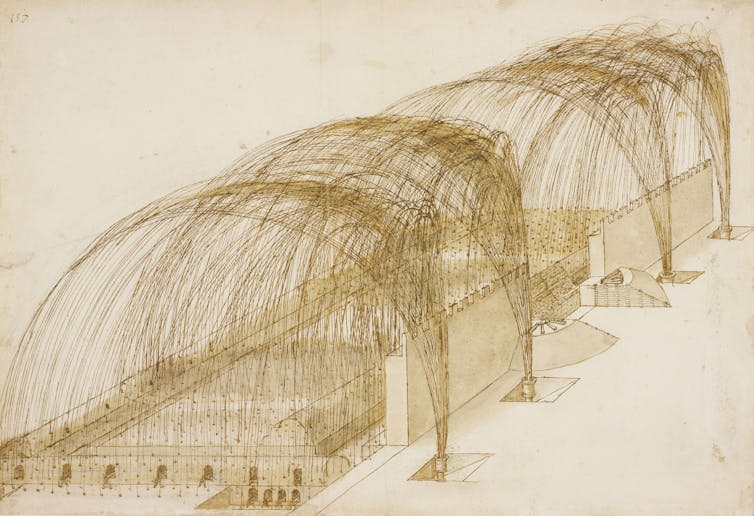
Mortars firing into a fortress, c.1503-4, black chalk, pen and ink, wash. Royal Collection Trust / (c) Her Majesty Queen Elizabeth II 2018

The Duke of Milan duly appointed Leonardo to his court and it was at Sforza’s court that Leonardo, at the age of almost 30, was to spend the next two decades painting his best-known works (the Mona Lisa, The Last Supper, The Madonna of the Rocks, the enchanting Lady with the Ermine). All the while he was working towards the one commission closest to his patron’s heart – the casting of a life-sized equestrian statue celebrating Sforza’s father.

Leonardo as an artist did not measure himself against his contemporaries alone, but his true competition were the great masters of classical antiquity. And the only way in which he could achieve lasting fame through his work, was to ensure that his works – especially the Sforza monument – became exemplars. These were intended as unsurpassable demonstrations of his skills and knowledge.

The greatest legacy Leonardo left from his Milanese years are his notebooks and drawings (including some of the ones now on show), and one of the reasons behind these drawings was his quest to master everything he might need in order to best execute that monument.

A design for an equestrian monument, c.1485-8, metalpoint on blue prepared paper. Royal Collection Trust / (c) Her Majesty Queen Elizabeth II 2018

He needed to understand the anatomy of the animal and its rider – his notebooks show the most extraordinary studies of human and animal anatomy, movement and expression, with Leonardo returning again and again to the same motif, endlessly working on minute variations.

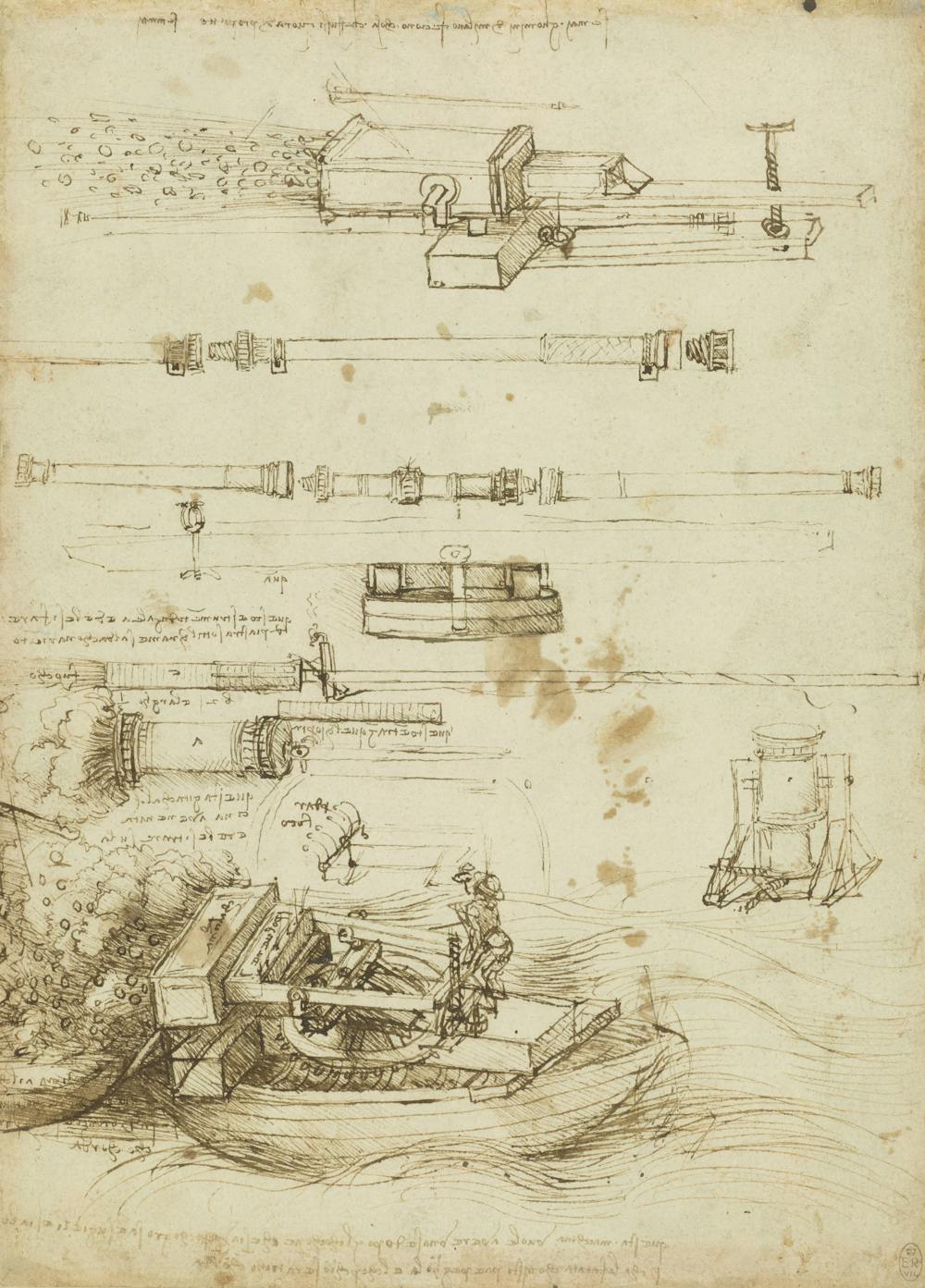
In order to cast the great monument, he would need to understand the behaviour of metals, fire and minerals – as well as the mechanical processes of casting and hoisting the monument. So he studied machines, drew existing ones, improved on old designs and invented new ones. Leonardo wanted to know about the minutiae of textures but also needed to understand a landscape holistically.

Designs for gun-barrels and mortars, c.1485, pen and ink. Royal Collection Trust / (c) Her Majesty Queen Elizabeth II 2018

The notebooks are encyclopaedic in their topics, and breathtaking in their intricacy and beauty. It is the ceaselessness of his drawing that provides the key to understanding the timeless appeal of this greatest of artists.
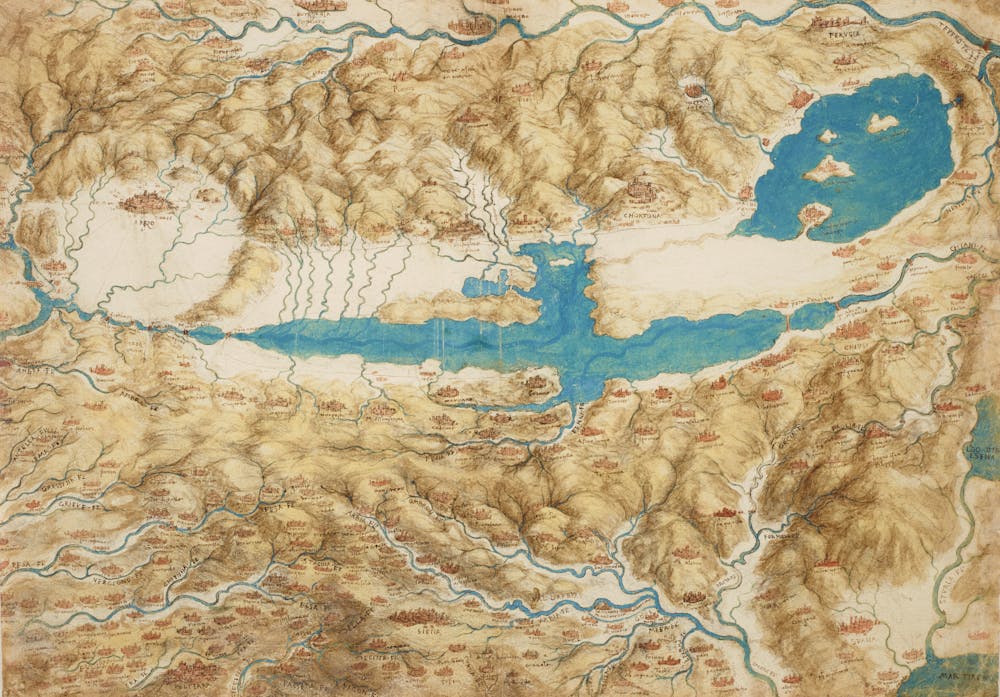
Leonardo died 500 years ago at Amboise, at the Court of Francis I, where he retired after working for some of the greatest patrons of the early 16th century. He travelled with Cesare Borgia’s army and drew some very early bird’s-eye-view maps.

Map of the Valdichiana, c.1503-4, watercolour, pen and ink, ink wash over black chalk. Royal Collection Trust / (c) Her Majesty Queen Elizabeth II 2018

He stayed at the Papal Court of Leo X (Giovanni de’ Medici) experimenting with mechanical clockwork devices and increasingly focused on his study of meteorological phenomena such as clouds and deluges, yet the one constant was drawing.

So enjoy these drawings that have come down through 500 years of art history and appreciate that you are looking inside the mind of the greatest “Renaissance Man” of them all.The Conversation

Gabriele Neher, Associate Professor in History of Art, University of Nottingham

This article is republished from The Conversation under a Creative Commons license. Read the original article.