2021 is when the impacts of COVID-19 really start to take their toll on universities, as more than140,000international students seek to return to study in Australia. My new analysis, presented in this article, reveals that if one in five international students don’t re-enrol, the loss of revenue would plunge half of all Australian universities into financial turmoil or budget deficit. While the impacts of COVID are unprecedented, modelling universities’ financial resilience shows which institutions fare better and why.
Recent modelling by the Mitchell Institute estimated more than 300,000 fewer international students would be studying inside Australia by mid-year, if travel restrictions continued.
In total, 32% of all full-time-equivalent enrolments at Australian universities are international students. About a quarter (24%) of all university revenue comes from these students. Universities’ operating revenue fell 4.9% in 2020, with an estimated 5.5% fall to come in 2021.
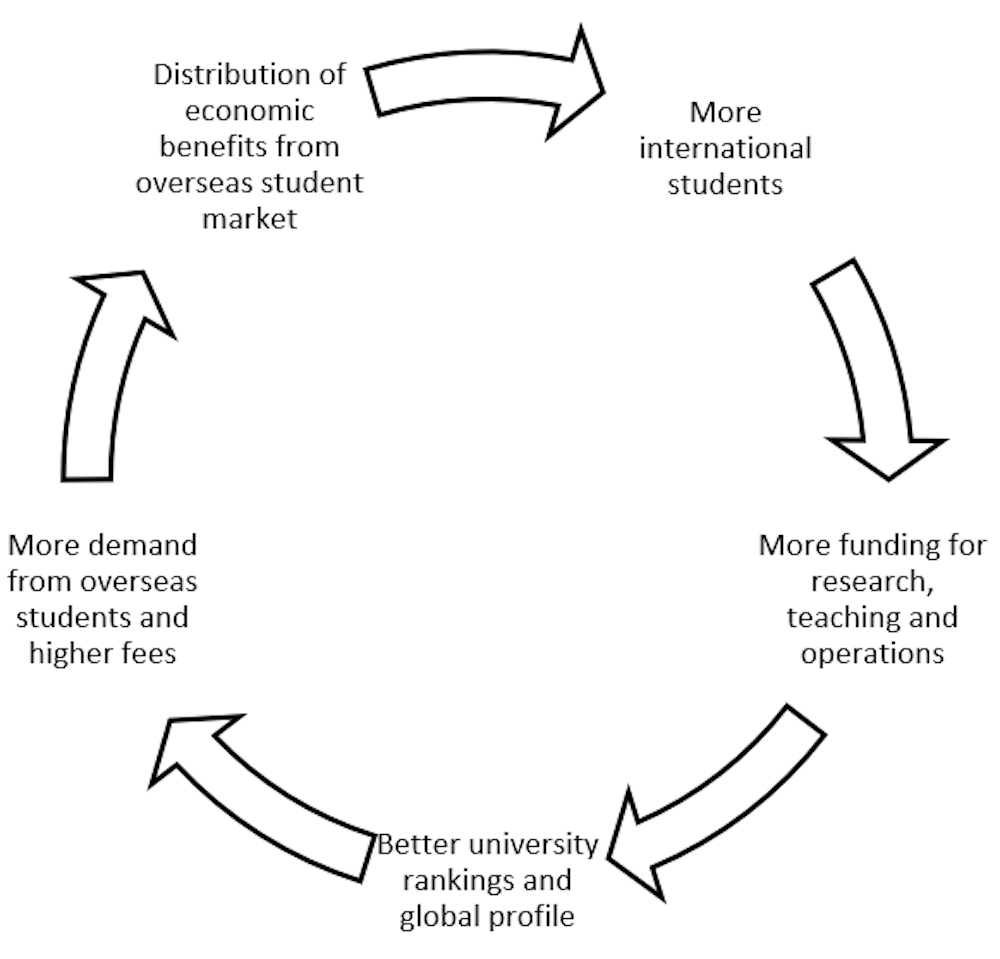
International student fees are correlated with university rankings but are also a self-reinforcing cycle: more international students generate more revenue to fund more research, which in turn leads to better rankings and more demand.
International student revenue increases university resources, which enhances reputation, which in turn attracts more international students.Author provided
Another risk factor for universities is the concentration of enrolments from just a few source countries. They are also concentrated in the largest institutions. One in four international students (25%) study at one of these five universities: Monash, RMIT, Melbourne, Sydney or UNSW.
The leading source of international students in Australia is China, with 36% of these students. It’s followed by India (14%), Malaysia (7%), Singapore (5%) and Nepal (4%). Just one or two geographic markets dominate international enrolments at most universities.
International students aren’t the only risk factor
The worst-hit universities may be those with small pre-COVID operating margins and high reliance on concentrated international student revenue.
My analysis shows a 20% fall in international student fee revenues would leave 22 universities in deficit or on the brink with a net operating result (revenue minus expenses) of 1% or less.
Those with a higher reliance on international students, less diverse revenue streams or a lower return on equity fare worse in the post-COVID modelling. The chart below shows the impact on university net operating results of five scenarios involving decreases in international students by 10%, 20%, 30%, 40% and 50%.
The net result decreases more dramatically for those with both a high reliance on international students and a limited operating buffer. In other words, the risks already existed – COVID amplified them.
Universities need a buffer to absorb shocks
Many Australian universities rely heavily on revenue from international students as part of their business model and global profile. Twelve rely on international student fees for more than 30% of their total income.
While all the universities in the above table are registered not-for-profits, they need to remain financially sustainable. Any organisation involved in high-stakes global markets should have a buffer against rare and unexpected shocks such as the COVID pandemic. A requirement for financial buffers was legislated in the US following the global financial crisis but still remains a vexed issue.
The average net pre-COVID operating result for Australian universities was a healthy 5.6%. However, several started the year with a result of less than 1%. These universities included Charles Darwin (-3.1%), Notre Dame (-2.6%), New England (-1.4%), Macquarie (0.14%), Central Queensland (0.71%) and Charles Sturt (0.77%).
These results raise important questions for university boards. What is a responsible operating result considering the risks of the business and the markets in which it operates? Was “pandemic” already identified in risk registers? And what was done about it?
Significant revenue write-downs leave institutions with only a few levers to buffer the COVID shock while minimising risks to quality.
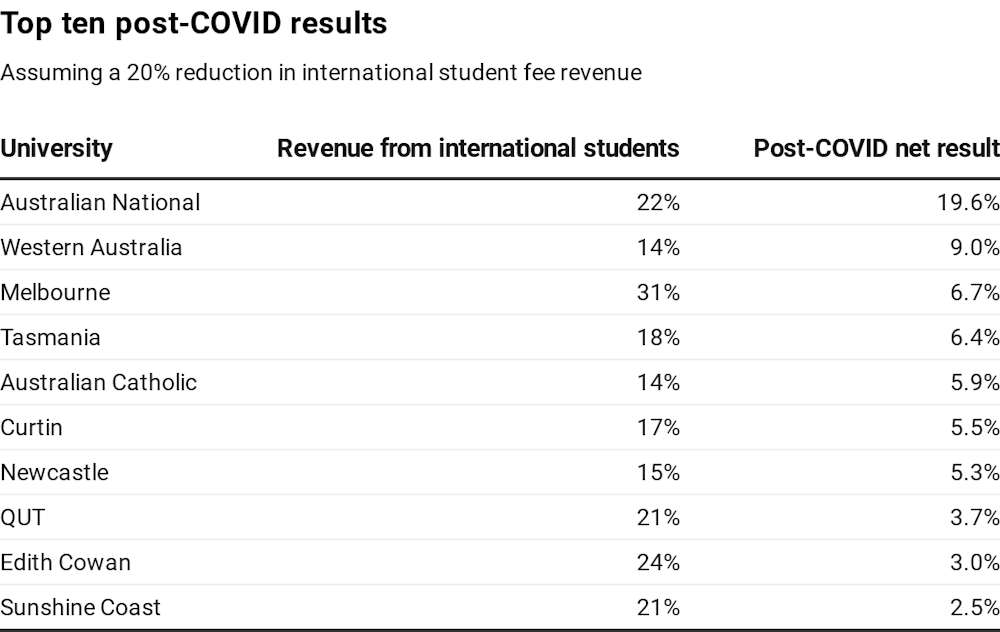
On average, the above top ten universities generate 20% of their revenue from international student fees. The sector average is 24%.
The University of Melbourne gets 31% of its revenue from international student fees. That’s higher than the average, but its very healthy pre-COVID operating result of 13.9% provides breathing space.
Newcastle, QUT, Edith Cowan and the Sunshine Coast are in the top ten universities, but under this model have a potential post-COVID result of less than the sector average of 5.6%. Their risk exposure to international student fee revenue is still average or lower.
How should universities respond?
Three main conclusions can be drawn.
First, to underpin their financial sustainability and avoid risks to quality, universities must consider not only their reliance on international student fee revenue and market concentration, but also strategies to understand and define their appetite for risk.
Second, the model for online education when travel across borders is limited could be a long-lasting effect of COVID. Long-term strategies and regulatory practices to deal with this “new normal” of global higher education will be needed, beyond temporary regulatory flexibility.
Third, disruption to higher education is here to stay. Waiting for a time when the view on the horizon is clear for all to see may be too late.
Global higher education requires a new organisational ambidexterity. That means universities must revisit core operating models, re-imagine future potential and succeed on the disruptive edge.
Note: Department of Education, Skills and Employment finance tables used for this analysis may differ from institutional reports due to various accounting methods.
Australian universities are expected to lose billions of dollars in revenue due to the impacts of COVID-19. Theestimated lost revenuefrom international students alone is A$18 billion by 2024. While all universities are affected, regional universities and communities are the most vulnerable.
Regional communities have limited resources, so their universities play a pivotal role in their economies. These universities must adjust to the rapidly changing circumstances and government policy changes, or risk jeopardising regional economic growth and jobs. Without targeted government support for these smaller universities, the long-term impacts on regional communities could be devastating.
The Regional Universities Network (RUN) includes CQUniversity, Southern Cross University, Federation University Australia, University of New England, University of Southern Queensland, University of the Sunshine Coast and Charles Sturt University. CQUniversity, where 39% of students are international students, has a revenue shortfall of A$116 million for 2020. Charles Sturt University (32% international students) faces a loss of about A$80 million.
All universities face job losses as a result of COVID-19. But the impacts of these job losses are greatest for regional economies.
RUN chair Helen Bartlett told a federal parliamentary committee hearing in May:
Job losses from regional universities have a significant impact on regional communities when there are few alternatives for professional employment locally.
The RUN chair, Professor Helen Bartlett, notes that when regional universities shed jobs their local communities have few professional employment alternatives.USC News
She called on the government to double the annual regional loading funding of A$74 million.
Regional universities educate around 115,000 students each year. That’s about 9% of enrolments at Australian public universities.
A 2018 study found regional universities inject A$1.7 billion a year into their local economies. And seven out of ten graduates go on to work in regional areas.
Regional universities also contribute over A$2.1 billion and more than 14,000 full-time jobs to the national economy.
In April the federal government guaranteed A$18 billion in university funding this year to help the sector through the coronavirus crisis. It also provided A$100 million in regulatory fee relief.
The Universities Australia chair, Deborah Terry, has warned as many as 21,000 university jobs could be lost.Mick Tsikas/AAP
The chair of Universities Australia, Deborah Terry, welcomed this as a “first step”. However, she warned an estimated 21,000 jobs would still be lost.
In June, the government announced the Job-ready Graduates Package. It plans to lower student fees for selected courses (and raise others) to encourage study for what the government deems to be jobs of the future.
Extra supportannouncedfor regional universities includes:
3.5% growth in Commonwealth Grant Scheme funding to regional and remote campuses
A$5,000 payments for students from outer regional, remote and very remote areas who transfer to Certificate IV study or higher, for at least one year
a new A$500 million-a-year fund for programs that help Indigenous, regional and low socioeconomic status students get into university and graduate
A$48.4 million in research grants for regional universities to partner with industry and other universities to boost their research capacity
guaranteed bachelor-level Commonwealth-supported places to support more Indigenous students from regional and remote areas to go to any public university.
The government has also promised a A$900 million industry linkage fund. The aim is to help universities build stronger relationships with STEM industries and provide work-integrated learning opportunities.
What does this mean for regional universities?
The Regional Universities Network welcomed the package. Bartlett said:
Lowering the cost of the student contribution for courses such as nursing, allied health, teaching, agriculture, engineering, IT and maths should encourage greater uptake by regional students in these areas. It is estimated that there should be more places in the regions. More graduates from our universities will produce more graduates to work in regional Australia in areas of skills need.
As the COVID-19 economic battle is ever evolving, the tertiary education sector must be vigilant. Spending should be prioritised to make it equitable for all universities and their communities. Decision-makers need to be aware of the key issues affecting the success of tertiary education in the regions and their dependent communities.
Regional engagement activities and programs, backed by increased funding, improve the prospects of successfully weathering the COVID-19 storm. Regional universities can deliver national benefits, by overcoming skill shortages and meeting local workforce needs, while contributing to public and private community services such as schools and health services.
The government package is important for all universities, but this support is the only means of regional universities surviving. If they are not supported and are forced to close, regional education and economies will suffer for many years.
Yep. Those dreaded words when you get the email back from the journal. R and R. Anything but Rest and Relaxation. Groan. In essence, the message says We have considered your paper and we have decided that – well it’s just not going to cut it. At this point. However, we see enough in it to give you another shot. But only one. And (to steal Ru Paul’s words) Don’t **** it up.
Now the usual advice – and I give it myself – is that when you’re working out what corrections to make it’s helpful to go through the reviewers’ comments and put them in a two column table. You put what the reviewer said in one column and what you did in the other. As in …
Add more detail to methods
I added four sentences about sampling and two about analysis
Use more literature particularly look at x,y,z
Added xyz to literatures section
Now the make-a-table approach is pretty well always going to work for minor corrections and probably even for the bigger major corrections. But it might not be enough for an R and R.
The key work in R and R is REVISE – re-vision, re-imagine, re-think. This may well be more than simply adding in a few sentences here or there or a new section. An R and R not always going to be a ‘tinkering around’ leaving most of the paper intact. Just adding and deleting a few things is a correction, not a re-imagining. In fact, most of the time, when reviewers recommend R and R they are looking for some pretty big changes. Gah – it’s likely to be a pretty substantial re-write.
It’s tough to front up to a paper and try to rethink it. To start again. To try to work out how it might be different. That’s because we get attached to our words. We may even like the paper that we wrote and find it pretty galling that the reviewers didn’t. We may want to try to get away with the least possible number of corrections. We may seriously not want to even consider the possibility that what we are being asked to do is a lot of extra hard work. That’s natural. But that is what we are being asked to consider.
And here a pause. Just to say that I speak here from experience. And lots of it. In just the last twelve months, my colleagues and I have had two R and Rs. Other papers went through with minor changes, but, yes, we had two papers where we were told R and R. It happens to all of us.
Our problems weren’t to do with the actual writing of the paper but what we were writing about. The reviewers of the particular journals just didn’t find the arguments we were making particularly interesting or persuasive. Now, it wasn’t all bad. Writing the papers had been very useful for our research project – they really helped to advance our analysis. But they just weren’t suited to the journals we wanted to publish in.
So, when faced with the two the R and Rs, we had choices – take the papers as they were to other journals, give up on the papers altogether, or try to do enough tweaks to get past the reviewers. Or – we could rethink the papers. Yes, rethink. Go back to the beginning and start over.
In both cases, that’s what we did. We went back to the beginning.
One paper didn’t require as much rethinking as the other. Paper A reviewers suggested some new literatures for us to read. We read them and then constructed a somewhat different argument – more nuanced perhaps than the one we had originally submitted. The title of the paper stayed the same, but there was a new abstract, a new theoretical discussion which incorporated the new literatures, a new thread of analysis and a new conclusion.
The second paper, paper B, had a much more dramatic change. The reviewers didn’t seem to get our argument and found the topic and our empirical work not particularly interesting. They seemed to say that our theorisation was pretty incomprehensible.Or light weight. One or the other. But potentially interesting. So we switched the focus of the paper and it became about the theoretical development since that was what seemed to be of interest as well as at issue. We used our empirical material – which we love – to show how the theoretical work might be done. The paper ended up with a new title, abstract and argument. It was almost entirely rewritten with only the methods section and some of the empirical reporting carried over.
While we might be able to explain the changes made to paper A through a table, paper B wouldn’t fit in a table at all. The changes were holistic. We had taken a cue from the reviewers’ comments and re-imagined and re-designed the lot. Holus-bolus. It was a new paper born from the remains of the first one.
I guess you want to know if the papers got published once the R and Rs were done. Yes. Both are now in print. But neither of them would be if we hadn’t been prepared to just go with where the rethinking took us. If we weren’t ready to make whatever changes followed on from the new literatures (paper A) or whatever resulted from trying to explain our theoretical development in sufficient detail for it to be understood. We were ready and able in both cases for a complete and comprehensive overhaul. And Paper B was just this – a complete and total reworking.
There’s a clear and obvious moral to this story. And it’s that R and R may mean more than a few additions and deletions. It often requires you to have the courage to say – wrong journal – or the courage to say Oh. I need to put the first version to one side and try to understand the reviewers’ overall message, not just the individual points they are making along the way. I just have to suck it up.
So some questions to help in this R and R revisioning process – What am I being told about the paper, what’s the reviewers’ story about my paper, where do the reviewers actually think the problem is? The structure of the paper? The argument isn’t evidenced? If I had read some different literatures I’d potentially change my argument? The theory doesn’t fit or isn’t well developed? The paper doesn’t fit with the interests of the journal and I need to shift focus if I want to be published here?
These kinds of questions orient you to consider the paper in its entirety. Take a helicopter view. See the paper in the landscape of the journal and its readers. Adopt an evaluative stance to your own work.
But ultimately R and R is a question of having the will to chuck the paper up in the air and see where it lands. And this might be a case of singing to yourself …
Who can forget his singing routine on national television last year when he borrowed the tune of the 1970s Skyhooks rock classic Horror Movie and lampooned alarmist commentary about the impact of the carbon tax?
Perhaps he could consider adding “Four Ministers In One Day” (apologies to Crowded House) to his repertoire.
Maybe Craig Emerson’s multitasking abilities were a factor, but we can safely assume it was not for his singing that prime minister Julia Gillard beefed up his ministerial responsibilities as part of Monday’s reshuffle, adding Tertiary Education, Skills, Science and Research to his Trade and Competitiveness portfolio.
Actually, the significant international education sector is a neat fit with the Trade and Competitiveness portfolio. After all, international education is Australia’s largest non-resource export earner worth around A$15 billion a year and supporting 100,000 jobs.
But an equally significant factor in the new arrangements is that the decision by the prime minister reflects a new type of thinking about the central role played by tertiary education, science and research in the economy.
Universities Australia has been making the point for some time that university education and research are critical to lifting productivity, innovation and competitiveness in order to transform and expand the economy, improve our existing industries, create the new knowledge based industries of the future and to strengthen our society.
The new arrangements also replace one minister and a parliamentary secretary with one Cabinet minister and two junior ministers.
Sharon Bird has been promoted to become the Minister for Higher Education and Skills, while Don Farrell will be the new Minister for Science and Research. Greg Combet continues on as Minister for Industry and Innovation.
All three ministers will face a steep learning curve but there will be no time for reading in with the process of shaping the May budget and the sensitive pre-budget negotiations well underway. The sector will need strong advocates within government to counter the axe-wielding efforts of the Department of Finance.
Universities fear that with such a loss of continuity, key policy decisions including in relation to funding strategic national research infrastructure, investment in university fellowship programs and implementation of the AsiaBound program could be at risk or delayed.
The government has some ground to make up with the sector to ensure that despite the swift turnover in ministers, the issues confronting universities are front and centre of the national agenda.
Having made that point, I know that if anyone can provide the sector with the confidence it needs it’s these four capable ministers.
But forget the honeymoon this time.
Belinda Robinson is the Chief Executive of Universities Australia.
Universities Australia chair and Vice-Chancellor of the University of Melbourne, Professor Glyn Davis, addressed the National Press Club in Canberra today. Here is a copy of his speech.
In 1970, when Julia Gillard was in primary school and Tony Abbott starting his secondary education, just 3% of adult Australians held a university degree.
Now we are tracking toward a national target of 40%, with more than a million and a quarter people enrolled in Australian universities this year, on their way to qualifications.
In just two generations, going to university has become a familiar part of life’s journey. Australians hope to be educated and affluent, moving beyond the school leaving certificate to embrace the lecture and the tutorial, the attitudes and mores of a secure middle class.
Australians understand our national prosperity is more than resources. It requires new skills made possible through higher education.
This profound change has encouraged a new Australian outlook. As research released yesterday by Universities Australia reveals, an astonishing 88% of Australians will encourage their children, and young people they know, to attend university. 88%!
That is an historic journey from the tiny numbers of 1970. For the first time, access to a university education has become the aspiration of an overwhelming majority of Australian families. They choose wisely. As every parent knows, a solid education in trade skills, or a good university degree, are the pathway to economic security.
More than half the jobs created in the Australian economy this year will require a university qualification. High-skilled jobs are growing 1.6 times faster than low-skilled jobs. Graduate incomes, on average, are twice those of school leavers.
Working class or middle, country or city, Indigenous or non-Indigenous - it doesn’t matter. Going to university is no longer an elite concern, but a plan for the future. This shift in public outlook is confirmed by research commissioned by Universities Australia.
More than 90% of individuals and businesses told researchers that universities make an important contribution to Australian society. A similar proportion believes a well-funded university system is critical to Australia’s economy and national growth.
Most agree it is important for Australia to increase the proportion of university graduates over the next 10 years. And 90% of businesses and the public agree that research is an essential part of what a university does.
Australians value the advancement of knowledge, even when the pay-off is long-term. They know the high standards we enjoy in medicine, in engineering, in cultural achievement, are made possible by research from the best minds in the nation.
Australians see universities as particularly well placed to conduct research, given their independence from business and government.
And they see the benefits of higher education up close, especially in regional Australia. University campuses provide contracts for small business, jobs, health services, sporting facilities, art galleries, theatre and the excitement of a community with many young people, lively, engaged, irreverent.
In short, the nation has turned an important corner. Our universities are now viewed as crucial to our country’s future, and vital to the economic prospects of most families. This makes now the right time to focus attention on the future of our university system.
A Smarter Australia
At the start of this election year, Universities Australia today launches a detailed policy statement, A Smarter Australia, and announces a campaign to promote universities in building our shared prosperity.
Our policy advice is addressed to the next government of Australia, regardless of party. It proposes a partnership through a specific and detailed set of proposals - some to be implemented by universities, others in the hands of the Commonwealth.
This is a call for political leaders to recognise the asset for this nation in the 37 public and two private universities represented by Universities Australia. We aim to make higher education core to the national vision for our economic future.
Through the ideas outlined in A Smarter Australia, an already strong university system can become truly great.
A Smarter Australia advocates:
continued growth in Australians accessing higher education by maintaining the demand-driven system;
supporting the global engagement through expanding the export of international education;
sustaining Australia’s research effort through support for research infrastructure, and an expanded research workforce;
increasing investment in teaching over the next five years; and
reducing the regulatory burden on universities.
Universities and prosperity
The arguments for greater investment and more supportive policies for our universities are popular – and compelling.
The reason is simple: our nation values equality of opportunity and rewards hard work. Universities are the key to maintaining an equitable and vibrant society in the knowledge age.
Other countries know this already. Consider the substantial investments in universities in a number of Gulf states made rich from oil. Qatar, which boasts the highest GDP per capita in the world, is pouring billions into its university system.
To quote Sheikh Abdulla bin Ali Al-Thani, a member of Qatar’s ruling family and a former university professor: “… the blessing of the oil and gas won’t last forever - so focusing on something sustainable is more important. Having been blessed with the wealth, there is no better way of using it than education.”
It won’t last forever, and there is no better way of using it than education. What other nation, made rich from natural resources, might benefit from such wisdom?
This same approach is being pursued with vigour by many of our Asian neighbours, as they build world-class universities and make unprecedented investments in research. We can and must do likewise.
Australia - a talent for higher education
Fortunately, we start with a major advantage: Australians have a talent for higher education. The most recent global survey of national higher education systems ranks Australia number eight in the world. This is a better performance than Australia achieved at the London Olympics, where we came tenth.
There are just nine Australian companies listed in the Fortune Global 500, but there are 19 Australian universities in the world’s top 500, five of these in the top 100.
There are so many reasons to invest in universities: they are major employers, often the largest in Australia’s regions. They promote innovation and develop social capital.
They build capabilities in almost every sphere of national achievement. And higher education is a powerful instrument of soft diplomacy. To date, the only political debate about education is about schools.
That’s fine. There is no more important issue than the quality of school education. With speculation the May budget will implement recommendations from the Gonski Review, an important step seems in prospect.
An important first step. Ensuring Australian children are well educated in their 13 years of schooling is essential. But waiting for them on graduation must be a quality university system. Their future requires education that carries students seamlessly from school to trades, vocation and higher education.
This is the challenge for government and universities: to achieve the best possible university system. To work together to make Australia an even smarter and more prosperous nation, wealthier in every sense.
A Smarter Australia sets out specific initiatives by universities and government, toward four goals: participation, global engagement, research and innovation, sustainable investment and better regulation.
Participation and access
We start with access.
Every qualified Australian should have the chance to go to university. Not all will accept the challenge, but high levels of participation in universities are crucial for national success.
We have lots of smart people. Their talents are part of our natural resources. The bigger the pool we draw from, the more prosperous everyone will be. That’s why we must find university places for qualified students regardless of social background, location or physical circumstance.
Universities Australia strongly supports the national target to lift university participation among students from low socioeconomic backgrounds to at least 20% of enrolments. We must lift participation among students from regional and remote Australia.
And we all know Indigenous Australians should be represented in universities in at least the same proportions as other Australians.
All these goals are in our grasp. On some campuses, more than half the students already come from a low socioeconomic background.
And innovation will expand opportunity. Think of Charles Darwin University, reaching out to students through online education and outreach teachers, deploying satellite-connected mobile classrooms to take education and training to far reaches of the Northern Territory.
To ensure campus reflects the whole of our society, universities will work with government to achieve national participation goals and broaden pathways into university study.
Much of the necessary machinery is already in place. The demand-driven system provides places for all Australians, and income-contingent loans ensure cost is no barrier to taking up the opportunity.
Yet more can be done, including improved links between vocational education and university study, targeted income support, and better student housing.
A globally engaged university sector
Our second goal is a globally engaged university sector.
Australian universities are among the most successful in the world at educating international students. International education has replaced tourism as Australia’s biggest source of service exports.
International students sustain our universities, create tens of thousands of jobs, and share knowledge across the world. Educating so many of our neighbours is Australia’s most significant contribution so far to the Asian century.
Australian universities are global and entrepreneurial. More than 20 Australian public institutions have courses or campuses in Asia.
RMIT alone educates 6,500 students every year in Vietnam. More than 5,000 people study at Curtin University in Singapore and Malaysia. Monash University hosts campuses in Asia, Europe, India and South Africa. This is a sector of global significance.
Australian universities have now educated two and half million international graduates. In doing so, we create a vast network of alumni connecting Australia with the region. There are champions for Australia in every Asian city and beyond. The Asian Century is the University Century.
We can build further on this success. By adopting the five year strategy recommended by Michael Chaney and released today, we can more than double international student numbers to more than 700,000 a year by 2030. Our present $14.76 billion a year education export industry will grow even larger, bringing benefits to every Australian.
This ambitious plan requires Australia to maintain a reputation for quality education, with an approach that welcomes international students through thoughtful policies on visas, access to work, safe and affordable accommodation, health care and transport.
Get this right, and university graduates throughout the region will speak first hand about Australia as a friend.
A powerful research and innovation system
The third goal of A Smarter Australia is a powerful research and innovation system.
Our universities are central to the national innovation effort, collaborating closely with industry, government and the community. Over the next decade, Australia should be recognised as a leader in the OECD world for the creation and practical application of knowledge.
This requires outstanding fundamental research and strengthened capacity for research training.
We have a way to go. Australians do great research, producing breakthroughs that find quick application in vital fields such as medicine and public policy.
But national investment in research remains modest, and industry take-up of research lags at the bottom of OECD measures. Only 3.1% of innovating Australian businesses source their ideas or information from a higher education institution.
Thought is needed on both sides, because great things happen when researchers and industry work together. Think of the bionic ear, which has improved the lives of people around the world.
What began as a research project led by Professor Graeme Clark at the University of Melbourne eventually gave rise to Cochlear, a global research-based company with an annual turn-over approaching $800 million, and impressive new facilities at Macquarie University.
Universities across the country are working hard to improve enterprise links. The University of Wollongong’s Innovation Campus co-locates commercial and research organisations to promote an exchange of ideas.
The University of Sunshine Coast’s Innovation Centre has helped entrepreneurs raise $26 million in capital for more than 90 local businesses.
The fourth and closing goal of the Universities Australia policy statement is public investment and smarter regulation.
Universities Australia sees substantial scope for reform in higher education to provide universities with autonomy to innovate, lift efficiency, cut costs, and improve quality.
Our universities are already among the world’s most efficient, ranked in the top five by the OECD for teaching and research. They outpace productivity growth in most other sectors of the Australian economy.
Australian universities are markedly entrepreneurial, whether going off-shore or exploring the potential of online technology.
We have long-established but innovative distance courses from institutions such as Deakin and the University of New England. More universities are using web-based delivery to expand access.
In the past year, for example, Professor Chris Mackie and his team at La Trobe University have welcomed almost 200,000 students from around the globe to subjects on Ancient Greece and Ancient Rome delivered through iTunes U.
Universities are also looking beyond traditional public funding. Australian universities lead the world in attracting international students, who support the finances of every institution.
And philanthropy is an aspiration, greatly encouraged by recent generous donations to the University of Sydney and the Australian National University. A Smarter Australia advocates matched funding programs and other proven incentives to unlock further philanthropy.
But the Commonwealth government must play a direct role through funding and regulatory reform. A Smarter Australia seeks to maintain indexation for funding per student, and a timetable to address funding shortfalls identified by recent external reviews.
Let us be clear - there has been a notable and welcome increase in public funding over recent years.
Schemes such as the Education Investment Fund are without recent precedent in Australia. They have supported the construction of superb new facilities on campuses across the nation.
And despite cuts at the end of 2012, overall public investment in research has improved markedly over the past five years, to the benefit of national innovation. But spending on teaching remains low.
Twice in the last five years government-appointed review panels have identified specific shortfalls in funding for university teaching. In terms of GDP, Australia now ranks just 25th out of 29 advanced economies for public investment in higher education.
Better-funded institutions in our region are pressing hard. Now is the right time to act.
Recognising difficult financial times, A Smarter Australia proposes an incremental response to the funding shortfall, with indexed base funding to increase by 2.5% annually over the next five years.
This would draw Australia closer to OECD averages for public investment, and address deficiencies identified by both the Bradley and Lomax-Smith reviews.
A Smarter Australia sets out a blueprint for investment and regulatory reform, but acknowledges the technical complexities involved. These will be addressed during the year by a series of policy papers from Universities Australia.
Campaign
So four vital policy goals - participation, global engagement, research, and investment with smart regulation – provide the way forward. We hope the people of Australia will embrace these ambitions.
Our research confirms that Australians are keen to know more about universities, and to ensure places on campus for their children.
To quote the newly fashionable Abraham Lincoln, “With public sentiment, nothing can fail. Without it, nothing can succeed.”
So today Universities Australia announces a $5 million national campaign to promote policy reform and encourage wider awareness of higher education. The campaign is funded entirely from dividends earned by a company owned by Australian universities.
Let me emphasise, not one cent of student fees or Commonwealth grant money will be spent on this campaign. We will engage Australians in a conversation about how universities can contribute to a more prosperous and intellectually vibrant Australia.
Australia boasts one of the best and most accessible higher education systems in the world. We do great research. We earn billions for the nation in export dollars. Around the region and the world, Australia is seen as a source of knowledge, a country that takes its place among the great education centres.
Our campaign will share these stories.
But Universities Australia is not a political organisation. We support no party. When the writs are issued, the campaign will stop. Our job is to advocate ideas as political parties prepare policies for the 2013 election. We want support for investment in universities to be bi-partisan wisdom.
Women and men of the National Press Club, in the 2010 election campaign higher education was all but overlooked.
Liberals, Labor and the Greens alike issued brief policy statements about higher education just days before the poll, long after the horse race overwhelmed any discussion of ideas. This was desultory and disappointing. We are determined 2013 will be different.
The future of Australia’s universities - and the hopes of that 88 percent of Australian families who want their children to have a chance for university education - demand more considered debate. The electorate should know, long before polling day, where every party stands.
Through A Smarter Australia, the members of Universities Australia make clear our aspirations.
And we have shared this vision with our communities. This morning vice-chancellors across the nation sent emails launching the campaign to the 110,000 people who work in the sector, to the 1.25 million local and international students who study at an Australian university, and to the many millions more alumni who remain proud members of their university community
No matter where they live - in the suburbs or the city, remote communities or right near campus - young Australians look to the political leaders of this nation to ensure a tertiary education is available to everyone.
It is a responsibility everyone in this National Press Club must share.
A Smarter Australia - a goal and a plan, released today to spark a national conversation. Since 1970 this nation has undertaken a remarkable journey. Children in school then are now our national leaders. They know, first hand, that university education can contribute powerfully to the prosperity and wellbeing of the Australian people.
So do you. Be part of the policy argument. Help spread the message - in a world where resources run out, there is no smarter investment in the future than a great university system for Australia.
Glyn Davis is the chair of Universities Australia. He steps down from that role in May.