Showing posts with label Language Learning. Show all posts

Monday, December 7, 2020

6 unis had Hindi programs. Soon there could be only 1, and that’s not in Australia’s best interests

by Christopher L. Diamond and Trent Brown, The Conversation:  https://theconversation.com/6-unis-had-hindi-programs-soon-there-could-be-only-1-and-thats-not-in-australias-best-interests-151096

La Trobe University is in talks to discontinue its Hindi program, along with Greek and Indonesian. In the mid-1990s, six Australian universities taught Hindi. If La Trobe ends its program, Australia will be left with just one university (ANU in Canberra) that teaches Hindi.

This would be a significant setback for Hindi in Australia. The decision reflects a COVID-induced budget crunch at La Trobe, but also a long-term decline in the study of Asian languages in Australia.

Good relations with India are vital

Hindi’s decline may seem strange, since it’s the official language of India, with more than half-a-billion speakers. Australians have a growing interest in India and connections between Australian and Indian universities are increasing.

Given the current tensions with China, Australia’s relationship with India – and other large Asian nations – has never been more important.

Even before the feud with China, the benefits of improving the Australia-India relationship were widely acknowledged. Australia and India have converging geostrategic interests. There is tremendous potential for mutual benefit by enhancing economic, social and cultural ties.

Here in Australia, the Indian diaspora is large, numbering around 660,000, and growing fast.

In the 2016 census, Hindi was among the fastest-growing languages in Australia. A closely related language, Punjabi, was the fastest-growing.

Community enthusiasm for Hindi is reflected in more than 2,400 community members signing a petition to save the La Trobe program.

Language helps bridge diplomatic gaps

In 2018, University of Queensland chancellor Peter Varghese, a former senior diplomat and public servant, released his government-commissioned India Economic Strategy to 2035. This report sought to guide Australia’s engagement with India for years to come.

Varghese noted Australia has struggled to match its enthusiasm for India with substantive engagement. Efforts to establish connections often fall short due to failures of mutual understanding.

The report argues “people-to-people” links between Australia and India will be as important as political linkages. They will help shape perceptions and foster mutual understanding in ways political delegations could never do.

Varghese was not alone. The Victoria government’s 2019 India Strategy made its first priority to “celebrate and strengthen our personal connections”.

Most recently, the 2020 joint statement on a Comprehensive Strategic Partnership between Australia and India, signed by their prime ministers, Scott Morrison and Narendra Modi, gives people-to-people connections a prominent place in “enriching all aspects of bilateral ties”.

Government talk of “people-to-people connection” has not been followed up with support for this goal. In particular, support for language programs has languished.

Classes foster people-to-people connections

Language education cultivates people-to-people connections. These personal connections start from the very first day of a language class.

Hindi classrooms in Australia have immediate positive effects for Australian students and society. Students are immersed in a complex of perspectives that reflect life in all parts of South Asia and in global diaspora communities.

Family waves Indian and Australian flags in an Australia Day parade.
Members of the Indian diaspora in Australia are invaluable for strengthening the human connections between the countries. David Crosling/AAP

Hindi language teachers capitalise on the bicultural experiences of students with South Asian heritage. These students are already experts in negotiating a relationship between Indian and Australian cultures. These skills make our students the best ambassadors for Australia in the “nooks” of Indian life that evade official state actors.

Equal contributors to our classrooms are non-heritage students who enrol in tertiary-level Hindi courses because of their personal interest in South Asia. Together, heritage and non-heritage students negotiate learning Hindi and understanding Indian culture. They form lasting friendships that deepen the ways in which Australians of many different backgrounds understand each other.

Cultivating culturally literate Indian-Australian and non-Indian-Australian speakers of Hindi depends on providing a learning environment that is found only in university classrooms.

La Trobe’s proposal, by halving the national university-level Hindi teaching capacity, would also undermine our capacity for building human connections between India and Australia.

A blow to the local Hindi ecosystem

University-level Hindi programs form part of larger language ecosystems. They depend on thriving primary and high school programs. This ensures a supply of Hindi students and educators at all levels.

In Melbourne, a Hindi language ecosystem was just starting to take root. Two schools, Rangebrook Primary and The Grange College, now offer Hindi as their main language other than English. A number of energetic informal networks and societies focus on Hindi language and literature.

La Trobe’s Hindi conferences and events have been an important focal point for these groups over a number of years.

The loss of the La Trobe program is thus not only a blow to students wishing to study Hindi at a university level, but also to this entire emerging Hindi language ecosystem.

While dynamic and engaging curriculums are needed to ensure sustainable Hindi programs at Australian universities, they are not enough on their own. There must also be sustained government support for establishing Hindi ecosystems in clusters around these universities.

One of us made this point in a co-authored policy brief  published in 2018. It echoes commentary by others on the decline of Hindi education in Australia since the mid-1990s. Current events in Australia and in the Indo-Pacific should make it clear why we need to reverse this trend.

Monday, January 21, 2019

The State of Australia's Indigenous Languages and How We Can Help People Speak Them More Often

by Jane Simpson, Australian National University, The Conversation: https://theconversation.com/the-state-of-australias-indigenous-languages-and-how-we-can-help-people-speak-them-more-often-109662

File 20190118 100276 dblvb2.jpg?ixlib=rb 1.1

November 2016 (left to right) Seraine Namundja, Donna Nadjamerrek, Julie Narndal and Cheryl Nadjalaburnburn preparing a new course in Bininj Kunwok, an Indigenous language in the Northern Territory. Provided by Cathy Bow, Author provided

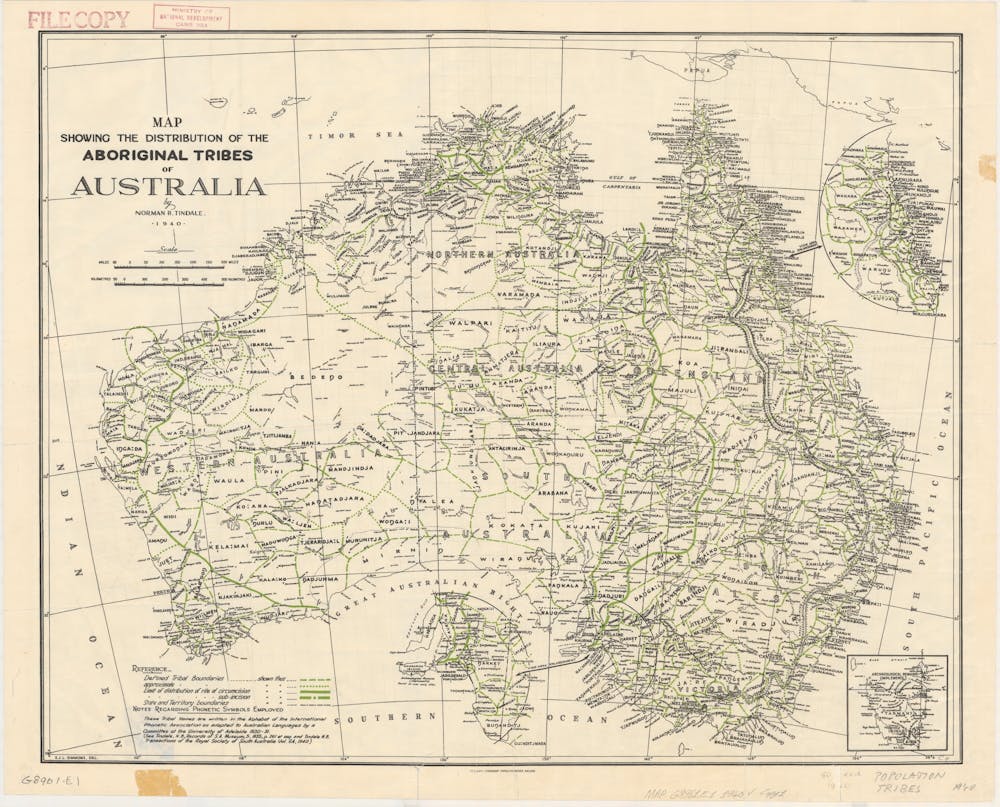
In 1788 there were between 300 and 700 Indigenous languages spoken across Australia by millions of people, as shown in anthropologist Norman Tindale’s 1974 map. However in the Australian 2016 Census, only around 160 of these languages were reported as being spoken at home.  And of these, only 13 traditional Indigenous languages are still spoken by children. 

It means that in 60 years’ time only 13 of Australia’s languages will be left, unless something is done now to encourage these children to keep speaking their language, and to encourage children from other language groups to start speaking their heritage languages.

Read more: Why do so few Aussies speak an Australian language?

In the Australian 2016 Census, nearly 650,000 Australians identified as Indigenous. Of these, around 10% (63,754) reported themselves as speaking an Indigenous language at home (they could also be speaking English and/or another Indigenous language). So which languages have the most speakers today?

Even for the 13 traditional Indigenous languages still spoken by children, the total numbers of speakers are tiny. The largest speaker numbers are:
  • Djambarrpuyngu (one of the large group of Yolŋu languages spoken in Arnhem Land - 4,264 speakers)
  • Pitjantjatjara (one of the large group of Western Desert languages - 3,054 speakers)
  • Warlpiri (spoken in Central Australia - 2,276 speakers)
  • Tiwi (spoken on the Tiwi Islands - 2,020 speakers )
  • Murrinh-Patha (spoken at Wadeye in the Northern Territory - 1,966 speakers)
  • Kunwinjku (one of a group of related languages spoken in west Arnhem Land - 1,702 speakers)
13,733 people report that they speak a new Indigenous language. New languages have developed since 1788 from contact between English speakers and Indigenous languages speakers.

These include Kriol spoken in the Katherine region and across the Kimberley, Yumpla Tok spoken in the Torres Strait and Cape York, and Aboriginal English. Others don’t have widely recognised names, and so the Census under-reports these.

Anthropologist Norman Tindale’s 1974 map of Aboriginal languages. Held at the South Australia Museum

Of the 600,000 other Indigenous people, many are actively relearning their ancestral languages. From the 2016 census these include:
However we should be wary of difficulties in counting languages and speakers in the Census. One is drawing boundaries between languages and dialects.

Another is variable names for languages – if Indigenous people don’t have a name for the language they talk (which is common among the world’s smaller languages), or if the Census data analysers don’t recognise that name, then their language will be assigned to “Australian Indigenous languages not further defined” – in the 2016 Census this accounts for 8,625 of the 63,754 people.

Read more: Some Australian Indigenous languages you should know

A third difficulty is that the Census question doesn’t distinguish between people who speak an Indigenous language as their main means of everyday talk, and people who are actively relearning an Indigenous language, and use English for most everyday talk.

The ambiguities and incompleteness in the Census results mean that it is important to find other ways to supplement it. Later this year the Australian government will release its National Indigenous Languages Report which will give a more comprehensive picture.

Read more: Explainer: how Tasmania's Aboriginal people reclaimed a language, palawa kani

Supporting languages

Indigenous people who speak English or a new Indigenous language as their first language often want to learn and reawaken their heritage language from old recordings and documents, and sometimes from elderly speakers.

The Federal government is currently supporting many groups in language reawakening, which can be a transformative activity. In some places it has made Indigenous people and heritage visible through signage, welcomes to country and art events.

Signage at Hobart’s Mount Wellington using the Tasmanian Aboriginal, palawi kani, name for the mountain, kunanyi. Flickr/Pursuedbybear, CC BY-NC-SA

The demand to learn these languages at school level is increasing, and the supply of teachers with relevant training can’t keep up. There’s only one public teacher education program that addresses this demand: the Master of Indigenous Language Education at the University of Sydney.

Three reawakening languages are now taught at university level: Kaurna (University of Adelaide), Gamilaraay (Australian National University and University of Sydney and Wiradjuri (Charles Sturt University).

Other languages still spoken by children and taught at universities include Yolŋu Matha through Charles Darwin University, and Pitjantjatjara through the University of South Australia.

In 2019 Charles Darwin University and the Australian National University are combining forces with Bininj Kunwok people to teach their language online.

Pressure to speak English

Indigenous people who don’t speak English as a first language face enormous pressure to switch to speaking English only (even though elsewhere in the world multilingualism is common, and affords social and intellectual advantages).

Things that currently make it hard are that:
  • all government services are delivered in English as the default
  • interpreters and translations are often not available, or only available for serious court cases and serious medical problems
  • schools mostly operate in English with inadequate attention to the language needs of the children.
The number of first language speakers of new and traditional language who need language support for access to services is very small - around 60,000. Governments could require at least some of the public servants servicing that area to speak the local language. There are few local Indigenous public servants in remote communities - what if a concerted effort was made to recruit and train more local people?

Jill Seraine doing the Bininj Kunwok course. Provided by Cathy Bow, Author provided

Schooling is another area for support. Governments could say that in communities where the majority of the population speak a language other than English, then the schools should recognise the children’s mother tongue in the initial years of schooling, in order to make the best decisions on how to use languages in their education. 

Skilled teachers fluent in the local Indigenous language and English are highly valuable in this process.  The most cost-effective way of doing this is to make sure local Indigenous people have access to good teacher training.

Having more local Indigenous teachers in remote communities has many other social advantages as well. Properly supporting lessons in Indigenous languages in schools requires rich documentation of the language and society, and so protects cultural heritage. Above all, it shows that the children’s first language is valued by everyone.

A New Year’s Resolution for this International Year of Indigenous Languages: let’s encourage governments to work with Indigenous people to help fulfil hopes for our national languages treasure.The Conversation

Jane Simpson, Chair of Indigenous Linguistics and Deputy Director of the ARC Centre of Excellence for the Dynamics of Language, Australian National University

This article is republished from The Conversation under a Creative Commons license. Read the original article.

Friday, September 21, 2018

Curious Kids: Why Does English Have So Many Different Spelling Rules?

by Kate Burridge, Monash University, The Conversation: https://theconversation.com/curious-kids-why-does-english-have-so-many-different-spelling-rules-98831

File 20180624 152140 112kqg9.jpg?ixlib=rb 1.1

More spelling problems came in when French scribes introduced new spelling conventions — their own of course, and not always helpful. Shutterstock, CC BY


This is an article from Curious Kids, a series for children. The Conversation is asking kids to send in questions they’d like an expert to answer. All questions are welcome – serious, weird or wacky! You might also like the podcast Imagine This, a co-production between ABC KIDS listen and The Conversation, based on Curious Kids.

Why does English have so many different spelling rules? – Melania P, age 12, Strathfield.

English spelling has been evolving for over a thousand years and the muddle we’re in today is the fall-out of many different events that have taken place over this time.

A bad start

It was a rocky beginning for English spelling. Quite simply, the 23-letter Roman alphabet has never been adequate — even Old English (spoken 450-1150) had 35 or so sounds, and our sound system is now even bigger.

More spelling problems came in when French scribes introduced new spelling conventions — their own of course, and not always helpful. Using “c” instead of “s” for words like city was messy because “c” also represented the “k” sound in words like cat.


William Caxton set up the first printing presses. Wikimedia Commons, CC BY

And then printing arrived in the 15th century — and with it more mess. William Caxton (who set up the presses in the first place) liked Dutch spellings and so established the “gh” in ghost and ghastly. Some printers were European and they introduced favourite spellings too from their own languages. Not terribly helpful either!

Those pesky silent letters

One of the biggest problems for English spelling has always been changes in pronunciation. Printing helped to stablise the spelling of words, but then some sounds changed their shape, and others even disappeared altogether. Think of those silent letters in words such as walk, through, write, right, sword, know, gnat — these were once pronounced.

If only the printer Caxton had been born a couple of centuries later, or if these sound changes had occurred a couple of centuries earlier, our spelling would be much truer to pronunciation.

And now comes another little wrinkle in this story – there’s a bunch of silent letters that were never actually pronounced. They appeared because of linguistic busybodies who wanted to make the language look more respectable. This caused some serious mess.

Take how we spell the word rhyme. When we swiped the word from French, it had a much more sensible look — rime. But this was changed to rhyme to give it a more classy classical look (like rhythm) – an interesting idea, but hardly helpful for someone trying to spell the word!

The 16th and 17th centuries saw many extra letters introduced in this way. Think of the “b” added to debt to make a link to Latin debitum. Now, the “b” might be justified in the word debit that we stole directly from Latin, but it was the French who gave us dette.
The “b” consonant was a mistake, and now we accuse poor old debt of having lost it through sloppy pronunciation!

Let’s make spelling more sensible

And so it is from this haphazard evolution that we end up with the spelling system we have.

But you know, there are in fact over 80% of words spelled according to regular patterns. So wholesale change is not what we want. However simple improvements could certainly be made without any major upheaval.

We could iron out inconsistencies such as humOUr versus humOrous. To introduce uniform -or spellings would be a painless reform (well, perhaps not painless, since many people are quite attached to the -our in words like humour).

We could also restore earlier spellings like rime and dette, and while we’re at it give psychology and philosophy a sensible look by spelling them sykology and filosofy.

So now, you can see the problem. No matter how silly spellings are, people get attached to them, and new spellings – even sensible ones – never seem to get a foot in the door.

Hello, curious kids! Have you got a question you’d like an expert to answer? Ask an adult to send your question to us. You can:
* Email your question to curiouskids@theconversation.edu.au
* Tell us on Twitter by tagging @ConversationEDU with the hashtag #curiouskids, or
* Tell us on Facebook


CC BY-ND

Please tell us your name, age and which city you live in. You can send an audio recording of your question too, if you want. Send as many questions as you like! We won’t be able to answer every question but we will do our best.The Conversation

Kate Burridge, Professor of Linguistics, Monash University

This article is republished from The Conversation under a Creative Commons license. Read the original article.

Tuesday, August 22, 2017

Hundreds of Languages are Spoken in the UK, but This Isn't Always Reflected in the Classroom


File 20170810 27688 7fpcof
It’s not all about English. shutterstock
Elizabeth Bailey, University of York and Emma Marsden, University of York


More than 300 different languages are now spoken in British schools. And in England, over 20% of primary school children use English as an additional language.

This equates to over 900,000 children for whom English is not their first language. These children might have been born in another country, their parents might speak another language to them at home, or they might just know a few words of another language because their grandparents immigrated to England a long time ago. But just like any other pupil, they attend schools across the country, speak (or learn to speak) in English and participate in the national curriculum. Yet the fact these children also bring with them a rich understanding of another language and culture can often go unnoticed.

Bilingualism is something we usually celebrate in adults yet not always in the classroom, where English is usually prioritised. This is despite the fact that many communities in Britain, speak more than one language.

In the 2011 British Census, for example, 4.2m people reported having a main language other than English. And just over half of all Europeans claim to speak at least one other language in addition to their mother tongue.

Lack of linguistic diversity

Research shows that some children never have the opportunity to use their home language at school. And in some cases, their teachers might not even know they speak another language.

In the absence of school or community support, these children can sometimes end up losing their home languages. This is something that may be particularly true in highly monolingual areas which experience less immigration.

The problem then is that these areas – where English is the only language spoken – become even more monolingual. All while other areas of the country grow and celebrate their linguistic diversity.


Most classrooms just teach in English. Shutterstock

Despite all the benefits that can come from having access to other languages, research shows there are a number of factors that may prevent teachers from feeling able to incorporate home languages into their classrooms. For example, there exists what has been described as a “monolingual mindset” whereby English schools have a long history of being monolingual and prioritising children’s progression in the English language. And promoting language learning in a country where a global language is spoken can be a hard sell.

Teachers are also under a lot of pressure to meet targets in English – just in the same way that pupils are under pressure to achieve in English. As a result, this can leave little room for individual variation, or for dedicating time to celebrate the linguistic diversity that exists within our schools.

How to create a multilingual community

Given that embracing other languages in school could be a great way of providing much needed linguistic and cultural education for the rest of the class, more could and should be done to make the most of these linguistic and cultural resources.

Even if a school doesn’t have any pupils using English as another language, chances are there are other languages being used in the wider community – and that could be utilised within local schools.


Children should be encouraged to embrace other languages. Shutterstock

But this idea of children or parents taking control of the learning seems to be one that some teachers can feel uncomfortable with – as this means having to put their trust in the child and perhaps become the language learner themselves. Findings from our own research also show that significant investment would be required to give teachers the confidence and willingness to feel comfortable with this.

But investing in more multilingual classrooms could help to open new doors for all. And this could be as simple as a child reading stories in their home language to the rest of the class, or parents coming in to school to work with all the children using their language. Teachers could even widen the learning out to ask all the class to label parts of a flower (for example) in two languages, with the help of a bilingual child.

By using their languages in an “official” school environment, children would be able to see that there is a place for languages other than just English in school. And that their skills as a bilingual speaker are valued.

The ConversationRecognising and encouraging bilingualism could also mean that monolingual children see positive examples of language learning. They would also hear the languages of their community and learn to appreciate linguistic diversity at a young age – vitally important in current climates of segregation and separation.

Elizabeth Bailey, PhD Student, University of York and Emma Marsden, Senior Lecturer, Department of Education, University of York

This article was originally published on The Conversation. Read the original article.

Monday, July 17, 2017

Brain Fitness: Why You’re Losing Out if You’re not Learning Another Language


commons.wikimedia.org
Most people in the world speak more than one language, suggesting the human brain evolved to work in multiple tongues. If so, asks Gaia Vince, are those who speak only one language missing out?

Listen to or download an audiobook of this story on SoundCloud and iTunes.
In a café in south London, two construction workers are engaged in cheerful banter, tossing words back and forth. Their cutlery dances during more emphatic gesticulations and they occasionally break off into loud guffaws. They are discussing a woman, that much is clear, but the details are lost on me. It’s a shame, because their conversation looks fun and interesting, especially to a nosy person like me. But I don’t speak their language.
Out of curiosity, I interrupt them to ask what they are speaking. With friendly smiles, they both switch easily to English, explaining that they are South Africans and had been speaking Xhosa. In Johannesburg, where they are from, most people speak at least five languages, says one of them, Theo Morris. For example, Theo’s mother’s language is Sotho, his father’s is Zulu, he learned Xhosa and Ndebele from his friends and neighbours, and English and Afrikaans at school. “I went to Germany before I came here, so I also speak German,” he adds.
Was it easy to learn so many languages?
“Yes, it’s normal,” he laughs.
He’s right. Around the world, more than half of people – estimates vary from 60 to 75 per cent – speak at least two languages. Many countries have more than one official national language – South Africa has 11. People are increasingly expected to speak, read and write at least one of a handful of “super” languages, such as English, Chinese, Hindi, Spanish or Arabic, as well. So to be monolingual, as many native English speakers are, is to be in the minority, and perhaps to be missing out.
Multilingualism has been shown to have many social, psychological and lifestyle advantages. Moreover, researchers are finding a swathe of health benefits from speaking more than one language, including faster stroke recovery and delayed onset of dementia.
Could it be that the human brain evolved to be multilingual – that those who speak only one language are not exploiting their full potential? And in a world that is losing languages faster than ever – at the current rate of one a fortnight, half our languages will be extinct by the end of the century – what will happen if the current rich diversity of languages disappears and most of us end up speaking only one?
I am sitting in a laboratory, headphones on, looking at pictures of snowflakes on a computer. As each pair of snowflakes appears, I hear a description of one of them through the headphones. All I have to do is decide which snowflake is being described. The only catch is that the descriptions are in a completely invented language called Syntaflake.
It’s part of an experiment by Panos Athanasopoulos, an ebullient Greek with a passion for languages. Professor of psycholinguistics and bilingual cognition at Lancaster University, he’s at the forefront of a new wave of research into the bilingual mind. As you might expect, his lab is a Babel of different nationalities and languages – but no one here grew up speaking Syntaflake.
The task is profoundly strange and incredibly difficult. Usually, when interacting in a foreign language, there are clues to help you decipher the meaning. The speaker might point to the snowflake as they speak, use their hands to demonstrate shapes or their fingers to count out numbers, for example. Here I have no such clues and, it being a made-up language, I can’t even rely on picking up similarities to languages I already know.
After a time, though, I begin to feel a pattern might be emerging with the syntax and sounds. I decide to be mathematical about it and get out pen and paper to plot any rules that emerge, determined not to “fail” the test.

© Nadine Redlich
The experience reminds me of a time I arrived in a rural town a few hours outside Beijing and was forced to make myself understood in a language I could neither speak nor read, among people for whom English was similarly alien. But even then, there had been clues… Now, without any accompanying human interaction, the rules governing the sounds I’m hearing remain elusive, and at the end of the session I have to admit defeat.
I join Athanasopoulos for a chat while my performance is being analysed by his team.
Glumly, I recount my difficulties at learning the language, despite my best efforts. But it appears that was where I went wrong: “The people who perform best on this task are the ones who don’t care at all about the task and just want to get it over as soon as possible. Students and teaching staff who try to work it out and find a pattern always do worst,” he says.
“It’s impossible in the time given to decipher the rules of the language and make sense of what’s being said to you. But your brain is primed to work it out subconsciously. That’s why, if you don’t think about it, you’ll do okay in the test – children do the best.”
The first words ever uttered may have been as far back as 250,000 years ago, once our ancestors stood up on two legs and freed the ribcage from weight-bearing tasks, allowing fine nerve control of breathing and pitch to develop. And when humans had got one language, it wouldn’t have been long before we had many.
Language evolution can be compared to biological evolution, but whereas genetic change is driven by environmental pressures, languages change and develop through social pressures. Over time, different groups of early humans would have found themselves speaking different languages. Then, in order to communicate with other groups – for trade, travel and so on – it would have been necessary for some members of a family or band to speak other tongues.
We can get some sense of how prevalent multilingualism may have been from the few hunter-gatherer peoples who survive today. “If you look at modern hunter-gatherers, they are almost all multilingual,” says Thomas Bak, a cognitive neurologist who studies the science of languages at the University of Edinburgh. “The rule is that one mustn’t marry anyone in the same tribe or clan to have a child – it’s taboo. So every single child’s mum and dad speak a different language.”
In Aboriginal Australia, where more than 130 indigenous languages are still spoken, multilingualism is part of the landscape. “You will be walking and talking with someone, and then you might cross a small river and suddenly your companion will switch to another language,” says Bak. “People speak the language of the earth.” This is true elsewhere, too. “Consider in Belgium: you take a train in Liège, the announcements are in French first. Then, pass through Loewen, where the announcements will be in Dutch first, and then in Brussels it reverts back to French first.”

Friday, September 26, 2014

Get Your Tongue Round German to Master Speaking English

English: Knowledge of German language in EU wi...
Knowledge of German language in EU and Croatia, Bosnia & Herzegovina, Switzerland & Turkey (Wikipedia)
by Jon Hughes, Royal Holloway

It has become commonplace to hear that English is now a sort of “global” language, or lingua franca. Although this might be partly true, is it right to draw the conclusion that native speakers of English have no practical reason to learn other languages?

As an academic who has chosen to specialise in German and the culture of the German-speaking countries, I find it hard not to get depressed at this line of reasoning.

The assumption that many Germans speak English so why bother with their language sits alongside the stubborn persistence of cultural stereotypes and prejudices dating back to the two World Wars, if not further.

Against this background, the case is now being made for the continued importance of having language skills beyond English, particularly for employment prospects.

I would argue that there is another good reason for learning a foreign language: it deepens one’s understanding of language in general and will improve your skills in your native language. Let’s consider the example of the “modern foreign language” that I know best - German.

Kindred words

It’s often overlooked that German is in one sense not a “foreign” language for English speakers at all, but a kindred one. The standard forms of modern English and German have shared roots in the family of western Germanic languages, along with Dutch.

This is fairly easy to spot in a lot of the core vocabulary: Mann (man), Mutter (mother), schwimmen (swim) and so on. These similarities can give you a head start as a learner - although inevitably there are a few “false friends” to watch for too: Gift for example is the German word for “poison”.

We even have equivalents to the famous German umlaut, the vowel shift common in plurals and irregular verbs.

So in English the singlular “man” becomes plural “men”, just as in German Mann becomes Männer. These are the words our Anglo-Saxon ancestors brought to Britain with their language, before the Normans further enriched the language with many words with their roots in Latin.

Grammar lessons

At a deeper grammatical level, English has visible Germanic roots. And the very things that beginners in German can find worrying often have analogies in English. By grasping them in a closely related language like German, a native speaker of English will often begin to appreciate the features of his or her own language.

Native speakers of English are notoriously prone to make certain grammatical mistakes in their own language. It nearly always reflects a lack of understanding of how languages work.

For example, the statement “If I was a rich man” might well be comprehensible. But it should of course - as in the famous musical song - be: “If I were a rich man”. This is an example of the subjunctive mood, in which a verb changes to reflect a theoretical or “unreal” situation.

It can be contrasted with the indicative, used to describe an actual situation: “I am not a rich man”. The confusion arises partly because “were” can indicate both tense and, in this case, mood. And in the indicative past tense, “I was” is naturally correct.

To add to the confusion, the difference between the imperfect past tense and the subjunctive is invisible with other verbs. So: “He spoke German” and: “If he spoke German” are both correct.

No confusion in German

In German, the subjunctive mood is much more visible and never confused with the indicative. “Wenn ich reich wäre” (If I were rich), uses wäre, the subjunctive form of sein (to be). It is what almost all German speakers would say, even informally.

This means that, as the learner of German becomes more familiar with the natural way to express such conditional situations in German, he or she will become sensitive to the equivalents in English. With English using words such as “were” in so many grammatical contexts, it’s no wonder that many native speakers of English aren’t sure what is actually correct.

Me or I

Here’s another example. One often hears sentences such as “He gave a present to my husband and I”. This reflects a fundamental confusion about subject and object words in English. German has retained a case system that makes it very clear whether a noun or pronoun is the active subject or passive object of a sentence. It’s a key difference and the system is still embedded in the language.

In English we tend to rely on word order to make the difference clear, as well as prepositions. But we do make the distinction in pronouns: “I”, “he”, “she” and “they” are always active subjects, whereas “me”, “him”, “her” and “them” are objects, being acted upon. So we say: “He gave a present to me.” Including the additional information about “my husband” changes nothing, grammatically speaking it should be: “He gave a present to me and my husband”.

In German, because prepositions are strongly linked with a particular object case it would be inconceivable to use the active “nominative” case after a preposition or a transitive verb like “give”.

Likewise any confusion between “who” and “whom”, the latter being an object form (“to whom am I speaking?”), wears off once one is used to German’s cases. Again, it’s highly unlikely a German would confuse wer (who) with wen or wem (whom).

Not “foreign”

These are just a few small examples. The plea I’d like to make, ahead of the European Day of Languages, is that rather than thinking of a language like German simply as “foreign”, speakers of English might start to view it as the neighbour and relative that it is.

And far from it being pointless to learn other languages, if you take the leap and start to learn another language you’ll discover it’s not as hard as you might think. In the process to improve your command of language in general, you could become a more sensitive and precise user of your own language.
The Conversation

Jon Hughes does not work for, consult to, own shares in or receive funding from any company or organisation that would benefit from this article, and has no relevant affiliations.

This article was originally published on The Conversation. Read the original article.

Thursday, September 25, 2014

How a Second Language Trains Your Brain for Math

brain
(Photo: alternative_illustrations/Flickr)
, Pacific Standard: http://www.psmag.com/navigation/health-and-behavior/language-trains-brain-math-91289

Speaking more than one language has some advantages beyond ordering food in the local tongue - psychologists believe that bilingualism has many other positive side effects. 

Now, researchers have evidence connecting bilinguals’ talents to stronger so-called executive control in the brain.

Much has been made recently about growing up learning more than one language, as about one in five do.

There’s evidence that children who grow up speaking two languages may be more creative, that bilingualism might stave off dementia, and that bilinguals are better at tasks that involve switching attention between different objects.

That led some researchers to suspect that speaking two languages might improve our brains’ executive functions, the high-level circuits that control our ability to switch between tasks, among other things.

To get a little more sense of the matter, Andrea Stocco and Chantel Prat of the University of Washington screened 17 bilingual and 14 monolingual people for language proficiency and other factors and then tested them using a series of arithmetic problems.

Each problem was defined by a set of operations and two inputs - divide x by two, add one to y, and subtract the second result from the first, for example - with x and y specified uniquely for each problem.

First, participants ran through 40 practice problems using just two operation sets. Next, they went through another 40 problems, this time a mix of 20 new ones, each with a unique set of operations and inputs, and another 20 featuring the previously studied arithmetic operations, but with new inputs for x and y. Finally, the groups worked through 40 more problems, again a mix of familiar and novel, but this time, they completed them inside a fMRI brain scanner.

While bilinguals and monolinguals solved the problems with equal accuracy and took about the same amount of time on arithmetic with familiar sets of operations, bilinguals beat out monolinguals, on average, by about half a second on novel problems.

What’s more, fMRI results showed that the basal ganglia, a brain region previously linked to learning about rewards and motor functions, responded more to novel math problems than old ones, but only in bilinguals.

That’s interesting, Stocco says, because more recent studies suggest the basal ganglia’s real role is to take information and prioritize it before passing it on to the prefrontal cortex, which then processes the information.

If that’s correct, the new results suggest that learning multiple languages trains the basal ganglia to switch more efficiently between the rules and vocabulary of different languages, and these are skills it can then transfer to other domains such as arithmetic.

“Language is one of the hardest things the brain does,” Prat says, though we often realize that only when we try to learn a new language - a task that is “at least an order of magnitude” more difficult than learning the first one.

But just as working on your core has benefits outside the gym, working your basal ganglia hard may be the key to promoting other cognitive skills, especially your hidden math genius.

Nathan Collins studied astrophysics and political science before realizing he wanted to learn about all of the science without worrying about tenure. In his second life as a freelance science writer, he’s written for Scientific American, New Scientist, and others.