Showing posts with label Inspiring Learning. Show all posts

Sunday, May 19, 2019

Critical Thinking: A Free Course

by Dan Colman, Open Culture: http://www.openculture.com/2019/05/critical-thinking-a-free-course.html

In the playlist above, Gregory Sadler presents a 24-lecture course on "Critical Thinking" - something the world could always use more of. Presented at Fayetteville State University, the course features lectures on topics like Deductive and Inductive Arguments, Fallacies, Rhetorical Devices, Appeals to Authority and much more. The textbook used (and referenced) in the course was Moore and Parker's Critical Thinking. The individual lectures are as follows:
  1. Issues, Claims, Arguments
  2. Arguments and Non-Arguments
  3. Value Judgements 
  4. Deductive and Inductive Arguments with Implicit Premises
  5. Complex Arguments, Unstated Premises
  6. Deductive and Inductive Arguments 1
  7. Deductive and Inductive Arguments 2
  8. Deductive and Inductive Arguments 3
  9. Fallacies of Composition and Division
  10. Information Sources
  11. Experts and Appeal to Authority
  12. Critical Thinking and Advertising
  13. Rhetorical Devices 1
  14. Rhetorical Devices 2
  15. Rhetorical Devices 3
  16. Fallacies 1
  17. Fallacies 2
  18. Fallacies 3
  19. Fallacies 4
  20. Fallacies 5
  21. Fallacies 6
  22. Inductive Arguments 1
  23. Inductive Arguments 2
  24. Inductive Arguments 3
Also find the complete playlist of lectures on YouTube here. Sadler's YouTube channel features other courses and a wealth of philosophy lectures.
"Critical Thinking" has been added to our list of Free Philosophy Courses, a subset of our collection, 1,300 Free Online Courses from Top Universities.
Related Content:

Friday, May 17, 2019

How Leonardo da Vinci Drew an Accurate Satellite Map of an Italian City (1502)

by Josh Jones, Open Culture: http://www.openculture.com/2019/04/how-leonardo-da-vinci-drew-an-accurate-satellite-map-of-an-italian-city-1502.html

When I look at maps from centuries ago, I wonder how they could have been of any use. Not only were they filled with mythological monsters and mythological places, but the perspectives mostly served an aesthetic design rather than a practical one. Of course, accuracy was hard to come by without the many mapping tools we take for granted—some of them just in their infancy during the Renaissance, and many more that would have seemed like outlandish magic to nearly everyone in 15th century Europe.

Everyone, it sometimes seems, but Leonardo da Vinci, who anticipated and sometimes steered the direction of futuristic public works technology. None of his flying machines worked, and he could hardly have seen images taken from outer space. But he clearly saw the problem with contemporary maps. The necessity of fixing them led to a 1502 aerial image of Imola, Italy, drawn almost as accurately as if he had been peering at the city through a Google satellite camera.

“Leonardo,” says the narrator of the Vox video above, “needed to show Imola as an ichnographic map,” a term coined by ancient Roman engineer Vitruvius to describe ground plan-style cartography. No streets or buildings are obscured, as they are in the maps drawn from the oblique perspective of a hilltop or mountain. Leonardo undertook the project while employed as Cesare Borgia’s military engineer. “He was charged with helping Borgia become more aware of the town’s layout.” For this visual aid turned cartographic marvel, he drew from the same source that inspired the elegant Vitruvian Man.
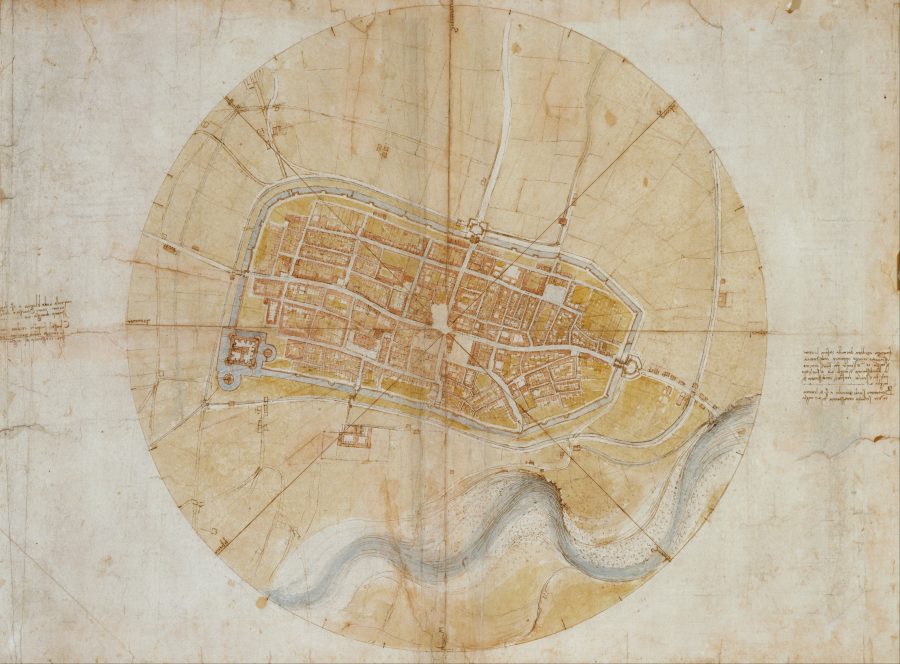
While the visionary Roman builder could imagine a god's eye view, it took someone with Leonardo’s extraordinary perspicacity and skill to actually draw one, in a startlingly accurate way. Did he do it with grit and moxie? Did he astral project thousands of miles above the city? Was he in contact with ancient aliens? No, he used geometry, and a compass, the same means and instruments that allowed ancient scientists like Eratosthenes to calculate the circumference of the earth, to within 200 miles, over 2000 years ago.
Leonardo probably also used an instrument called a bussola, a device that measures degrees inside a circle—like the one that surrounds his city map. Painstakingly recording the angles of each turn and intersection in the town and measuring their distance from each other would have given him the data he needed to recreate the city as seen from above, using the bussola to maintain proper scale. Other methods would have been involved, all of them commonly available to surveyors, builders, city planners, and cartographers at the time. Leonardo trusted the math, even though he could never verify it, but like the best mapmakers, he also wanted to make something beautiful.
It may be difficult for historians to determine which inaccuracies are due to miscalculation and which to deliberate distortion for some artistic purpose. But license or mistakes aside, Leonardo’s map remains an astonishing feat, marking a seismic shift from the geography of “myth and perception” to one of “information, drawn plainly.” There’s no telling if the archetypal Renaissance man would have liked where this path led, but if he lived in the 21st century, he'd already have his mind trained on ideas that anticipate technology hundreds of years in our future.
Related Content:
Josh Jones is a writer and musician based in Durham, NC. Follow him at @jdmagness

Friday, April 26, 2019

800+ Treasured Medieval Manuscripts to Be Digitized by Cambridge & Heidelberg Universities

by Colin Marshall, Open Culture: http://www.openculture.com/2019/04/800-treasured-medieval-manuscripts-to-be-digitized-by-cambridge-heidelberg-universities.html
Western civilization may fast be going digital, but it still retains its roots in Ancient Greece. And so it makes a certain circle-closing sense to digitize the legacy left us by our Ancient Greek forebears and the medieval scholars who preserved it. 

Cambridge and Heidelberg, two of Europe's oldest universities, this month announced their joint intention to embark upon just such a project. It will take two years and cost £1.6 million, reports the BBC, but it will digitize "more than 800 volumes featuring the works of Plato and Aristotle, among others." As the announcement of the project puts it, the texts will then "join the works of Charles Darwin, Isaac Newton, Stephen Hawking and Alfred Lord Tennyson on the Cambridge Digital Library."
These medieval and early modern Greek manuscripts, which date more specifically "from the early Christian period to the early modern era (about 1500 - 1700 AD)," present their digitizers with certain challenges, not least the "fragile state" of their medieval binding.

But as Heidelberg University Library director Dr. Veit Probst says in the announcement, “Numerous discoveries await. We still lack detailed knowledge about the production and provenance of these books, about the identities and activities of their scribes, their artists and their owners – and have yet to uncover how they were studied and used, both during the medieval period and in the centuries beyond." And from threads including "the annotations and marginalia in the original manuscripts" a "rich tapestry of Greek scholarship will be woven."
This massive undertaking involves not just Cambridge and Heidelberg but the Vatican as well. Together Heidelberg University and the Vatican possess the entirety of the Bibliotheca Palatina, split between the libraries of the two institutions, and the digitization of the "mother of all medieval libraries" previously featured here on Open Culture, is a part of the project. 

This collected wealth of texts includes not just the work of Plato, Aristotle, and Homer as they were "copied and recopied throughout the medieval period," in the words of Cambridge University Library Keeper of Rare Books and Early Manuscripts Dr. Suzanne Paul, but a great many other "multilingual, multicultural, multifarious works, that cross borders, disciplines and the centuries" as well. And with luck, their digital copies will stick around for centuries of Western civilization to come.
Related Content:
Based in Seoul, Colin Marshall writes and broadcasts on cities, language, and culture. His projects include the book The Stateless City: a Walk through 21st-Century Los Angeles and the video series The City in Cinema. Follow him on Twitter at @colinmarshall or on Facebook.

Sunday, April 14, 2019

How Can I Know Right From Wrong? Watch Philosophy Animations on Ethics Narrated by Harry Shearer

by Josh Jones, The Conversation: http://www.openculture.com/2015/03/how-can-i-know-right-from-wrong-watch-philosophy-animations-on-ethics.html

The history of moral philosophy in the West hinges principally on a handful of questions: Is there a God of some sort? An afterlife? Free will? And, perhaps most pressingly for humanists, what exactly is the nature of our obligations to others? The latter question has long occupied philosophers like Immanuel Kant, whose extreme formulation—the “categorical imperative”—flatly rules out making ethical decisions dependent upon particular situations. Kant’s famous example, one that generally gets repeated with a nod to Godwin, involves an axe murderer showing up at your door and asking for the whereabouts of a visiting friend. In Kant’s estimation, telling a lie in this case justifies telling a lie at any time, for any reason. Therefore, it is unethical.
In the video at the top of the post, Harry Shearer narrates a script about Kant’s maxim written by philosopher Nigel Warburton, with whimsical illustrations provided by Cognitive. Part of the BBC and Open University’s “A History of Ideas” series, the video—one of four dealing with moral philosophy—also explains how Kant’s approach to ethics differs from those of utilitarianism.

In the video above, Shearer describes that most utilitarian of thought experiments, the “Trolley Problem.” As described by philosopher Philippa Foot, this scenario imagines having to sacrifice the life of one for those of many. But there is a twist—the second version, which involves the added crime of physically murdering one person, up close and personal, to save several. An analogous but converse theory is that of Princeton philosopher Peter Singer (below) who proposes that our obligations to people in peril right in front of us equal our obligations to those on the other side of the world.
Finally, the last video surveys one of the thorniest issues in moral philosophical history—the “is/ought” divide, as problematic as the ancient Euthyphro dilemma. How, asked David Hume, are we to deduce moral principles from facts about the world that have no moral dimension? Particularly when those facts are never conclusive, are subject to revision, and when new ones get uncovered all the time? The question introduces a seemingly unbridgeable chasm between facts and values. Moral judgements founded on what is or isn’t “natural” flounder before our terror of much of what nature does, and the very partial and fallible nature of our knowledge of it.
The problem is as startling as Hume’s critique of causality, and in part caused Kant to remark that Hume had awakened him from a “dogmatic slumber.” What may strike viewers of the series is just how abstract these questions and examples are—how divorced from the messiness of real world politics, with the exception, perhaps, of Peter Singer. It may be instructive that political philosophy forms a separate branch in the West. While these problems are certainly difficult enough to trouble the sleep of just about any thoughtful person, in our day-to-day lives, our decision making process seems to be much messier, and much more situational, than we're probably ever aware of.

Sunday, April 7, 2019

What Makes a School Good? It's About More Than Just Test Results

by Jen Jackson and Stephen Lamb, The Conversation: https://theconversation.com/what-makes-a-school-good-its-about-more-than-just-test-results-114372

File 20190402 177193 ir7qso.jpg?ixlib=rb 1.1

A successful school isn’t necessarily one that gets high test scores. from shutterstock.com

One of the more elusive goals of education research is answering the question: what makes one school perform better than another? The evidence base is growing, but so far the answer is: it depends.

School success depends on context. What works for one group of students and teachers might not work for another. Teachers themselves may vary in their effectiveness depending on the students they teach.

Some schools improve their performance by attracting more affluent and/or high achieving students. This strategy may lift performance in one school, but risks “residualising” neighbouring schools, leaving them to cope with increasing concentrations of disadvantage.

The socio-economic status of students is a major factor in school performance. It is harder for a school to achieve high academic performance with large numbers of students facing risk factors such as low family income, or parents with limited education who may struggle to provide support for learning. Many disadvantaged schools across Australia achieve results more than one year behind the national average.

But just because schools in poorer areas may achieve lower results, it doesn’t mean these schools are “unsuccessful”, and schools in wealthier suburbs with higher average scores are “successful”. Schools in poorer areas can make a significant impact on their students’ lives. And lifting outcomes for disadvantaged students can transform lives and communities, across generations.

There are three key ways that schools in disadvantaged contexts achieve success that other schools can learn from.

1. Success is more than test scores

The most effective schools aren’t necessarily the highest academic performers. They are schools that yield better-than-anticipated results, bringing the best out of every student regardless of background.

Measures of school performance, including MySchool, typically take into account the socio-economic profile of the student community for this reason. This draws on established research about schools’ value-add – their success in lifting student outcomes.

A successful school fosters broader dimensions of learning critical to students’ overall success. These include social and emotional development, creativity and innovation, positive attitudes to learning, and citizenship.

Some Australian governments actually include measures of student well-being and sense of connectedness to school in assessments of school performance. Schools themselves often point to the value of their work in shaping student aspirations, behaviours, and values – not just academic achievement.

Disadvantaged schools may succeed in these areas, even more highly than schools whose focus is academic achievement.

2. Students need to learn how to learn

Effective teaching practice will have little impact if students are not equipped to learn. Students from advantaged backgrounds typically inherit knowledge about how to learn, and why. Students from disadvantaged backgrounds rely more heavily on schools to build their skills for learning, and to help them to see themselves as capable and motivated learners.

Students from more advantaged households typically inherit understanding about how to learn, and why, from their parents. from shutterstock.com

High-performing lower socio-economic status schools routinely provide targeted support for students within and outside the traditional school day. This may include small-group and individual tutoring, self-paced interventions using technology, one-on-one academic advising and coaching, homework support, and additional assessment time.

Evaluations of school reforms and intervention programs for schools with high concentrations of disadvantaged students have revealed the importance of establishing a shared understanding around teaching and learning, and school goals.

For example, one school established playgroups and a parent café to work with parents as partners in the learning process. This meant more students came to school motivated and ready to learn, and teachers could do their jobs more effectively.

3. Extra funding matters and must be put to good use

Needs-based school funding – as recommended in the first Gonski review – goes some way towards combating the downward pressure student disadvantage places on school performance. Yet the effects of school funding on learning outcomes are mixed.

Achieving better outcomes requires changing the way you practise and using the extra money to enact the change. This is because learning outcomes are driven by a complexity of factors, especially in communities experiencing a number of challenges.

A recent evaluation of the impact of additional school funding shows that a stable teaching and school leadership team is essential to enable schools to make good use of additional funding. One school, which had seen four principals come and go in five years, invested in building the executive leadership team, including mentoring and leadership training.
Although gains in test scores remain a work-in-progress, the professional climate and teaching practice have notably improved.

Schools with many disadvantaged students can face other challenges besides a high turnover of staff. Addressing these challenges requires school leaders to examine the many facets of school performance, not only student achievement, to identify where the best opportunities are for improvement.
Additional funding is needed, but continuity, stability, and evidence-based planning are essential for it to have maximum effect.

Applying knowledge across contexts

Schools that achieve success for the most disadvantaged students have much to contribute to our knowledge of what makes a good school. They are at the frontline of engagement with the enduring equity gap in Australian education, and living proof it can be narrowed.

Their potential contribution is illustrated by the example of a school partnership in Victoria, involving a highly advantaged and highly disadvantaged school. The partnership was successful because knowledge flowed both ways.

While the advantaged school focused on high achievement, the disadvantaged school helped the more advantaged school understand the influence of home and family context on learning, and adopt tailored strategies so their least advantaged learners would not fall through the cracks.

This kind of understanding not only leads to successful schools: it is the foundation of a successful system.The Conversation

Jen Jackson, Education Policy Lead, Mitchell Institute, Victoria University and Stephen Lamb, Research Chair in Education and Director of the Centre for International Research on Education Systems, Victoria University

This article is republished from The Conversation under a Creative Commons license. Read the original article.

Friday, March 22, 2019

Oxford’s Free Course Critical Reasoning For Beginners Teaches You to Think Like a Philosopher

by Ilia Blinderman, Open Culture:  http://www.openculture.com/2019/03/oxfords-free-course-critical-reasoning-for-beginners-teaches-you-to-think-like-a-philosopher.html
When I was younger, I often found myself disagreeing with something I’d read or heard, but couldn't explain exactly why. Despite being unable to pinpoint the precise reasons, I had a strong sense that the rules of logic were being violated. 

After I was exposed to critical thinking in high school and university, I learned to recognize problematic arguments, whether they be a straw man, an appeal to authority, or an ad hominem attack. Faulty arguments are all-pervasive, and the mental biases that underlie them pop up in media coverage, college classes, and armchair theorizing. Want to learn how to avoid them? Look no further than Critical Reasoning For Beginners, a top rated collection of lectures led by Oxford University’s Marianne Talbot.

Talbot builds the course from the ground up, and begins by explaining that arguments consist of a set of premises that, logically linked together, lead to a conclusion. She proceeds to outline the way to lay out an argument logically and clearly, and eventually, the basic steps involved in assessing its strengths and weaknesses.

The six-part series, which was recorded in 2009, shows no sign of wear, and Talbot, unlike some philosophy professors, does a terrific job of making the content digestible. If you’ve got some time on your hands, the lectures, which average just over an hour in length, can be finished in less than a week. That's peanuts, if you consider that all of our knowledge is built on the foundations that this course establishes. If you haven’t had the chance to be exposed to a class on critical thought, I can’t recommend Critical Reasoning For Beginners with enough enthusiasm: there are few mental skills that are as underappreciated, and as central to our daily lives, as critical thinking.
Critical Reasoning For Beginners is currently available on the University of Oxford website in both audio and video formats, and also on iTunes and YouTube. You can find it listed in our collection of Free Online Philosophy Courses, part of our collection of 1300 Free Online Courses from top universities.
Note: An earlier version of this post appeared on our site in 2014.
Ilia Blinderman is a Montreal-based culture and science writer. Follow him at @iliablinderman, or read more of his writing at the Huffington Post.
Related Content:

Monday, March 18, 2019

Philosophers Name the Best Philosophy Books: From Stoicism and Existentialism, to Metaphysics & Ethics for Artificial Intelligence

by Josh Jones, Open Culture:  http://www.openculture.com/2018/10/philosophers-name-the-best-philosophy-books.html


As an English major undergrad in the 90s, I had a keen side interest in reading philosophy of all kinds. But I had little sense of what I should be reading. I browsed the library shelves, picking out what caught my attention. Not a bad way to make unusual discoveries, but if you want to get a focused, not to mention current, view of a particular field, you need to have a knowledgeable guide.

Back in those days, the internet was, as they say, in its infancy. How much better I would have fared if something like Five Books had existed! The site's general idea, as it trumpets on its homepage, is to recommend “the best books on everything.” Argue amongst yourselves about whether any one resource can deliver on that promise, but let’s keep our focus on the excellent space of their Philosophy section, curated by freelance philosopher-at-large Nigel Warburton.

You may know Dr. Warburton from his many forays in public philosophy. Whether it’s the Philosophy Bites podcast, or its spin-offs Free Speech Bites and Ethics Bites, or his work on the BBC’s animated history of ideas series, or any one of his books, he has a rare knack for bringing the obscure and often difficult concepts of academic philosophy to light with both conversational good humor and intellectual rigor. Most of that work takes place in dialogue, the original form of classical philosophy.

The Five Books forum is no exception. In the latest post, Warburton interviews University of Sheffield’s Keith Frankish on the five best books on Philosophy of Mind. What is “Philosophy of Mind”? Read Frankish’s answer to that question here. What are his five picks? See below:

A Materialist Theory of the Mind, by D.M. Armstrong

Consciousness Explained, by Daniel C. Dennett

Varieties of Meaning: The 2002 Jean Nicod Lectures, by Ruth Garrett Milikan

The Architecture of the Mind, by Peter Carruthers

Supersizing the Mind: Embodiment, Action, and Cognitive Extension, by Andy Clark

What about the best books on Ethics for Artificial Intelligence? It's a far more pressing question than it was when Arthur C. Clarke published 2001: A Space Odyssey, which happens to be one of the books on Oxford academic  Paula Boddington’s list. In his interview with Boddington, Warburton asks for, and receives, a clarification of the phrase ethics for artificial intelligence.” In her choice of books, Boddington recommends those below. You may not find some of them shelved in philosophy sections, but when it comes to our sci-fi present, it seems, we may need to expand our categories of thought.

Heartificial Intelligence: Embracing Our Humanity to Maximize Machines, by John Havens

The Technological Singularity, by Murray Shanahan

Weapons of Math Destruction: How Big Data Increases Inequality and Threatens Democracy, by Cathy O’Neil

Moral Machines: Teaching Robots Right from Wrong, by Wendell Wallach and Colin Allen

2001: A Space Odyssey, by Arthur C. Clarke

There are dozens more enlightening interviews and lists of five best books—on Nietzsche, Marx, and Hegel, on  Existentialism, Stoicism, Consciousness, Chinese Philosophy ... too many to directly quote here. There are lists from Warburton himself, on the best philosophy books from 2017, and best introductions to philosophy. 

The whole experience is a little like visiting, virtually, a couple dozen or so highly-regarded philosophers in every field, listening in on an informative chat, and getting a booklist from every one. You’ve still got to find and buy the books yourself (and read and talk about them), but this kind of guidance from living philosophers currently working in the field has never before been so widely and freely available outside of academia.
Related Content:
Josh Jones is a writer and musician based in Durham, NC. Follow him at @jdmagness