Great resources created by great educators is what we need if we are going to succeed in the long PhD and Masters thesis journey. To this end, a terrific article has just landed in my inbox outlining, and reviewing, a whole host of great resources for thesis writing and all that goes with it - by Sian Lund from the Royal College of Art PG Art and Design college in the UK. Enjoy the article and the resources.
Our guest blogger is Siân Lund from the Royal College of Art PG Art and Design college in the UK. She has been the EAP (English for Academic Purposes) Coordinator for almost 6 years. She has a background in language education and is passionate about exploring diversity in communication with a special interest in acculturation processes. At the RCA she is responsible for providing Academic Literacies support for all students at MA and Doctoral level as well as promoting pedagogic strategies for enhancing learning.
By Siân Lund
While building up support in academic literacies skills for our students, I was struck by distinct epistemologies of Art and Design disciplines and how this impacts on the way students develop their research and writing. Through interviews with staff, I recognised the importance of a reflective process of enquiry underpinning the research process in these fields. Tutors often expect the students’ experiences, inspirations and reflections to become part of the writing with individual perspectives and interpretations.
Combining this creative and often very personal approach with more conventional and critically objective elements of academic writing has caused difficulties for many students. We are often asked ‘how can I combine my individual journey and voice with criticality and academic writing?’ At the risk of opening a huge can of worms here around terminology, I am thinking of ‘objective discussion’ as a genre along a spectrum of ‘academic writing’. Sometimes a tutor’s conversation with students which involves encouragement to use personal perspectives, narratives and a creative approach in the writing process can lead to a struggle for students to combine these elements with critical, more objective discussion.
The Australasian Council on Open, Distance and e-Learning (ACODE) recently published a white paper on lectures, based on survey responses from 43 member universities (91% response rate). About two-thirds indicated they would not be conducting on-campus lectures this year.
University of Southern Queensland (USQ), for example, sent a document to all staff and students announcing on-campus classes, such as tutorials, lab work and small-group seminars, will continue in 2021, with the notable exception of the traditional lecture. At USQ, when didactic content does need to be delivered, it will be done online, in smaller chunks, with student learning activities interspersed.
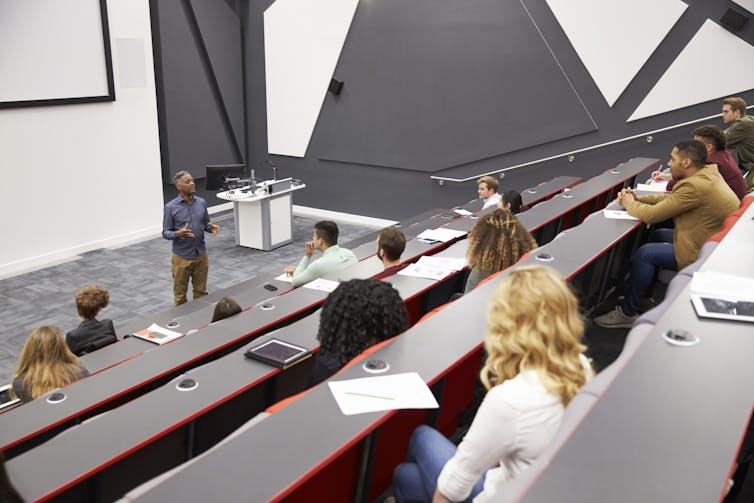
Traditional lectures are often poorly attended and several universities have already decided to abandon them permanently.Shutterstock The lecture was ailing before COVID
Now that COVID-19 has forced universities to cease on-campus lectures, many report that they will not return after the pandemic. Only 23% of ACODE-surveyed universities said they would return to full lecturing.
Times Higher Education reported last month that Curtin, Murdoch and Victoria universities believe in-person lectures are a mode of the past.
Some universities started “killing off” lectures long before the pandemic. In 2012, for example, The Conversation reported the University of Technology Sydney (UTS) was tearing down its lecture theatres.
Many new and redesigned tertiary campuses are not including blueprinted lecture theatres. The University of Tasmania, for example, is in the process of creating the Inveresk Precinct with non-traditional teaching and learning spaces.
Why are lecture theatres on the way out?
Mostly this is happening because there are better ways to learn and to prepare for employment. In 2014, UTS explained its rationale for demolishing lecture theatres was not physical, but educational.
For universities, a primary reason for cancelling lectures is to improve pedagogy or teaching methods. In the ACODE survey, only 7% disagreed with this rationale.
Times Higher Education reported that, by 2013, more than 700 studies had all found lectures are an ineffective teaching approach. There is little empirical evidence to prove that lectures are an optimal way to learn or to develop graduate career skills.
Lectures are passive. They seldom get students to do anything, beyond listening and perhaps taking notes. Lectures fail to foster deep learning and student engagement. The purpose of the lecture is called into question.
This learning mode particularly appeals to mature-aged students, who are working while studying and have difficulty fitting long lecture blocks into their schedules. And this description fits a high proportion of university students today.
University students with busy schedules clearly prefer to engage with much of the traditional lecture content online.fizkes/Shutterstock Are students or employers concerned?
Early in the pandemic (June through September 2020), i-graduate conducted a survey of Australian domestic and international students. Of the 24,000 respondents, 70% were satisfied with how the universities adapted to COVID-19 and 68% with their overall online learning experience.
While students expressed current satisfaction with online lectures (about 70%), only half thought they should remain. Notably, students were not surveyed about their preference for the online recorded long-form lecture versus alternatives.
A recent FutureLearn survey of just over 1,000 American employers asked: “Are you more likely to hire applicants with online education since the pandemic?” While 75% responded yes, 63% said they would need to “rethink” the hiring process.
But how will students learn what they need to know?
The questions within these surveys are asked in a Shakespearean binary: to lecture, or not to lecture. On-campus or online. The reality is not so simple.
Lectures are not the only approach to university education. Furthermore, the choice of on-campus or online learning is now mostly redundant.
All students spend a lot of their time within online “learning management systems”. Even before the pandemic, curriculum without an accompanying website was rare.
The lecture is still the lecture, whether on-campus, or recorded and posted online. The lecture does not teach any better just because it is digital.
Searching for, planning and booking travel is flourishing online (or at least it was during non-pandemic times). Streaming services have radically changed how people watch television. It is time for universities to catch up to other industries and take full advantage of the opportunities of the internet.
It might be time to let the lecture die, now that other modes of learning and interactions (pedagogies) can thrive.
The University of Southern Queensland, for example, is rolling out a suite of alternative teaching approaches. Most of these are available online. Examples include panel discussions, animated explanations, online experimentation, problem-solving demonstration videos and website hunts.
Such approaches are a sign of the nature of educational change brought forward by the pandemic, which was perhaps long overdue in the higher education sector.
by John Gill, Times Higher Education: https://www.timeshighereducation.com/features/new-world-disorder-academys-role-upholding-internationalism As dean of the oldest graduate school of international relations in the US, Rachel Kyte is acutely aware of her institution’s foundation in the run-up to the Second World War and the echoes of that past today.
As a former executive and adviser on climate change for the United Nations and the World Bank, she is equally aware of the new dangers facing the world as we start a new decade, in which action to address the emerging environmental catastrophe will be crucial for all of our futures.
The two issues are, of course, inextricably linked. “If you’re interviewing me in 2029 and we haven’t got more traction than we have today on decarbonising our economy then we are in big trouble,” says Kyte, who took over as dean of The Fletcher School at Tufts University, just outside Boston, in October. “How we will…overcome or put to bed politics which makes people look inside rather than outside is going to be the biggest challenge.”
After a career she likens to an “international merry-go-round” of the supra-national organisations that dominated global governance in the 20th century, Kyte’s move into academia comes at a time when we “may be about to break into a [separate] Chinese sphere, a US sphere [and] a European sphere”.
And she is clear about the additional responsibility that this puts on universities. In the face of numerous challenges, many driven by climate change, “having an academy that is able to collaborate will be essential – these issues are resolvable only at a global level”.
Equally important, if universities are to rise to the exceptional challenges we face, is ensuring that there is diversity of every sort in the academy – but most vitally, for Kyte, diversity of perspective.
“The preciousness of a multiplicity of view must be understood,” she says. “We are at a moment when anything that’s elite can be branded as of no value or dangerous, and there’s a definite echo to earlier in the 20th century. As a school of international relations, I think it’s particularly important for us to stand back and understand what’s going on. We were founded in the 1930s for this precise reason. So it does really matter that your faculty is diverse, not just in…race and gender but in its perspectives.”
A couple of months into her new position, it is natural that Kyte reaches for examples from her previous incarnations to make her point. But it helps that there are clear parallels.
“That was the same at the World Bank,” she explains. “If every economist is from one of four schools of economics, then do we have a diversity of opinion? From the right or the left, we need those perspectives.”
For universities to fulfil their role in helping society to “look around corners”, Kyte continues, it is not viable for them to continue to “look at the world from the perspective of mid-20th-century European man, which is how the whole construct of international relations has been taught”.
And the pressure to change is coming not only from the global agenda but from students too: “This generation of students are intersectional in the way they think about themselves and the world,” Kyte says. “And graduate students are surgical in their analysis of whether we are giving them what they want, and whether we are able to give them what they want.
“Over the last 15 years we have been able to build a very strong female cohort within the faculty at Fletcher, but we now have to travel that distance on other issues of diversity as well. We also have the issue of decolonisation of international relations as a discipline, and the students are saying to us that this just has to get done. There are nuances about exactly how you achieve that, but for them it is a sine qua non. This is not a phase. It’s not going to snap back to where we were. For this generation, this is a baseline.”
Kyte, who grew up in England, is also a strong advocate of interdisciplinarity, observing that “having walked through the back of the wardrobe” from organisations such as the World Bank into academia, “I can see that when we do that well that’s when we attract resources and students”.
She is also impressed by the learning environment to be found in a graduate school in which students come to their studies with considerable life experience. “There’s something very powerful about being in a team of four people talking about some aspect of human security when you have a guy who has done three tours of Afghanistan sitting next to you,” she says.
As for the specific responsibilities of a school of international relations at a time when international relations are more strained than they have been perhaps in living memory, Kyte is clear that it is up to institutions such as hers not only to evolve but also to hold their ground.
“We have three responsibilities,” she says. “We are based in the US, but we are a globalist institution in our views, and we have a responsibility to remain globalist and not get sucked in to the US view of the world to the extent that we can’t represent how things look from other parts of the world.”
A related responsibility responds to the fact that the process of getting a US visa is “more important and expensive than it used to be. So, along with the rest of the academy, we must try to ensure that the US is still a place where scholars can come and exchange their views.”
And a third responsibility reflects the Fletcher School’s history of “studying, influencing [and] feeding people in and out of a set of global institutions which are on the ropes at the moment. And so rescuing multilateralism, or understanding the future international order, is very important. And being open to very different ways of organising the world is important.”
One of the biggest geopolitical tensions of the final years of the last decade, and very much carrying over into the new one, is the increasing dominance of China in a number of spheres: a phenomenon that is often depicted as an inconvenience and a threat to the West. But Kyte believes that maintaining scholarly engagement is essential – and notes that China is not the only nation that is potentially problematic to work with.
“In my previous jobs, there were moments when we were involved in collaborative work between international organisations, thinktanks and academic institutions, and [the question was often]: ‘Are we going to be OK with China?’” she recalls. “But in the last couple of years – particularly in the area where I was working, which was on climate – it became the US that was the problem. It was the US that was saying: ‘This is not going to get published.’”
She also contends that without deep relationships with Chinese institutions and scholars, and a true understanding of China, there is too often a “naivety about who you’re dealing with and how they are going to react. There is often a tendency to paint China as if it is a monolith, and it isn’t. You’ve got reformers and conservatives within central government in Beijing; you’ve got different tendencies among provincial leaders, in state-owned and private enterprises; there’s a bit of naivety here.”
Given her previous roles, as special representative of the UN secretary-general, chief executive of the non-profit Sustainable Energy for All and vice-president and special envoy for climate change at the World Bank, Kyte has thought deeply about how institutions can best respond to the climate crisis.
In the case of universities, she suggests that individual campuses can do their bit locally by enacting divestment policies, cutting down on air travel (which she says is a subject of “robust debate” in a sector that remains addicted to long-haul travel for academic conferences and collaborations), and ensuring that their estates become as sustainable as possible. “But even more important is what and how we teach,” she adds.
Researchers’ contribution to the understanding of the science of climate change is clear, Kyte adds – even if the reliability of the science was still being seriously debated as recently as the start of the last decade. And Kyte says that, as dean, she will aim to further strengthen the work that is done in Fletcher’s Center for International Environment and Resource Policy.
“But I also want our work in international security studies to have climate built in, because Nato is struggling with what climate means for military installations,” she says, adding that global warming is also relevant to security because of its anticipated role in enhancing the number of refugees on the move as parts of the world become increasingly uninhabitable.
“So, for me, [climate change] is a threat intensifier and an existential risk, and I want to teach it across our curriculum – that’s where I think the academy can really help,” Kyte says.
She adds, as an aside, that she finds it “astonishing” that business schools still do not teach in this way, despite the work by pioneering scholars such as Lord Stern, chair of the Grantham Research Institute at the London School of Economics, who was “the first person to bluntly point out that [climate change] is an economic risk”.
It is only by understanding and teaching the ways in which the climate crisis affects everything, Kyte suggests, that universities will maximise their ability to bring about the change the world needs. But she cautions that this has to be done as part of a “symbiotic” effort with industry and government – with each understanding the role they fulfil.
“When it works well, those three are pulling together,” she concludes. “In a world where facts are being thrown back in our faces, when to be elite or an expert is bad, the academy has to have the chops to hold the space.”
As for the argument that politics is too short-termist to deal with the climate crisis, she dismisses it by pointing to the politically toxic impact of intensifying wildfires and flows of refugees.
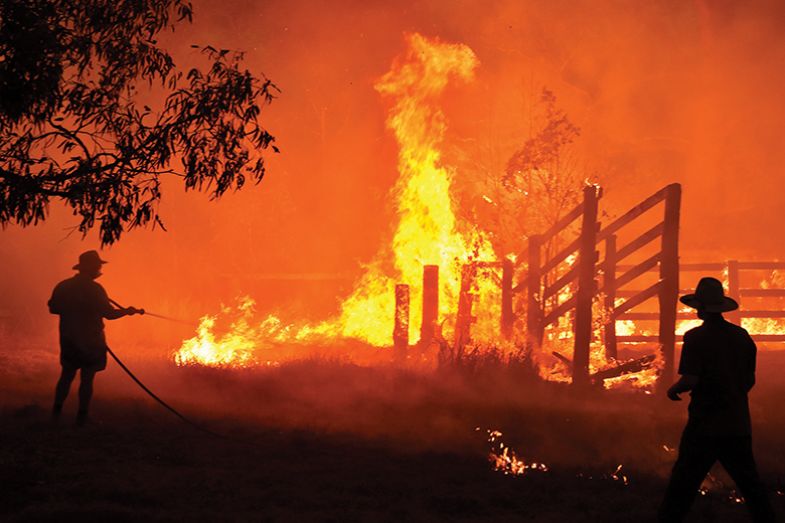
Not that the path from crisis to action is always straightforward. A case in point is Australia, which holds general elections every three years and whose government continues to resist serious measures to address climate change even as unprecedentedly intense bushfires choke the air in Sydney and other eastern cities. The country’s energy minister, Angus Taylor, is reportedly fighting to keep open a loophole that allows Australia to meet its commitments under the Paris climate agreement via what thinktank The Australia Institute has dismissed as “clever accounting” rather than genuine emissions reductions.
But Kyte suspects that a change of heart is only a matter of time.
“Tomorrow came today,” Kyte says, reflecting on Taylor’s presence at the UN’s COP25 climate talks in Madrid in December. “The entire eastern seaboard of Australia is on fire and he is going to try and persuade them that there is some accounting trick he can play to avoid hitting any aggressive targets.
“Time just ran out on that kind of thing. Because when he took off from Canberra, I am assuming he saw the smoke.”
How should you take notes in class? Like so many students who came before me and would come after, I had little idea in college and even less in high school. The inherently ambiguous nature of the note-taking task has inspired a variety of methods and systems, few of them as respected as Cornell Notes. Invented in the 1940s by Cornell University education professor Walter Pauk, author of How to Study in College, Cornell Notes involves dividing each page up into three sections: one to paraphrase the lecture's main ideas, one to summarize those ideas, and one to write questions. After writing down those main ideas during class, immediately summarize and add questions about the content. Then, while studying later, try to answer those questions without looking at the main body of notes.
You'll find a complete and concise explanation of how to take Cornell Notes at Cornell's web site, which includes information on the "Reflect" stage (in which you ask yourself broader questions like “What’s the significance of these facts?" and "What principle are they based on?") and the "Review" stage (in which you "spend at least ten minutes every week reviewing all your previous notes" to aid retention). For a more detailed visual explanation, have a look at teacher Jennifer DesRochers' instructions for how to take Cornell Notes in the video above, which now approaches one million views on Youtube. Her own version encourages taking down main-idea summaries in drawings as well as text, and including things like "key points" and "important people or ideas" in the question column.
That DesRochers' video now approaches one million views suggests students still find the Cornell Notes system effective, as much as or even more so than they did when Pauk first published it. Over time, of course, its users have also augmented it: take Doug Neill's video "Improving Cornell Notes With Sketchnoting Techniques" above, which combines standard Cornell Notes with his system of "sketchnoting," also known as "visual note-taking and graphic recording." He provides examples of what such Cornell-formatted sketchnoting might look like, explaining that "having the option of doing something more visual in your mind triggers a different type of processing power, so that you're more active in the way that you're responding to the ideas. You're not just passively taking in information." The nature of school, as students in every era have known, can often induce a state of passivity; systems like Cornell Notes and its many variations remind us of how much more we can learn if we have a way to break out of it. Related Content:
Based in Seoul, Colin Marshall writes and broadcasts on cities, language, and culture. His projects include the book The Stateless City: a Walk through 21st-Century Los Angeles and the video series The City in Cinema. Follow him on Twitter at @colinmarshall or on Facebook.
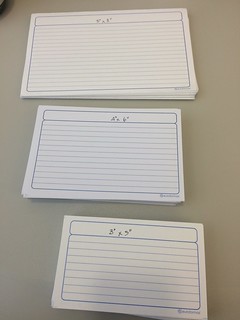
Therefore, I am sure that it will come as a surprise to absolutely nobody in the entire world that I still write bibliographic references, quotations and thoughts on index cards. Yes, small (3″x5″), medium (4″x6″), and large (5″x8″) cardboard, ruled index cards. In a previous blog post, I had shared how I take notes, but I am not 100% certain that undergraduate students would actually find my blog post very useful, since it’s been a very long while since I last took a class.
I graduated with my PhD years ago and I’ve been a professor for a pretty long time, so I thought that maybe I needed to settle down and clarify my ideas of the process I follow to take notes. In this series, I will share my processes to take notes using different methods.
The very first method I use is the Index Cards Method. Other authors have referred to the process Niklas Luhman followed (Zettelkasten). Hawk Sugano has shared his Pile of Index Cards (PoIC) method as well. Mine isn’t all that sophisticated, and since I combine my very analog Everything Notebook and notes in index cards with digital synthetic notes, memorandums,Conceptual Synthesis Excel Dumps, and Evernote, I don’t know that my system would be extraordinarily systematic. But here goes more or less how it works.
People have asked me if you could digitize (or make analogous) all my processes. Of course. What I call synthetic notes (summaries of articles, books) can be done in traditional index cards. And the reverse, you can digitally store these in Evernote. Make sure to note page number
I produce at least 5 different types of index cards, which are more or less the same categories other folks have all agreed upon. Here are some resources on taking notes in index cards that I found useful as I was trying to make sense of my own system.
1. The Direct Quotations Index Card I use index cards to write direct quotations (with page number and full bibliographic reference) from articles, books and book chapters I find useful. This card is the analog equivalent of my Synthetic Note method.
I am more used to writing index cards of books than of articles. I usually write important quotations but other times I summarize chapters or the entire book. pic.twitter.com/tMUdmyabR3
2. The Bibliographic Reference Index Card It’s rare that I do this one anymore because I have been using Mendeley and EndNote as reference managers for more than 15 years, but this was my study method and strategy to conduct research before: I would write the full bibliographic reference in a 3″x5″ index card. Then I would write a small paragraph on the back summarizing the entire book, or at least, the main idea behind it.
Some people (NOT ME) can use these "ideas" index cards to assemble their full papers. I am not this kind of index card user. I do write ideas here, but then I need to staple the card or include a plastic arrow that marks where in the paper this particular idea goes.
This is an example of “bibliographic index card” - it’s basically the full citation plus keywords. It is VERY rare that I use an index card purely for bibliographic data as I use Mendeley, but it’s still worth discussing. pic.twitter.com/w5MZ6fTfMZ
3. The One Idea Index Card I find that these are useful for when you’re studying for an exam, testing your ability to recall, or when you’re giving a talk without reading a set of Power Point slides (e.g. when you’re leading a seminar, using each card as a theme for the seminar). I also use them to remind me of key authors who discuss particular themes and topics.
Some people recommend writing JUST ONE IDEA/quotation per index card. I don’t do this. I use 1 index card per article, and per book chapter. If a book has 9 chapters I write one for each chapter (more of chapter is very dense). Note this paper by @rioconpiedras on nonhuman agency
I also write index cards of journal articles, particularly when I feel that they’re particularly powerful or relevant to my research. As you can see, this index card shows my notes of this article rather than direct quotations.
As its name indicates, the Content Index Card is a combination type of index card that includes direct quotations, draft notes and ideas, conceptual diagrams, etc. that are all associated with the main article, book chapter or book discussed in the index card. I use larger (5″ x 8″) index cards for those cases.
This is what some people call a “combined” or “content” index card. Note I included direct quotations (with page #s) from Debbané and @rkeil’s paper but I *also* write my own thoughts (e.g. “this paper converses with @andrewbiro and his social construction of scale paper”
There are obvious questions that people ask me, so I’ll try to answer them here.
1. Can you do digital index cards? For sure. You can either do combinations as I do (physical index cards, then row entry in a Conceptual Synthesis Excel Dump row), or all digital (either in Evernote or simply in Excel, or synthetic notes or memorandums in Word or Scrivener as you may choose).
You can do digital or analog, or a combination, whatever suits you best. I combine, because I find that as I write on an index card, by hand, new ideas come to me. When I read full books, I write copious synthetic notes and then write a row entry in my Excel Dump.
When I designed my Conceptual Synthesis Excel Dump, I made sure to include a column with the Quotation and another with the Page Number. This is important because as we know, plagiarism is bad, terrible citation practice, and can lead to degree termination/career ending!
2. How do you store and classify index cards? I usually have boxes that fit my index cards, and add a plastic tab with the reference in Author (Date) format. Other people use different classification systems (by keyword, by topic, by author). I just recommend that the process be consistent across.
Quick responses to questions I get asked often, by students and fellow professors: 1) when do I use index cards, when do I write in my Everything Notebook, when do I simply type a synthetic note? The answer is complicated but comes down to laptop battery life and writing block.
If I'm on a plane to Santiago, 8 hours by plane, my laptop battery lasts 3 hours, no chargers on plane - if I want to be awake and work on the plane, I need to write by hand, either in my Everything Notebook or on index cards. Also, if I feel mentally blocked, I write index cards
Index cards help me reframe my thoughts. In fact, that's one way in which some people write their papers: they write one idea in an index card, and then spread them on a surface and arrange them by chapter/theme/sub-heading. Aren't index cards more time consuming? Yes, they are.
I'm always stressed and under pressure to write, submit, revise and publish papers, but I have slowly come to the realization that it's better to let my thinking simmer and evolve, and mull ideas over, and writing by hand helps me do exactly that. So, yes, I do write index cards.
I also write index cards on topics/papers I find super challenging. There's stuff that I am so familiar with that I can simply highlight and scribble and then transcribe my notes to a synthetic note/memorandum. But other topics are more challenging to me, thus writing by hand.
Can all this process be digital? Sure thing. Even a combination can work. You could scan your index cards into an optical character recognition thingie and store the digital content into Evernote, tag it and easily search through your bank of notes. Or you could simply type them.
I have index cards in 3 sizes: 3”x5” (for quick ideas, but could be used as bibliographic reference cards), 4”x6” (for quotations from journal articles and summaries), and 5”x8” (for full books or very dense articles and book chapters)
I do teach my students the Index Card Method of Note-Taking because I believe it is important to learn the old-school techniques, but also because I find that it helps me, and I strongly believe that if it helps ME, then it may also help THEM. In subsequent blog posts I’ll share some of my note-taking techniques when using my Everything Notebook, and other types of media.