Showing posts with label Effective Programs. Show all posts

Monday, April 26, 2021

Australia’s universities dominate global impact rankings

by Brendan O'Malley, University World News: https://www.universityworldnews.com/post.php?story=20210421154215704

Image: timeshighereducation.com

The University of Manchester in the United Kingdom has topped a table of more than 1,100 universities around the world on action towards the United Nations’ Sustainable Development Goals (SDGs), according to the third edition of the annual Times Higher Education (THE) Impact Rankings, released on 21 April.

But in terms of higher education systems, Australia is the world leader, with its universities claiming four positions in the overall ranking top 10, three more than any other country or region.

In total, 17 universities from 10 different countries and regions claim a top position across the 18 rankings, including Mexico, Thailand, South Africa and Saudi Arabia.

The rankings assess university commitment to sustainability at an institutional, local, national, regional and global level, from carbon neutral campuses to global partnerships responding to the COVID-19 pandemic at a multi-national level.

Launched in 2019, the Impact Rankings are the first global attempt to measure university progress towards the 17 SDGs, providing a total of 18 rankings, one for each SDG as well as an overall table.

The University of Manchester came first in the overall table after achieving first place for work towards both SDG 11 (Sustainable cities and communities) and SDG 12 (Responsible consumption and production) and second place for SDG 14 (Life below water).

Vice-Chancellor Dame Nancy Rothwell said the University of Manchester is “delighted to top the world” in the rankings, “but more importantly we’re pleased to be part of a growing community of universities committed to measuring and sharing their societal impact”.

She said the university values the feedback the rankings provide about their performance on each of the global goals.

“They cover every aspect of a university’s impact: our research, our teaching and learning, our engagement with the public and how we operate as sizeable organisations in our cities and regions.”

Top 10 institutions overall

The top 10 institutions overall are: University of Manchester, UK (1), University of Sydney, Australia (2), RMIT University, Australia (3), La Trobe University, Australia (4), Queen’s University, Canada (5), University of Wollongong, Australia (=6 or tie 6th), Aalborg University, Denmark (=6), University College Cork, Ireland (8), Arizona State University (Tempe), US (=9) and University of Auckland, New Zealand (=9).

While Western countries dominate the top 10, 24 countries and regions from six continents appear in the overall top 100, demonstrating a high level of commitment and excellence across global higher education for achieving the SDGs.

Phil Baty, chief knowledge officer at THE, says the rankings – with a record 1,240 universities participating this year but 1,115 institutions ranked – demonstrate that universities are showing “just how important they are to helping global society solve some of its toughest challenges”.

He said: “The results of this year’s rankings demonstrate the cohesiveness of institutions worldwide for a single shared goal, with representatives from 24 countries and regions, and six continents in the top 100 alone.”

All of Australia’s entrants appear in the overall top 200, while the University of Sydney comes first in SDG 6 (Clean water and sanitation), the University of Canberra tops the table for SDG 10 (Reduced inequalities), La Trobe University takes first place for SDG 15 (Life on land) and the University of Newcastle climbs from =82 last year to claim number one spot for SDG 17 (Partnerships for the goals).

Some 405 institutions entered the rankings for the first time, with Canada’s Queen’s University achieving fifth place overall and topping the ranking for SDG 1 (No poverty).

Top ranked universities by SDG

The number one ranked institution overall and for each SDG are:

• Overall: University of Manchester, UK.

• SDG 1 (No poverty): Queen’s University, Canada.

• SDG 2 (Zero hunger): Metropolitan Autonomous University, Mexico.

• SDG 3 (Good health and well-being): Oregon Health and Science University, US.

• SDG 4 (Quality education): Aalborg University, Denmark.

• SDG 5 (Gender equality): Princess Nourah bint Abdulrahman University, Saudi Arabia.

• SDG 6 (Clean water and sanitation): University of Sydney, Australia.

• SDG 7 (Affordable and clean energy): King Mongkut’s University of Technology Thonburi, Thailand.

• SDG 8 (Decent work and economic growth): University of Johannesburg, South Africa.

• SDG 9 (Industry, innovation and infrastructure): Four universities tied in first place: University of British Columbia, Canada; Delft University of Technology, Netherlands; Technical University of Munich, Germany; and University of Toronto, Canada.

• SDG 10 (Reduced inequalities): University of Canberra, Australia.

• SDG 11 (Sustainable cities and communities): University of Manchester, UK.

• SDG 12 (Responsible consumption and production): University of Manchester, UK.

• SDG 13 (Climate action): University at Buffalo, US.

• SDG 14 (Life below water): University of Plymouth, UK.

• SDG 15 (Life on land): La Trobe University, Australia.

• SDG 16 (Peace, justice and strong institutions): Queen’s University, Canada.

• SDG 17 (Partnerships for the goals): University of Newcastle, Australia.

Professor Tshilidzi Marwala, the vice-chancellor and principal of the University of Johannesburg, South Africa, said its top ranking for SDG8 – after coming 48th last year – was an “exceptional feat”, but its work in tackling global issues was also demonstrated by its top 100 ranking overall, in 92nd place.

He said the university remains “steadfast in supporting the UN SDGs through our research, teaching and learning, community outreach and engagement, stewardship and knowledge transfer”.

La Trobe University Vice-Chancellor Professor John Dewar AO said the rankings were an “outstanding endorsement” of the university’s commitment to improving quality of life, health outcomes and the environment through high-impact research, teaching innovation and meaningful partnerships on a local, national and global scale.

“Coming first in the world for protecting life on land highlights La Trobe’s leading role in investigating better ways to produce high-quality foods and medicines while reducing environmental impact and restoring vulnerable ecosystems.”

He said the rankings reflect how closely La Trobe’s values and ambitions “resonate with important global issues and the very real work we are doing to align with and advance the UN’s Sustainable Development Goals”.

Russia is most represented country

Russia (86) is the most represented country or region in the rankings, with an additional 33 universities ranked in at least one SDG table since 2020. Japan has 85 ranked institutions, followed by India (57), Turkey (55), UK and US (both 52), Brazil (47), Pakistan and Spain (both 40) and Iraq (38).

Baty said: “The THE Impact Rankings offer a platform for universities in every corner of the planet to showcase their active commitment to sustainability. The record turnout this year shows how universities are standing up to be counted and fulfil the vital role they play in society.

“Success in any of the SDGs means being responsible at every level, from the individual institutions, all the way up to the multinational. Therefore, we are thrilled to see the growing number of debutants who have qualified this year, as it shows just how seriously they are taking their roles in helping to ensure a sustainable future.”

In this year’s ranking postgraduate-only institutions were included for the first time.

A ‘catalyst for action’

According to THE Chief Data Officer Duncan Ross in his explanation of the methodology, it is hoped that the rankings “can be a catalyst for action, a mechanism for holding our universities to account, and an opportunity for them to highlight great work that they are already doing.”

The THE Impact Rankings assess universities on metrics across all 17 UN SDGs. Data was collected from universities and Elsevier and the metrics were developed in partnership with Vertigo Ventures.

The findings are displayed in 18 league tables, one for each of the 17 individual SDGs and one overall ranking table. To appear in the overall ranking table, universities must have submitted to SDG 17 (Partnerships for the goals) and a minimum of three other SDGs.

According to THE, a university’s final score in the overall table is calculated by combining its score in SDG 17 with its top three scores out of the remaining 16 SDGs. SDG 17 accounts for 22% of the overall score, while the other SDGs each carry a weight of 26%. This means that different universities are scored based on a different set of SDGs, depending on their focus.

A university’s contribution to individual SDGs is assessed on the basis of research metrics (27%) and other evidence-based criteria. So, for instance SDG 1 (No poverty) is based on research on poverty including scale and citations, as well as the number of papers co-authored with a university based in a low- or middle-income country; other factors are the proportion of students receiving financial aid; and evidence of university anti-poverty programmes providing student support and community support.

Comparison with previous years’ rankings is difficult because the number of participant institutions increased by 211 (or 38%) from 556 in 2019 to 767 in 2020 and further increased to 1,240 this year; secondly, the number of SDGs included rose from 11 to 17 between 2019 and 220, increasing the number of metrics ranked.

Monday, December 21, 2020

Why students need to learn academic words

by Sophia Skoufaki, The Conversation: https://theconversation.com/why-students-need-to-learn-academic-words-147628

Image: The Conversation

Method
, analyse, conversely. These words are more useful than you think.

These and other “academic” words are used in writing and speech at school and other educational settings without being specific to any discipline. They can be used, among other things, to describe research (method, analyse) and to structure speech and writing (conversely).

What’s more, knowing them can predict performance at  primary school, secondary school and university. In other words, how well students know academic words may affect how well they do at school. But although students are surrounded by academic words, they are not typically taught them at school – so learning them can be challenging.

Challenging vocabulary

International university students in Hong Kong and New Zealand have reported difficulty with learning and understanding English academic vocabulary.

Monolingual native speakers of English also face problems with academic words, including frequently used vocabulary such as summarise and contribute. Despite the common view that native speakers have well-developed vocabulary knowledge, research suggests that a low socio-economic background can hinder language development, including vocabulary, at both primary and secondary school.

Some academic words occur in everyday language too, so they may go unnoticed. A student can easily fail to realise that reliable means “of consistent quality” in a scientific journal article if they already know that in everyday language it often means “dependable”. Research suggests that people find it hard to correctly guess new meanings for words they encounter in a reading passage, because they stick with the meanings they already know.

With extra meanings come other things students need to learn about a word. For example, when random appears before  sample or sampling, it means that “all the people or things being involved have an equal chance of being chosen”.

As with all word learning, academic word learning isn’t just about understanding what a word looks and sounds like and a definition of its meaning. It also includes understanding which other words tend to appear close to it whenever it has a certain meaning.

Another reason why it is difficult to learn academic words is that some can also be jargon – a word with a special meaning in a particular context. For example, the noun function is used with various shared meanings across scholarly disciplines but it has a specialised meaning in mathematics, and a more recent one in computer science.

teenage boy reading book outside
Academic words are often not taught in schools. smolaw/Shutterstock

Perhaps a more important reason for the difficulty students face with learning academic words is how they are exposed to them. Unsurprisingly, words are learned faster when they are taught than when they are not. Unlike scientific jargon, academic words are not, typically, taught at school or  university.

Ways forward

Academic vocabulary instruction has been trialled at primary and secondary schools. Most of these studies have taken place in the US. They show that teaching academic vocabulary can lead to increased knowledge of academic words.

It is important to note that not any kind of instruction will do. Contrary to common practice in vocabulary teaching, these studies went beyond teaching a word’s spelling and pronunciation together with its most frequent meaning. For example, in one study students encountered the same word in different contexts, were taught more than one meaning for each word, and did activities such as meaning guessing and breaking words into meaningful parts.

Research on what makes some academic words harder to learn than others for students with specific characteristics – age, English proficiency level – can help make educated guesses about which words and which aspects of these words should be taught to different students.

For example, my research suggests that bilingual university students are more likely to recognise an English academic word the more frequent it is, but they tend to recognise cognate words (words similar in form and meaning, such as English university and Spanish universidad) even when they are infrequent.

Woman looking in dictionary.
Academic vocabulary instruction should be tailored to individual students’ needs.  PHENPHAYOM/ Shutterstock

However, not all bilingual students recognise a cognate word when they see or hear one. Teachers can raise bilingual students’ awareness of cognates by pointing out equivalent word parts between English and the students’ other language. They can also encourage them to use their knowledge of cognates while reading or listening in English.

As with any word, knowing many things about an academic word is more likely to help students understand it correctly in reading and listening and use it appropriately while speaking and writing.

However, classroom time is precious. Not all academic words  can be taught in such depth. The teaching of these words will be more efficient if it is tailored to individual students’ needs.

Monday, November 30, 2020

Building equitable practices in schools in the midst of COVID-19

by Team XQ, XQ Rethink Together:  https://xqsuperschool.org/rethinktogether/equitable-practices-schools-covid19/

Image: thelearningcounsel.com

Last spring, the global pandemic interrupted schools and brought concerns over equity to the forefront of education discourse. The shift to remote and hybrid learning highlighted inequitable truths and provided a chance to rethink equitable practices — ones that recenter relationships, reinvent how they use time, and focus on deep learning experiences.

Equity in a school building doesn’t just happen, it is purposefully cultivated. 

As part of a panel hosted by the 2020 Aurora Institute Symposium, leaders from several XQ schools shared their ideas and practices on “How Intentional Equity Serves All Students.” The panel included incredible leaders from four XQ schools across America and offered clear takeaways for how to build equity into your remote and hybrid learning models. We wanted to extend the lessons from this workshop to those who attended and anyone else interested in being more intentional about building equitable practices.

Tips for Building and Maintaining Relationships with Students

Building caring relationships with students in a time when our regular social infrastructure is critical to the success of all students. 

  • Explain and reiterate that this is a mutual experience to create a commonality within the school community, including and especially with families
  • Ensure every student has at least one adult responsible and point-person for their academic and social wellbeing 
  • Leverage tools like Brooklyn Lab’s Success Coaching Playbook to embrace strength-based mindsets that cultivate motivation and engagement in academics
  • Reduce the advisor-to-student ratio to create close relationships in group settings quickly
  • Expand the advisory model to span multiple grades as a way to facilitate relationships between incoming students and upperclassmen 
  • Follow up daily — or multiple times a day — with students who have individualized education plans and may need help navigating complicated schedules 

Focuses on What Matters Most in Virtual and In-Person Classrooms

  • Focus on depth over breadth — challenge teachers to break away from traditional pressures and timelines to go in-depth on specific content.
  • Create work time throughout the virtual school day to give students an opportunity to concentrate on school work
  • Allow students to engage in different learning models — including whole group sessions and smaller group learning opportunities — and provide options when possible
  • Hold virtual office hours so students can access staff members regularly
  • Leverage technology, including social media, to expand access to professionals and experts in diverse fields for students 

Learn More From XQ School Leaders Who Are Committed to Equity 

Eric Collazo

Principal, Washington Leadership Academy

Eric is passionate about creating more equitable urban education. He mentors students and develops effective teachers in order to benefit the greater community. Eric attended the College of the Holy Cross. After graduating, Eric joined Teach For America. While teaching, Eric attended American University and earned a Master of Arts in Teaching. He now serves as the principal of Washington Leadership Academy.

Lillian Hsu

Principal, Latitude High School 

Lillian’s work is rooted in the belief that all students are capable of doing incredible things when given the right opportunity and support. Lillian has worked in a variety of educational settings such as Teacher Magazine and the television show Sesame Street. Lillian earned her B.A. in psychology from Yale University, her Master of Arts in Teaching from Brown University, and her Master’s in Education in School Leadership from the High Tech High Graduate School of Education.

Andy MacMannis

Assistant Head of School and Special Education Director,  Trinity Academy for the Performing Arts

Andy MacMannis has been at TAPA since 2010 and currently serves as assistant head of school and special education director. These jobs entail overseeing support services like special education, TAPA’s Title One programming, and all after-school programming. He also handles all fund development initiatives and “big-picture” planning, such as the management of TAPA XQ + RI. Prior to TAPA, Andy attended Providence College, majoring in Elementary and Special Education. While at PC, he worked for the YouthRAP after-school program in Providence. From there, he attended Brown University, where he received a Master’s degree in Urban Education Policy. 

Bennison Ntsakey

Director of Academics at Brooklyn Laboratory Schools

Bennison is a school leader who is driven by results that transform lives in the 21st century. He’s eager and wants to ensure that all of his learners master the skills needed to excel in college and their professional lives as ethical leaders. Bennison attended Syracuse University and earned a Master of Education in School Leadership Design from Columbia University. 

Additional Resources about Equity and Education 

As we constantly say, we are better when we work together. We are deeply committed to building and sharing resources from schools across the country. Check out these additional resources to learn how to build an equitable practice in your school both in a remote setting and a hybrid one: 

Monday, November 2, 2020

For the first time, Closing the Gap has a higher education target – here’s how to achieve it

by Ian Anderson - Palawa, The Conversation: https://theconversation.com/for-the-first-time-closing-the-gap-has-a-higher-education-target-heres-how-to-achieve-it-147984


The new National Agreement on Closing the Gap has a higher education target for the first time.

It’s also the first time an agreement between governments on Indigenous issues was negotiated and signed by Indigenous Australians. The Coalition of Aboriginal Peak Organisations  represented Indigenous Australians.

Endorsed by the National Cabinet on July 30 this year, the ten-year agreement replaces the 2008 National Indigenous Reform Agreement.

To reach the higher education target, universities and vocational education providers must overcome the educational and social barriers Indigenous students face. Higher education providers can also have an impact on all the agreement’s target areas as well as the reform agenda set out in the agreement.

What is the target?

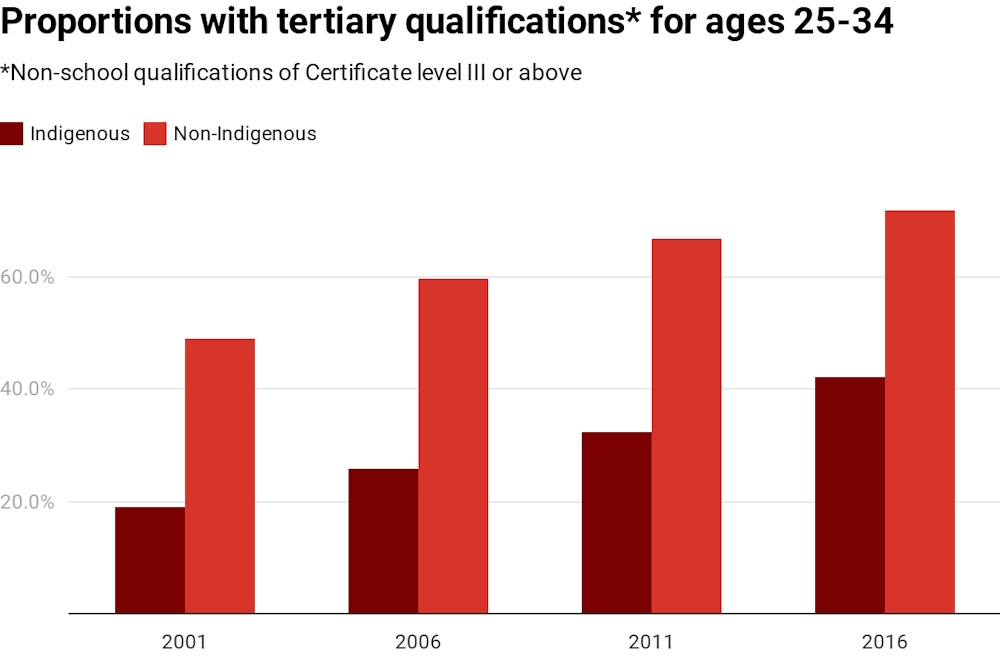
The higher education target is for 70% of Indigenous Australians between 25 and 34 years of age to have a tertiary qualification by 2031.

In 2016, 42.3% of Indigenous Australians in this age group had tertiary qualifications at the target’s required level. The proportion had more than doubled from 18.9% in 2001. By contrast, however, 72% of non-Indigenous Australians had such qualifications in 2016.

Chart showing proportions of Indigenous and non-Indigenous Australians with tertiary qualifications
Data: Australian Census of Population and Housing, 2001-2016, Closing the Gap, CC BY

The target includes all university qualifications and those in vocational education above Certificate III level. Tertiary qualifications at these levels prepare Indigenous Australians for jobs.

Helping students take the next step

Year 12 completions are one factor with an impact on tertiary outcomes. It is encouraging to see growing numbers of Indigenous students completing high school. In 2020 this target was on track.

However, schools need to ensure Indigenous students who complete Year 12 are academically equipped for further university education and/or vocational training. More focus is needed on educational attainment in schools. Options for Indigenous students can also be broadened, including stronger pathways in secondary school mathematics and science.

Many Indigenous students are the first in their family to enter higher education. To support their journey, universities and vocational education providers need to develop long-term relationships with schools and Indigenous communities.

What higher education providers can do

Indigenous university enrolments continue to grow. In fact, Indigenous enrolments increased by about 100% over the decade from 1996.

Chart showing increases in Indigenous and non-Indigenous commencing student enrolments
Source: AIHW analysis of Department of Higher Education Statistics Collection, Author provided

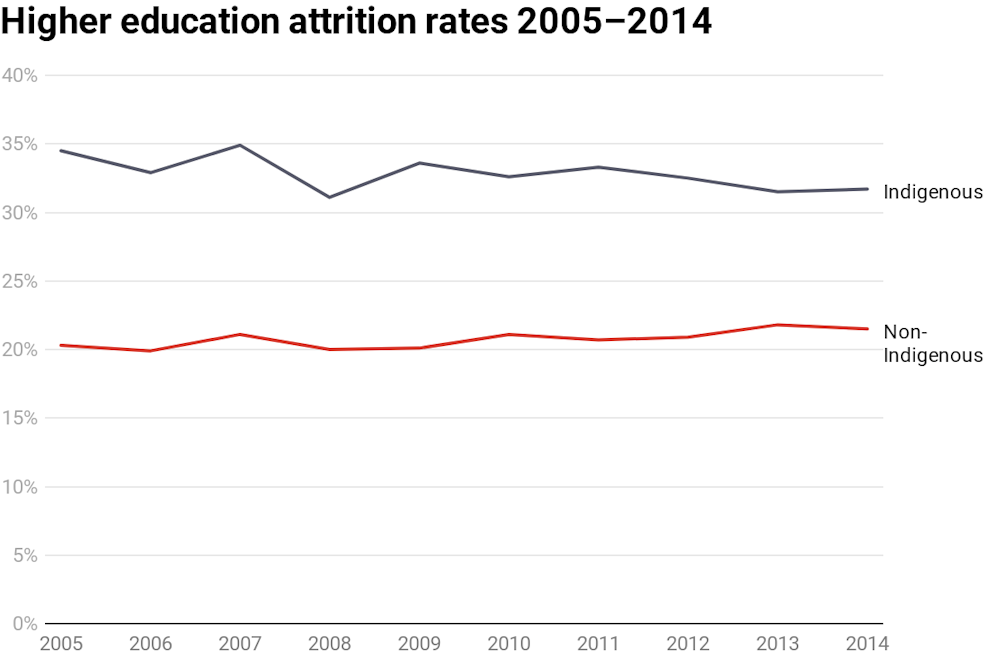
However, Indigenous attrition rates continue to be high. This is a key issue that demands attention.

Chart showing Indigenous and non-Indigenous higher education attrition rates
Source: AIHW analysis of Department of Higher Education Statistics Collection, Author provided

A number of things can be done to improve university completions and lower attrition rates. Targeted education support is sometimes needed for Indigenous students who have gaps in their earlier education. Universities should also continue to provide appropriate social and cultural support.

The university sector has already taken some important steps to address these issues. It’s important to maintain the momentum for reform, particularly while we respond to the challenges posed by COVID-19.

Indigenous students are enrolled in vocational education at a higher rate than their non-Indigenous peers. However, enrolments tend to drop off significantly above Certificate III level. There is, however, some evidence this pattern is changing.

Educational strategies to improve literacy and numeracy will improve progression to higher levels of vocational education. Strong regional links between employers and vocational education will help ensure training lines up with jobs.

Leading change in other ways

Higher education providers also can contribute across all priorities in the Closing the Gap agenda. The new agreement has 16 targets. The targets cover: health, early childhood and child protection, education, housing, employment, community safety, language and land.

Higher education providers can better equip all their students to engage with these priorities over their professional lives.  Embedding Indigenous knowledge in curricula is a key to this. So too is research undertaken to investigate Indigenous disadvantage and identify strategies to improve the quality and impact of Indigenous services.

The agreement has a particular focus on Indigenous-led initiatives.

An important reform is shared decision-making between governments and Indigenous Australians. The agreement also outlines reforms to strengthen the Indigenous community-controlled services sector. Finally, there is a focus on Indigenous-led evaluation and data management.

To that end, it is important that universities and vocational education providers think about how they can lead change. They should consider how they invest in Indigenous leaders within the sector. They should also consider the quality of the Indigenous partnerships they develop.

The National Agreement on Closing the Gap presents some new challenges for higher education providers. The first is to focus on improving educational outcomes for Indigenous Australians. However, these providers have a broader contribution to make; their role in producing the knowledge and workforce for change is equally important.

Tuesday, September 29, 2020

How universities can ensure students still have a good experience, despite coronavirus

by Helen Higson, The Conversation:  https://theconversation.com/how-universities-can-ensure-students-still-have-a-good-experience-despite-coronavirus-146790

As UK university students begin an academic year, they are experiencing a totally different way of life. Some have already found themselves in lockdown in their residences and are afraid they will not be getting some of the usual benefits of university education.

Universities have a duty of care for students’ health and well-being, and a responsibility to ensure that the students of 2020/21 experience a high quality, engaging and innovative learning experience.

It is important to universities that they provide excellent student satisfaction, and they are judged on this by students and the government. So far, it looks very possible that students will rate their experience as less satisfying than usual.

As a researcher with extensive experience in policy and practice in higher education, I suggest there are a number of vital ways in which universities can ensure student satisfaction and continued value for money.

New challenges

New students often find their first term disorientating and now there are additional challenges to deal with, such as managing the use of new technologies and attending face-to-face sessions with social distancing in place.

To maintain student satisfaction and manage expectations, universities have to find ways of listening attentively to students. Institutions may have been doing all they can to support students, but it has not always felt like that to students themselves. Universities need to survey student views regularly and make changes based on these views, so that students find universities to be responsive to their needs.

Woman with headphones on holding pen looking at laptop screen
Students will have differing requirements and preferences for their learning experience. fizkes/Shutterstock

Universities must not treat learners as one homogeneous group. There are not going to be “one size fits all” solutions. Some students will be keen for on-campus sessions, and others will only feel comfortable if everything is online.

Universities have to design learning which can be flexed either way, according to student demand, but also as the pandemic restrictions change. This needs to be done with a new speed and agility – something that universities are sometimes not known for.

Keep in touch

Institutions need to communicate to students more than they have ever done before, and via multiple channels. Students say that email is not the best form of communication.

More interactive ways of connecting, such as virtual question-and-answer sessions, individual phone calls replying to specific questions and social media are far more effective. Universities have a responsibility to explain what they are doing from a student’s point of view, and to tailor their responses to different students.

Young black woman looking at phone
Students may prefer to receive information via social media or messaging.  skyNext/Shutterstock

Finally, universities need to make good use of technology. Paradoxically, a medium which was a response to having to educate at a distance has become the means by which universities can offer a far more individualised, flexible and engaging experience. For example, online learning and communication should allow for new one-to-one conversations on study and progress, informed by data on students’ engagement with their learning.

Invest in staff and students

All this may not be easy for some staff. In the new environment, every teacher needs to be comfortable and creative with the blended technologies they are using. More than this, they need to rethink their approaches to designing, delivering and assessing everything that they taught before, so the 2020/21 curriculum will be fresh, innovative and value for money.

As ever, if you want a high quality product you need to invest, and universities pride themselves on the excellence of their learning experiences. So as well as resourcing extensive extra investment in hardware, software and networking capacity, it is necessary to invest in the training of staff. Staff will need to have the tools to ensure consistency, innovation and excellence of design.

Students also need support in order to take full advantage of the imaginative technological approaches on offer. All this is not cheap, but it is a very positive and necessary investment.

Six months ago the world changed, and with it many accepted approaches to learning and providing a holistic student experience. The relationship universities have with students has to change as a result – more interaction, more innovation and certainly more flexibility for individual learners, learning situations and approaches are all needed.