by
A.C. Shilton, Yes! magazine:
http://www.yesmagazine.org/climate-in-our-hands/these-three-colleges-stopped-investing-fossil-fuels-endowments
You can hear the sounds of new construction from just about any point
on Sterling College’s bucolic Vermont campus.
The whirr of saws and
plink of hammers ricochet off the nearby Lowell Mountains as
students - 26% more than were enrolled just two years ago - shuffle
to class through a carpet of fall leaves.
Things have never been better at this small college, which
specializes in environmental education. An entire Sustainable
Agriculture and Food Systems Center, which will house a new major on
the same topic, is in the works. And not a dime of the money used came
from investments in fossil fuels - because the college sold off all
its stock in that industry last year.
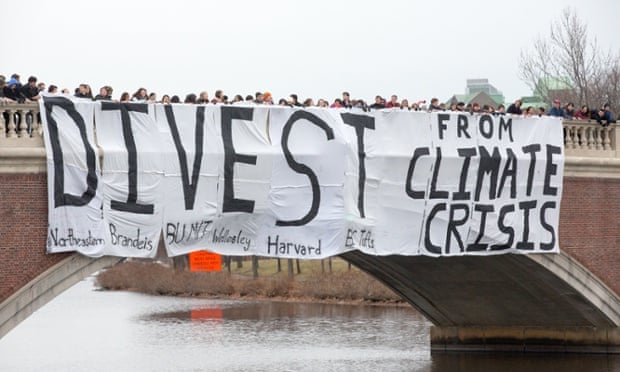
On college campuses nationwide, the key argument against
divestment - or removing all investments from oil, coal, and natural gas
companies - has been that it’s not economically feasible; that
divesting would be an abdication of fiduciary responsibility.
Not
“warranted or wise” were the exact words Harvard President Drew
Faust used in October 2013 to excuse the Ivy League institution from
taking its $30 billion endowment out of environmentally devastating
corporations.
But evidence is mounting against that argument. Several colleges and
universities have completed the process of divestment. None has declared
financial ruin. In fact, many, like Sterling, are seeing improved
returns on their investments.
Meanwhile, the call to divest has never been stronger. During the
week of the People’s Climate March in September, individuals and
institutions pledged to divest
more than $50 billion from fossil fuels.
And earlier this week, 350.org launched its campaign for a Global
Divestment Day, an event planned for February 2015 that the
organization hopes will lead to even greater financial pressure on
fossil fuel companies from universities, organizations, and religious
institutions.
With evidence and enthusiasm on the side of divestment, schools like Harvard may need to rethink their portfolios.
Three days
Sterling College’s move to divest came at the behest of the school’s
trustees, many of whom were already familiar with the issue. The
school’s president, Matthew Derr, said that Sterling had a
relatively small percentage of its investments in fossil fuel companies.
But he felt divestment was the right thing to do because of the
school’s environmental mission.
The financial committee broached the topic with the students and
faculty to make sure there was campus-wide buy-in before moving forward.
Then, Sterling hired Trillium Asset Management, a Boston-based firm
that focuses on sustainable investing, to manage the transition.
“We sold everything in three days,” says Matt Patsky, Trillium’s CEO,
who estimates that about 13 percent of the college’s endowment had been
invested in fossil fuels in some way. “We sold all those funds and
bought them a portfolio of individual stocks and individual bonds that
were fossil fuel free.”
Patsky says that he rolls his eyes when he hears about schools
promising to divest over the next five, 10, or even 15 years. “Why five
years?” he says. “We know from history it can be done in a much
shorter period of time.”
Not long after Sterling College completed its divestment, the school
announced that, for the first time in its history, its endowment had
surged over $1 million. It’s tempting to want to credit that success to its newer, cleaner
portfolio, but that isn’t the whole picture. “They also had an
aggressive capital campaign,” says Patsky.
Sterling is a pretty unusual school though. It’s tiny, with just 123
students. And it’s a work college, where students are required to hold
on-campus jobs, thereby offsetting overhead costs. It might be
tempting to call the school a divestment anomaly - but it’s not.
Other schools that have divested are seeing the same kind of results.
On October 31, 2013, Naropa University in Boulder, Colorado, finished
its divestment process. This time, students were the driving force
behind the campaign.
“We're a values-driven school and we believe in leading by doing,”
says Todd Kilburn, the school’s chief financial officer. “We value our
role in being the tip of the spear on this issue.” Unlike Sterling, Naropa is a medium-sized school, with both graduate
and undergraduate programs. It also has a bigger endowment, around $6.25
million.
San Francisco-based Veris Wealth Partners helped Naropa manage its transition, which was completed in less than one year. Almost exactly a year later, Patricia Farrar-Rivas, the CEO of Veris,
said: “It hasn’t had a significant change on their portfolio.”
But what about a really big school? De Anza and Foothill Community
colleges work together as a single “college district” that serves more
than 600,000 students each year in the southern part of the San
Francisco Bay area.
The private foundation that supports the two schools
is among the largest in California, with $33 million in assets.
Unlike Naropa and Sterling, which are private and are attractive to
students because of their strong environmental commitments, the
state-mandated mission for De Anza and Foothills is clear: to offer
affordable education to the community.
While both of the community colleges have campus-wide sustainability
management plans in place, it is neither institution’s main focus. “My
first goal is a fiduciary one,” says Robin Lyssenko, interim
executive director for the Foothill-De Anza Foundation. “I wouldn't be
here if I didn’t believe that providing open access education was
important.”
In 2012,
students approached the foundation about
divesting, but the foundation requested more information. Six months
later, the students came back armed with data and a resolution
passed by the student body. Lyssenko and the board were impressed.
A review of the foundation’s assets showed that about 1 percent of
its $33 million in holdings was invested in some of the worst fossil
fuel offenders. Eight months later, the foundation’s portfolio was clean
of them.
“To date, I don’t think there’s been an impact on our
investments because of it,” says Lyssenko. In fact, the endowment
recently broke $35 million - though that’s partly due to several
successful fundraising campaigns.

The mechanics of divestment
It turns out that divesting is not nearly as calamitous as Harvard’s president might have us believe. Any time you take stocks out of your portfolio you create a “tracking
error,” which means that your portfolio will track differently than the
overall index.
If the S&P 500 is your baseline, taking out
certain stocks will change how your portfolio performs in relation to
that baseline. In the simplest terms, the more stocks you take out,
the bigger your tracking error is going to be.
A tracking error isn’t necessarily a bad thing - a fund with a tracking
error can do better than the overall index. But it tends to make
investors nervous because there’s always a chance that things will
go the other way. There’s a way to fix that though: Investors can
reinvest the cash or proceeds from stock sales in ways that offset
this tracking error.
When index managers are diverting funds from fossil fuels, they’re
able to look at which ones have performed similarly to fossil fuels in
the past - and reinvest in those. For example, a stock’s “beta
estimate” quantifies a stock’s volatility over time.
Say you take Exxon
Mobile out of your portfolio and it has a beta estimate of .79; you
could replace that stock with Target, which historically has had a beta
of .78. By doing this you can tweak your divested portfolio so it
tracks similarly to the overall index.
Divesting also offers the benefit of letting schools reinvest in things that fit with their beliefs.
At
Sterling this meant reinvesting in companies that produce solar
power, an LED light bulb manufacturer, and even in a company that
produces carpets from recycled materials.
Naropa was already invested in
green real estate and sustainable forestry and land conservation
companies prior to its divestment process, but it added even more weight
to those investments, as well as adding more healthy living-focused
companies to its portfolios.
Fringe Benefits
Sometimes the reward you get on your investment isn’t just a monetary one. “This
really strengthened our student and administration relationship,” says
Todd Kilburn, chief financial officer of Naropa University. “The
students felt like we really listened to them ... I think it has
really built trust.”
“Divesting made our entire board of
trustees, not just the financial committee, much more intimately aware
of our investments,” says Matthew Derr, president of Sterling
College.
“The divestment movement really gave our board members a
chance to see our students in action,” says Robin Lyssenko, interim
executive director for the Foothill-De Anza Foundation. “They really
realized how incredibly passionate, articulate, and well-organized our
students are.”
If trading Exxon Mobile stock for shares in sustainable businesses
seems like a bad financial move, consider this: A 1997 paper in the
Journal of Investing
analyzed the long-term performance of portfolios that had been modified
to exclude a variety of unsavory investments.
It found that
portfolios adjusted for all social issues - with the exception of
military-related companies - performed better than their non-adjusted
counterparts.
This is partly because socially questionable stocks often have high
volatility. Oil is a perfect example. Depending on world events, oil
prices can be up, down and around the corner before noon (oil is
also currently having a terrible quarter, which is great for those that
have divested, but may not always be the case).
All of this data makes Harvard’s reluctance to divest (even as
students and faculty engaged in a week-long hunger strike this fall)
seem, well, silly. Sure, Harvard has the largest endowment of any
university in the nation, but risk is risk, regardless of dollar amount.
Instead, what’s most likely causing Harvard’s noncommittal response
is pressure from its trustees and big donors, many of which (like hedge
fund manager Kenneth Griffin, who gave $150 million earlier this
year) have assets tied up in the fossil fuel industry.
If a university like Harvard dumped its massive volume of stocks,
prices might be affected. And that would be a problem for large
shareholders like Griffin,
an outspoken supporter of the Keystone XL pipeline.
But advocates of divestment say this isn’t so much about money as about creating a sense that oil companies are social pariahs.
Ultimately, “The incremental risk of divesting is really, really
minimal,” says Liz Michaels, director of environmental, social, and
governance investing and socially responsible investing at the
Aperio Group, a firm based in Sausalito, California, which specializes
in hand-picking stocks for investors. “Despite that, there’s some
decision-making that has to go into it.”
At Sterling, that process was easy. “When it was brought up, it
wasn’t so much of an ‘aha!’ moment as it was a ‘duh!’ moment,” says
President Derr. He adds, “We knew we were willing to forgo the concept
of maximum return to be in line with our mission.”
What the school’s administrators didn’t know, however, was how easily
divestment could help them meet their responsibilities to both students
and the bottom line - no fossil fuels required.
A.C. Shilton wrote this article for
YES! Magazine,
a national, nonprofit media organization that fuses powerful ideas
with practical actions. A.C. Shilton is a south-Florida based freelance
journalist and winner of multiple Florida Press Club awards. She is
Outside Magazine’s online Eat & Drink columnist and contributes regularly to a number of national and regional magazines.