The new learning economy is creating opportunities for universities to move on from the current focus on cutting costs, downsizing and job losses. Many universities appear stuck in a downward spiral, but now may be the time to offset this with new initiatives. Growth in the need for ongoing learning creates these opportunities.
Current education providers, as well as new entrants, have the chance to replicate the business models and innovative practices of Spotify, YouTube, Uber, Airbnb and other disruptors of other sectors. For example, we can envisage a platform provider brokering crowd-sourced production of education content. The resourcing of expertise from the higher education sector would provide access to new, scaleable and more widely available forms of academic content.
Significant disruption is imminent. We believe those with ambition will thrive in the emerging new learning economy. They will not only disrupt, but also generate new forms of demand and supply for education.
Old assumptions overturned
The education market has been stable for generations. This stability has relied on three assumptions.
First, knowledge gained through upfront education equips people to master the immediate and ongoing needs of work. As a basis of lifelong competence, the knowledge gained by novice professionals is expected to be sufficient for career entry and beyond.
Second, as we gain experience in our career, we only occasionally require new learning. Experience builds incrementally and continuously on upfront knowledge over time, leading to ever-increasing competence.
Third, there is no need for learning consciousness. In other words, the individual does not need to know how much they know, what else to learn, or how to unlearn.
These assumptions have driven government policy, student demand, employer practices and university business models. With changes to the future of work and digital disruption, these assumptions can now be seen as creating three systemic learning disorders:
the rate of innovation and knowledge development has accelerated, so our knowledge is out of date sooner
experience gained through repetitive work and professional practice is of less value in a world of changing practices and new requirements
our competence is something about which we have less consciousness or literacy – we increasingly don’t know what we don’t know, and not knowing how to learn and unlearn matters even more.
The 3 learning disorders explained
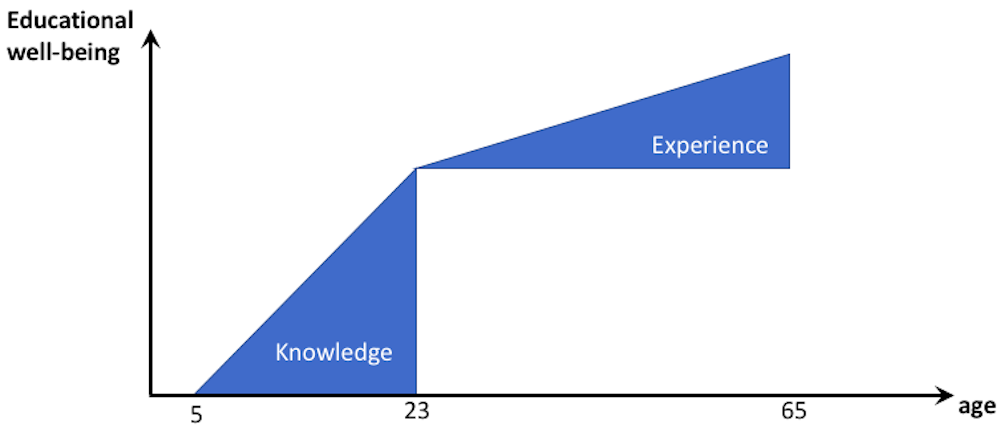
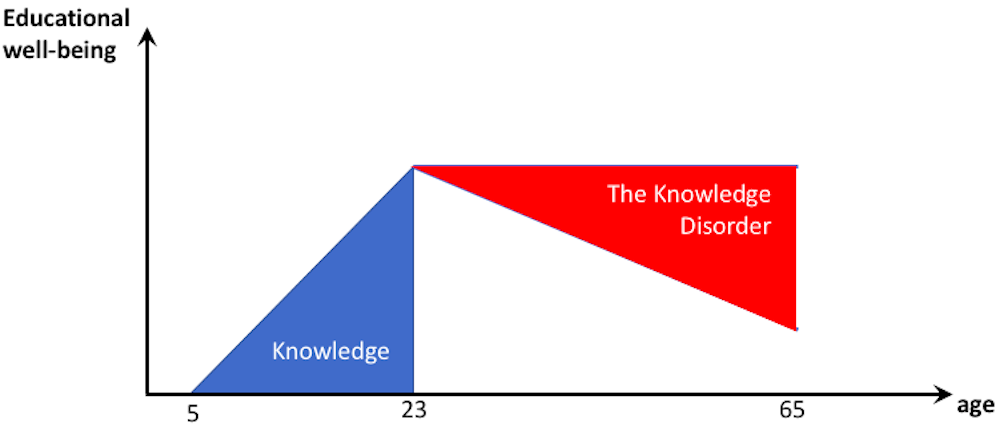
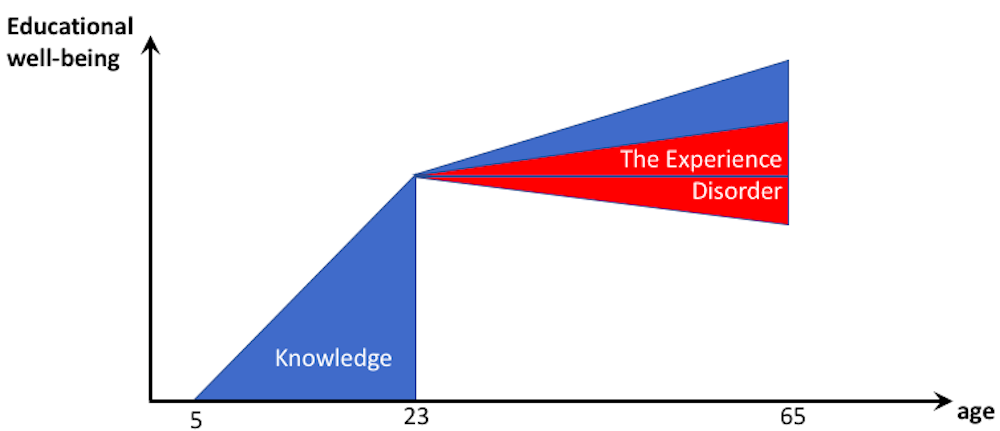
We illustrate these disorders in the three charts below. These plot the way knowledge, experience and competence develop over lifetimes, and the impacts of the emerging learning disorders.
The first chart uses a simplistic model of learning development consistent with the seminal work on self-efficacy in education of Caprara et al. The underlying idea is that competence is a combination of knowledge gained from learning and experience gained from working.
The traditional model of learning: knowledge and experience combine to form competence.Author provided
However, competence is not sufficient. Similar to our understanding of physical well-being (for example, is my blood pressure OK?) or financial well-being (will I have enough super?), we need consciousness about our competence. We suggest this is the basis of educational well-being. The pursuit of this goal gives rise to the new learning economy.
The first disorder, the knowledge disorder, shown in the chart below, captures the fact that the knowledge gained from formalised learning now decays more quickly. This happens due to faster rates of innovation and knowledge development within the periods that learning had been designed to serve.
The knowledge disorder: knowledge is decaying more quickly.Author provided
The rate at which knowledge grows and develops has overtaken our intention to create novice professionals with knowledge lasting a lifetime. One-off degrees that testify to a certain qualification at a certain point in time are no longer sufficient. The world requires educational well-being as much as it requires a healthy and prosperous population.
The third chart shows how the value of experiences we gain in the workplace has changed. No longer does cumulative experience lead to increasing competence. Experiences of old ways of doing things are becoming hindrances to ongoing competence in disrupted environments.
The experience disorder: experience can become unhelpful.Author provided
As a result, experience might matter less. Even worse, it could become counter-productive when unlearning established practices becomes increasingly difficult. In some situations, current knowledge has become more important than past knowledge with added experience.
We can see the impacts of this experience disorder in recent years. Large organisations have let “experienced” staff go, then hired new graduates with contemporary knowledge. NAB was criticised for doing this.
How should education respond to these changes?
We predict we will see on-demand, tailored and customised learning on new platforms. These may be ubiquitous and scaleable programs of what are being called micro-credentials. Google’s “career certificates” are one recent example.
We foresee a need to support continuously improving workplace experience through partnerships between educational well-being providers, maybe universities, and providers and receivers of workplace experiences, employers and employees. We see opportunities for new, platform-based, lifelong experience-management services.
The consciousness disorder arises from us being unaware of how change undermines competence. As US secretary of state, Donald Rumsfeld famously coined the term “unknown unknowns” in highlighting the danger in dealing with complex, fast-changing situations. In such a world, competence becomes more fragile, but we are not aware of it, which makes us vulnerable to disruption.
When Donald Rumsfeld spoke about ‘unknown unknowns’ he wasn’t talking about education, but the concept has emerged as a key issue for the sector.
We can foresee new services to help identify unconscious incompetence. Maybe automated online “health checks” of educational well-being will be made available to alumni. This service could be aligned with personalised access to new knowledge to address gaps.
We believe that responding to these three disorders, in these sorts of ways, provides a blueprint for a new learning economy. This learning economy is global and will scale up to satisfy the demands of citizens who are no longer served by our current model of education.
This evolution of education will not only present new directions for established education providers, but also attract new competitors. They might range from ed-tech start-ups with niche services, to others that see the global learning economy as a high-growth opportunity. Google is unlikely to be the last new challenger to the traditional university model.
Monash University will reportedly cut 277 jobs by the end of the year, due to projecting a more than A$300 million financial shortfall caused by COVID-19. It comes after the vice chancellor of another Group of Eight university, UNSW, Ian Jacobs, announced on Wednesday the university would cut 493 jobs.
These announcements are the latest in a long line of cuts to university workers’ pay, conditions and job losses across the country in recent months. In May, Universities Australia projected 21,000 job losses in the next six months, with more to go after that. The group’s modelling shows Australia’s universities could lose $16 billion in revenue between now and 2023, largely due to the loss of international student enrolments.
University staff have borne the brunt of this funding crisis. The government has not increased funding for the higher education sector, and excluded public universities from the JobKeeper scheme.
University after university has sacked casual staff – which make up up to 70% of teaching staff at some universities - and declined to extend the contracts of fixed-term staff. While the cuts at UNSW include full time staff, in April, around one-third of casuals at the university had reported having lost work.
Casual jobs lost run into the thousands nationwide, but the full extent of losses is unknown. Casual staff are flexible labour, so reliable statistics are not kept. An idea of the scale can be garnered by La Trobe vice chancellor John Dewar’s statement A$7 million had been saved at his institution by cutting casual jobs.
What about the union deal?
The context for industrial relations in universities is the National Tertiary Education Union’s (NTEU) National Jobs Protection Framework - an agreement negotiated between the NTEU national leadership and a representative group of four university vice chancellors in March this year.
The premise of the deal was ask some staff to take wage cuts and pay freezes in return for saving some jobs.
Category A universities could implement cuts of up to 10%. Category B universities - those most affected by revenue reduction - could cut some staff’s pay by up to 15%. Category C comprises the small number of universities hardly affected financially by COVID-19, who would not make changes. Clauses requiring consultation before major restructures in existing enterprise agreements would be severely weakened. Union officials estimated 90% of universities would fall into Category A or B.
This controversial plan sparked a civil war in the union, and was withdrawn on May 26, having been released less than two weeks earlier.
Staff meetings, including branch committees and members’ meetings, in around 15 universities voted against the concessions in the framework. In the end only four (Charles Sturt, Monash, UWA and La Trobe universities) - out of Australia’s 39 vice chancellors signed up to it.
Critics of this strategy argued offering reductions to hard-won pay and conditions showed weakness from the union and would only lead to further attacks on conditions by the universities. They said the wage cuts were unnecessary, and pointed to the vague nature of the job protections. Instead they advocated a political and industrial campaign by the union to defend members’ pay and conditions and demand the government fully fund the industry.
Since then, agreements based on, or similar to the union’s framework, have gone through on a number of campuses, supported by the NTEU leadership.
La Trobe University’s amended enterprise agreement allows for pay reductions of up 15%. This is $174 per fortnight for those on the median full-time wage of $65,000. Shortly after the all-staff vote and despite 239 voluntary redundancies, La Trobe announced it was looking at 215-415 forced redundancies later in the year.
This indicates there is no guarantee that voting to support cuts to wages and conditions will prevent job losses.
Staff don’t have to pay for crisis
At the University of Western Australia, a combination of compulsory taking of unpaid leave and pay cuts means staff will have almost 10% less in their pockets. Monash University, the Western Sydney University and the University of Tasmania have also seen union-management schemes which reduce staff pay. And, as we have seen, Monash will be slashing jobs anyway. Although vice chancellor Margaret Gardner says they have managed to save 190 of them.
Hundreds of job losses have also been announced at Central Queensland University, Southern Cross University and Deakin University. The picture is bleak. But it is by rejecting the notion only staff pay and conditions are the flexible factors in the equation - and being prepared to campaign against university administrations and governments on this basis - that the sector can be improved for staff, students and the public.
Universities have financial resources - property, bequests and philanthropic funds and access to lines of credit - they can access rather than forcing staff to sacrifice pay and conditions, or lose their jobs. The notion of public education as a public good must be re-asserted, especially in the face of the government’s unfavourable stance towards universities.
By staff rejecting concessions on pay and conditions, fighting for every job, and organising towards industrial action in next year’s bargaining round, they can start to put pressure on universities to treat them better, and the government to increase funding.
Kaye Broadbent was a casual academic at Central Queensland University until she lost her job in a recent round of cuts. She co-authored this article.
The recent release of global university rankings and the way these are reported raises important questions about the role and reputation of our tertiary institutions.
Are universities measured and ranked according to what we really value? Or are they ranked and valued only by what is measured? And are those measures authentic and trusted indicators of quality?
There was a time when no one feared that a university might slip a quality ranking or two in the eyes of the world, the taxpayer, benefactors or students considering domestic or international study. Nowadays, however, universities see no limit to the black hole of global rankings. Its gravitational pull consumes their attention.
While a modern phenomenon, rankings have historical origins. The birth of the modern research-intensive university can be traced to Western Europe in 1665 when the first academic journals appeared. In Germany, more than 3,000 journals were published between 1665 and 1790, marking an institutional move from the teaching university to the research university.
Academics were able to share and legitimise their research by publishing in these journals. Students who were called on to write and defend their essays orally could draw on the journals to support their learning.
There is no one ranking standard
Today’s journals and the number of citations academics can claim in them are key indicators of a university’s rank and quality. However, when a university has to research and teach in a language other than English, the effect on its ranking can be drastic.
Databases used by the larger university ranking systems, such as Scopus and CSI/SSCI, don’t automatically pick up non-English journals. Opportunities for researchers to gain “ranking points” through peer citations are therefore reduced.
The University of al-Qarawiyyin in Morocco, the oldest operating institution in the world.Shutterstock
In the global rankings of university quality, various factors are weighted slightly differently. The QS World University Rankings pay particular attention to reputation among colleagues in the discipline. The Academic Ranking of World Universities (ARWU) considers citations in journals as a proxy for research quality. And the Times Higher Education World University Rankings (THE) allocate equally across peer reputation, citation and institutional self-report surveys.
The systems are far from simple and universities increasingly invest in experts to advise on how to improve and maintain ranking scores, especially as more universities crowd the global ranking field.
If we are to accept this imperative to measure and rank universities by academic reputation, publishing record, teaching and research intensity, then we need to ask another question: what other indicators of quality and value might be included?
While online programs have often been considered inferior to “live” learning, for instance, the impact of COVID-19 has forced us to reconsider. There is now broader awareness of the opportunities online teaching opens up – including its positive impact on universities’ carbon footprints.
In fact, the THE rankings tracked progress towards the UN’s Sustainable Development Goals for the first time in 2019. One example of such sustainable activity is Goldsmiths College at the University of London, which banned the sale of beef on campus.
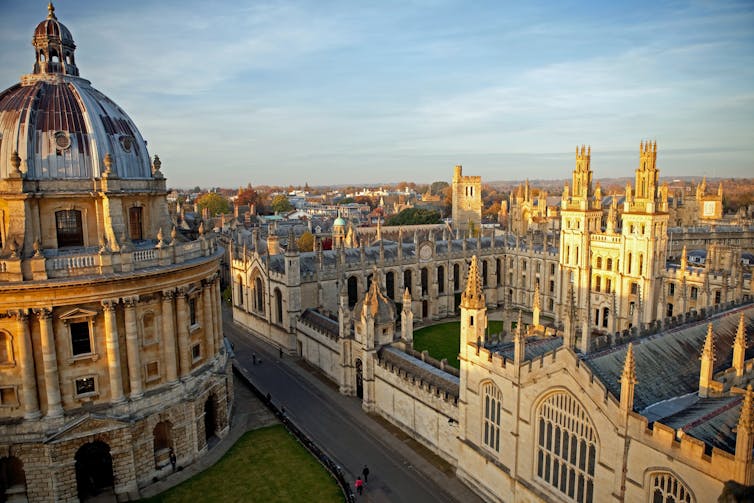
Oxford University: ‘The Lord is my light’Shutterstock
How do you measure intangible value?
Taking an even broader view, might we consider the spiritual dimension of higher education? The university has long been valued for its divine contribution: Oxford University’s motto has been “Dominus illuminatio mea” (the Lord is my light) for at least 200 years. “O my Lord. Advance me in Knowledge” is the motto of the University of Karachi.
This marriage of the sacred and the scientific has been a theme since the founding of the University of al-Qarawiyyin in 859 AD in Morocco. It’s said to be the oldest continually operating higher educational institution in the world.
In the rush to measure quantifiable indicators of output have we obscured these less tangible forms of value?
If COVID-19 taught us anything, it was the value of communication and connection (sometimes called connectivism). In fact, experts from universities came to the fore as rarely before. Rather than handing more influence to PR and social media experts, might this be an opportunity to re-create the university as the place for exchanging ideas, teaching and research?
Maybe we should look back to the House of Wisdom (بيت الحكمة), founded in Baghdad in 786 CE, where scholars met daily to translate, discuss and write in many languages: Arabic, Farsi, Hebrew, Aramaic, Syriac, Greek and Latin. Aristotle’s work was famously translated from Greek. So too the work of the physician Hippocrates.
What hadn’t been accessible was made accessible and shared. The “West” benefited from this knowledge from the East, laying the foundations for the Renaissance.
This was a true academy of the arts and sciences, valued not for its citations, number of Nobel Prize winners or the ratio of doctorates to bachelor degrees, but for the exchange of knowledge and ideas. One wonders how this global multilingual forerunner of a quality modern university might fare under our ranking regime.
By reaching back in history we might recover those other measures of quality and value that formed the foundations upon which modern universities are built. The adage that “if everything is to be as before, then all must change” rings true. How we value and rank the exchange of knowledge and ideas will once again become something worth striving for.
I’m reading Thomas Carlyle’s poetic classic, The French Revolution, published in 1837. It occurred to me that the historical narrative of Australian universities and their relationship to government is like that revolution, but in reverse.
Carlyle summarised the goal of the French Revolution with the refrain “victorious analysis”. This was the foundation of Australia’s modern, rational system of government, achieved with universities. It was a triumph that turned out to be deeply flawed, as we will see.
Reversing the revolutionary process, in recent years universities have descended into the kind of aristocratic excess Carlyle described in pre-revolutionary France. This leaves a large scholarly workforce facing (this is Carlyle again) “an indubitable scarcity of bread”.
It is an admittedly dubious historical parallel, but it helps us understand something of the relationship of higher education to Australian politics, and the mess we now face.
The foundation of the Australian university
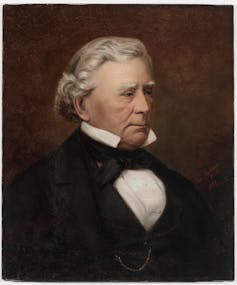
W.C.Wentworth.State Library of NSW
In the mid-19th century, when Australians decided they wanted to govern themselves, political leaders knew they needed a university. Politician and university founder W.C. Wentworth went so far as to argue that self-government in New South Wales – the kind of modern, rational government increasingly in vogue since the French Revolution – would be “useless” without higher education.
In Carlyle’s more flowery language (citingPlato’s Republic): Australia had no aristocracy to overthrow and the founders of our first governments sought a basis for rule that did not rest on inherited position. University graduates, Wentworth believed, were needed to “enlighten the mind, to refine the understanding, to elevate the soul of our fellow men”. They were also needed to train men – and, shortly, women – to fill “the high offices of state”.
Kings can become philosophers; or else philosophers Kings. Let but Society be once rightly constituted, by victorious Analysis.
This merit-based elite – which some of Wentworth’s contemporaries ridiculed as a “bunyip aristocracy” – constituted the emerging professional class. Their work as medical practitioners, lawyers, clergy, teachers, charity workers, engineers and politicians was to guide this “rightly constituted” society.
Such modern, rational governments relied on the kinds of knowledge that a university pursued. “Victorious analysis” guided Australian governments through rabbit plagues and conquered parasites and diseases that threatened food supply and human health.
But it also steered the conquest of Aboriginal lands with knowledge of geology, geography, anthropology and agriculture. And it equipped generations of teachers and clergy with the wealth that was Western history, literature and philosophy – embedded in a racialised, moral superiority.
It was not perfect. Indeed, in many ways this “victorious analysis” was downright harmful.
The kind of knowledge the university produced helped build the nation, but it did so by also developing and reinforcing ideas that expropriated Indigenous land and oppressed people of colour. It built and encouraged ideas that determined a human’s worth on the basis of race, gender and sexuality. Universities and the governments they supported structured a so-called “rational” world that extracted value from some people and concentrated it among themselves.
Exposing the flaw in ‘victorious analysis’
By the second world war, some of these problems were becoming evident worldwide. In that war, the same “victorious analysis” combined with political regimes that sought to use “rational” knowledge to commit atrocities, even genocide, and demolish cities full of civilians.
It was at work when Nazi doctor Josef Mengele compared the effects of cruel experiments on twins at Auschwitz. Through those unspeakable experiments on 1,500 sets of twins, only 200 survived.
The dangers of aligning scholarly knowledge with political regimes was further exposed when, in the Soviet Union, Joseph Stalin dismissed, imprisoned or executed thousands of biologists. The reality that their knowledge may have helped prevent a tragic famine was not more important to Stalin than that their understanding of genetics contradicted government doctrine.
Democratic regimes were not immune. “Victorious analysis” led to the bombing of Hiroshima and Nagasaki. When news of those horrors filtered through, Western democracies saw the problem engendered by the relationship between modern, rational government and scholarly research.
Protecting the independence of scholarship
This did not mean governments sought to dismantle or undermine universities. On the contrary, Australian governments, like most others, invested in them further. However, care was taken, in Australia as elsewhere, to increasingly protect universities from political interference.
At this moment, Nobel-prize-winning author Herman Hesse had his character Joseph Knecht express the significance of scholarly independence in his novel The Glass Bead Game, published in 1943. Describing an age where rulers “determined the sum of two and two” and scholars capitulated (and lost their self-respect), protested (and died) or learned the art of silence (merely going hungry), Hesse’s character concluded that scholarship and politics must not mix:
The scholar who knowingly speaks, writes or teaches falsehood, who knowingly supports lies and deceptions, not only violates organic principles. He also, no matter how things may seem at the given moment, does his people a grave disservice. He corrupts its air and soil, its food and drink; he poisons its thinking and its laws, and he gives comfort and aid to all the hostile, evil forces that threaten the nation with annihilation. The Castalian [scholar], therefore, should not become a politician.
These sentiments were not confined to fiction. As the Commonwealth government sought to support the expansion of higher education – a tricky task, since education was and is the responsibility of Australia’s states – they were conscious of the contradictions required of them.
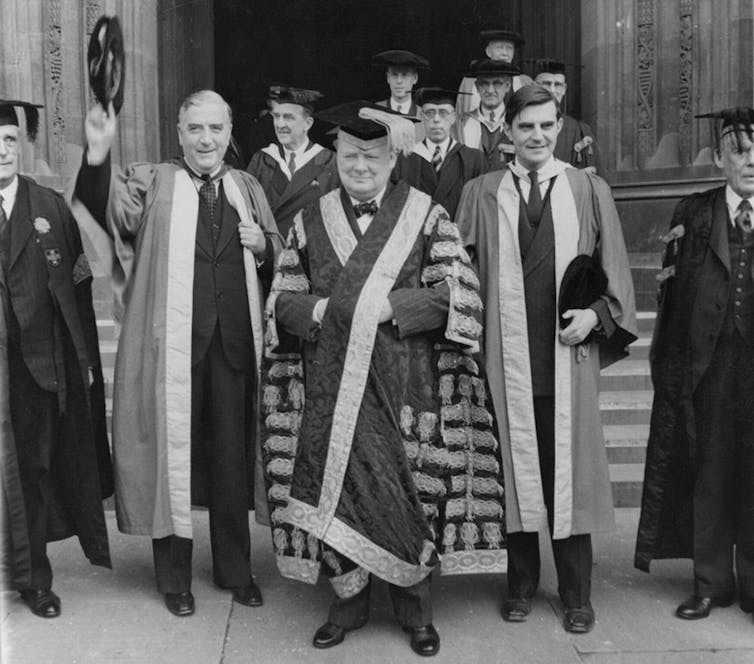
Robert Menzies, here receiving an honorary degree from Winston Churchill in 1941, invested heavily in universities.National Museum of Australia
The 1957 Murray Report, arguably the founding document for the modern university in Australia, pointed to exactly this.
Here is one of the most valuable services which a university, as an independent community of scholars and inquirers, can perform for its country and for the world. The public, and even statesmen, are human enough to be restive or angry from time to time, when perhaps at inconvenient moments the scientist or scholar uses the licence which the academic freedom of universities allows him, and brings us all back to a consideration of the true evidence and what it may be taken to prove …
… No nation in its senses wishes to make itself prone to self-delusion, or to deceit by other nations; and a good university is the best guarantee that mankind can have that somebody, whatever the circumstances, will continue to seek the truth and to make it known. Any free country welcomes this and expects this service of its universities.
On the basis of this report, Prime Minister Robert Menzies instigated what is likely the most generous funding Australian universities have ever seen.
He was building on work that Labor did during the war, establishing the Universities Commission and implementing a funding scheme that helped universities build new infrastructure.
The clashes produced by the dual need for scholarly independence and democratic accountability emerged early. “What I am asking,” argued the vice-chancellor at Sydney University in 1943, “is that you give us the money and be done with it.”
It is a large sum of money and when the Government says ‘We gave this subsidy, did the universities find it all right?’, we must be able to say something more than just ‘Trust the Universities’.
Paul Miller/AAP
Solutions and compromises were negotiated, though the original problems of “victorious analysis” remained.
Contesting the moral foundation of the university
By the 1970s, students and academics began to point out that this rational, supposedly objective system of knowledge veiled ideologies. This was not avoidable, they argued, and so the solution was to seek knowledge systems that were inclusive and decolonising, rather than those that supported established systems of inequality.
Under Prime Minister Gough Whitlam’s policy of free public education, the university sector expanded, seeking innovative and inclusive methods of learning and teaching.
In retrospect, this disruption in the universities marked a shift in the moral focus of the professional class. Where university graduates were originally central to the colonial project and capitalist expansion, they now turned their moral efforts towards moderating both.
This put them at odds with the political and managerial classes with whom the professional class, in the mid-20th century, had managed the entire world, through institutions like the World Health Organisation.
Rise of the managerial elite
But now the professional class split from the managerial class. Using radical student critiques of old moral codes as a springboard, in the 1980s the managerial class sought freedom from traditional moral constraints, which they believed also constrained capitalist growth.
This was more than a culture war: it was conflict over the moral foundation – and thus the control – of the economy. It was a kind of class struggle between a changing professional class and a newly separate, managerial class.
National Library of Australia
New values infused government and university leadership alike, forging what became known as neoliberalism. By the mid-1980s, “victorious analysis” was no longer the basis of government. Yet, ironically, government and economy alike relied on universities more than ever. Innovation was often key to profitability, and the changing global economy required ever more white-collar workers: university graduates.
In 1987, Labor Education and Training Minister John Dawkins led a review of higher education that sought to shift the entire university and college sector from “victorious analysis” to economic asset. Rather than considering the university as a moral institution, it would now be an economic one. An international student “export” market was a key component of 1980s reforms. So too, was massive expansion in the enrolment of Australian students.
But that professional class – which included academics, journalists and teachers, in influential roles – could clearly not be trusted to prioritise capitalist expansion over moral reform.
Transformations in higher education, then, wrested institutions from academic control. Over the following two decades, management of universities became a professional pathway almost entirely distinct from the pursuit of scholarship.
We must not romanticise universities run by academics under the old conditions of “victorious analysis”. As we have seen, this did a great deal of harm. But the fact that the system needed to change need not imply a managerialist solution.
Steered by government policy, an expensive managerialist epidemic infected the universities. Every year, millions of dollars in salaries alone propped up a this new “aristocracy”, a managerial elite.
Leaders assured us this was the best way to manage these growing and complex institutions. But, instead, managers encouraged one another to game the government’s funding system to achieve their KPIs (and earn spectacular bonuses). The cost has been a failure to invest in good universities that are sustainable in the long term.
Failure to build a good university sector
Looking at the state of the university sector now, we surely cannot consider the managerial salary bill to be money well spent. The present crisis was exacerbated by COVID-19 but was not unexpected.
University leaders were repeatedly warned of financial risks, of threats to the university’s legitimacy (and thus community and political support). They have also been reminded continually of their moral responsibility as public institutions. And yet, like Carlyle’s King Louis XV, they have pilfered resources that were “sufficient not to conquer Flanders, but the patience of the world”.
Like that French aristocracy, the university sector in Australia has been teetering on the edge of ruin for decades. In some ways it is astonishing it has taken so long to tip over. Carlyle, on pre-revolutionary France, noted that:
[…] it is singular how long the rotten will hold together, provided you do not handle it roughly.
Australian universities have long teetered – or, worse, arrogantly swaggered – on a precarious foundation. Their precarity goes beyond their over-reliance on international student fees and management’s tiresome reprises of what Geoff Sharrock calls “yesterday’s logic”.
Julian Smith/AAP
All of this – the education of young people, the medical research we’ve all been sitting at home waiting to be done, our entire stock of knowledge of history, mathematics, robotics, climate science – sits atop a 93,000-strong workforce of casual academics on starvation wages. It is these academics who will probably be out of work within the month.
They will likely be followed by thousands of their better-paid, but still overworked, teaching and researching colleagues, then thousands of the indispensable workers who throughout the pandemic have kept the technology running, the exams timetabled, library resources accessible, the payroll delivered, and who have cared for troubled or confused students.
A good university sector would look at 100,000 very clever, highly qualified and extremely hard-working scholars and see a valuable resource.
A good government would work with them.
The job of building a good university out of the system we have inherited from history is a more revolutionary task. It is one we all need to share.