Saturday, February 13, 2021

The PhD: A first draft in five minutes a day?

by Pat Thomson, Patter: https://patthomson.net/2021/02/08/a-first-draft-in-five-minutes-a-day/


This is a brief post. It’s a brief post about a brief strategy which helps you to get started on writing that feels a bit – well – a bit boring. It’s the five minutes a day strategy.

Boring? Yes … sometimes we all have to write things that don’t excite us. We often try to put off tedious writing. We find it hard to get going. We have no energy. Just thinking about the writing makes us feel tired. And perhaps resentful.

When faced with an enervating writing task, it’s tempting to put it off. To do something that’s more interesting. Or perhaps we could sit and look at the blank screen for a while, then switch to email, or marking, or analyse some data, or one of the many other tasks that need doing.

So the boring bit of writing stays unwritten. It becomes increasingly pressing. But no less tedious. You can’t face it. Rinse and repeat. 

Here is one way to get going. Set aside five minutes. Five minutes only.

For the first minute, brainstorm on your screen or on a piece of paper as many elements of the boring piece of writing as you can. What are the bits of stuff you have to write about? Just bullet point them. Don’t fret about it, you’ll know the most important.

Now you have a list. That’s already an improvement on a blank screen or page, but you can do more.

Pick the most boring of all of the boring items. Set your timer for four minutes and write or type as fast as you can about the boring topic for the four minutes. You goal is to reach 250 words. That’s it, just 250 words. Don’t pause, don’t correct the syntax, and leave a blank or write “something” if you can’t think of the right word. Just get stuff down. Your goal is not to generate a coherent flowing piece of writing but to get out as much of the boring stuff as you can.

At the end of the five minutes you’ll actually have made a start on the boring bit of work. You might like to reward yourself for getting going.

Now, if you have time, you can repeat this procedure straight away. Choose the next most boring thing on the list, set your timer for five minutes and write like there’s no tomorrow. Or continue on with the first one if you think you have more to say. Another 250 words down. Again another little reward. 

If you don’t have another five minutes, or the will to go on, put the list and the new 250 words aside and do the same exercise tomorrow.

Five minutes is not a lot of time. And two lots of five minute writing gives you a whole 500 words (but if it’s not working for you, you have only spent ten minutes seeing if it will. Not a lot of time compared to staring at a blank screen). But if it has worked, good for you. You’re underway.

You can keep going in five minute slots a day. Once you have four slots done, you’ll have 1,000 words. Who knew a few days ago that 1000 words could be written without significant pain?

At the 1000 word point, you may want to put the chunks of writing together, and in the order that you think they will go in the paper. You can also add into the document the leftover bullet points from your initial brainstorm. And you now have something like an outline.

You may now be able to go ahead and fill in the various pieces, writing around the remainder of the points. Without timer. Without rewards.. Or you may like to keep going on five minutes a day, point by point, with rewards, until you have the entire outline – lots of chunks of stuff.

These chunks all need work, and they need to be strung together, to link into a narrative chain. But hooray. You do have, at the end of a sequence of only five minutes a day, something that is pretty close to a crappy first draft. Well done you.

So that’s the five minutes day strategy. It’s an adaptation of a common creative writing exercise, tailored to an academic purpose. While it may appear that the major part of this strategy is a short pomodoro, the more important aspect of the strategy is the development of tiny targets, sometimes called micro-goals. Each bullet point from your brainstorm is a tiny writing target.

For people who find getting going hard, or who have very little time to spend on their writing, developing and sticking with tiny targets can be very helpful.

You don’t have to confine tiny targets to boring writing. You can apply tiny targets to anything. With an initial focusing – the brainstorm leading to choice of the mini pomodoro – tiny writing targets can add up very quickly to a text that can then be worked on as a whole. It’s a crappy first draft for sure, but it’s not a blank screen or page. And even a lot of that next stage of second drafting, where you focus on structuring the argument, can happen in little five to ten minute slots.

Photo by Wilhelm Gunkel on Unsplash

Monday, February 8, 2021

Which universities are best placed financially to weather COVID?

by Omer Yezdani, The Conversation: https://theconversation.com/which-universities-are-best-placed-financially-to-weather-covid-154079

Image: The Conversation

2021 is when the impacts of COVID-19 really start to take their toll on universities, as more than 140,000 international students seek to return to study in Australia. My new analysis, presented in this article, reveals that if one in five international students don’t re-enrol, the loss of revenue would plunge half of all Australian universities into financial turmoil or budget deficit. While the impacts of COVID are unprecedented, modelling universities’ financial resilience shows which institutions fare better and why.

International students generated A$10 billion in fee revenue  for universities in 2019. This in turn drives jobs, local industryresearch and Australia’s reputation as a destination for quality higher education.

Recent modelling by the Mitchell Institute estimated more than 300,000 fewer international students would be studying inside Australia by mid-year, if travel restrictions continued.

Universities employ more than 130,000 staff at 200 campus locations across Australia. Many of these jobs could be at risk. Universities Australia figures show at least 17,300 have already been lost.

Revenue and reputation: a self-reinforcing cycle

In total, 32% of all full-time-equivalent enrolments at Australian universities are international students. About a quarter (24%) of all university revenue comes from these students. Universities’ operating revenue fell 4.9% in 2020, with an estimated 5.5% fall to come in 2021.

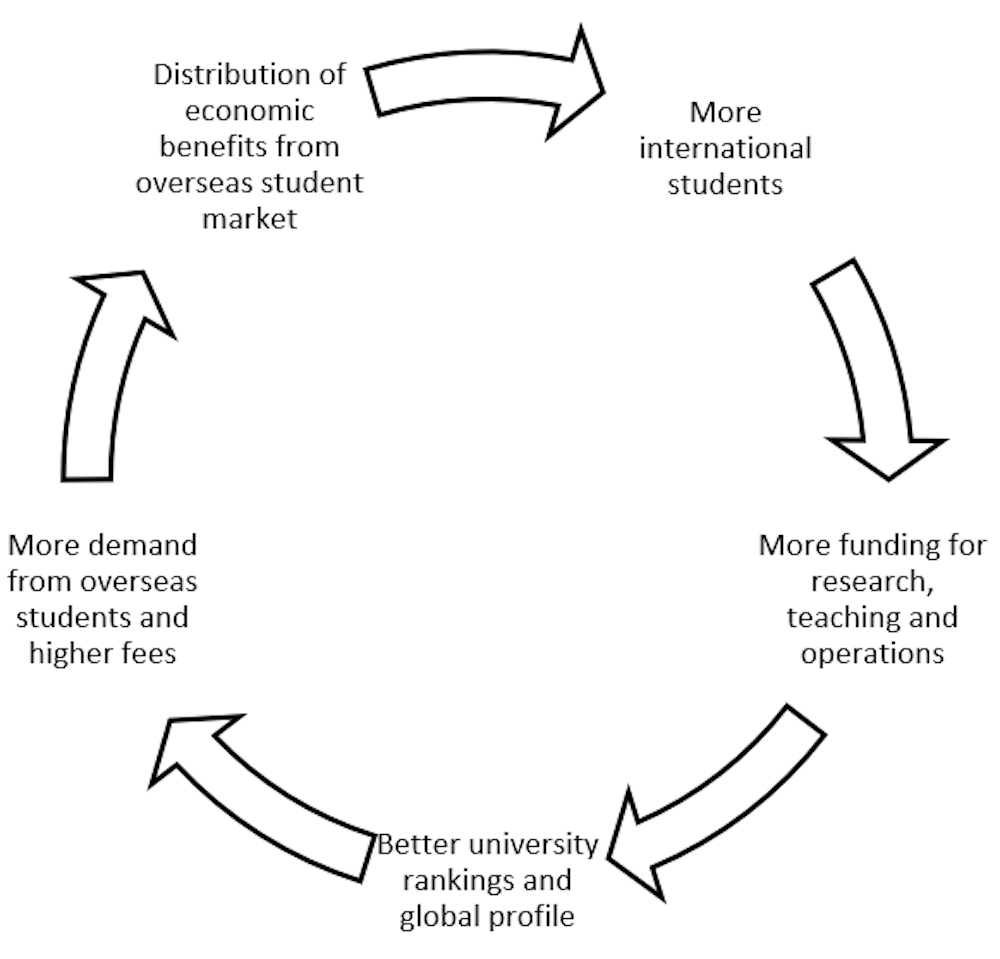
International student fees are correlated with university rankings but are also a self-reinforcing cycle: more international students generate more revenue to fund more research, which in turn leads to better rankings and more demand.

Chart showing links between student fee revenue, university resources and reputation.
International student revenue increases university resources, which enhances reputation, which in turn attracts more international students. Author provided

Another risk factor for universities is the concentration of enrolments from just a few source countries. They are also concentrated in the largest institutions. One in four international students (25%) study at one of these five universities: Monash, RMIT, Melbourne, Sydney or UNSW.

The leading source of international students in Australia is China, with 36% of these students. It’s followed by India (14%), Malaysia (7%), Singapore (5%) and Nepal (4%). Just one or two geographic markets dominate international enrolments at most universities.

International students aren’t the only risk factor

The worst-hit universities may be those with small pre-COVID operating margins and high reliance on concentrated international student revenue.

My analysis shows a 20% fall in international student fee revenues would leave 22 universities in deficit or on the brink with a net operating result (revenue minus expenses) of 1% or less.

Those with a higher reliance on international students, less diverse revenue streams or a lower return on equity fare worse in the post-COVID modelling. The chart below shows the impact on university net operating results of five scenarios involving decreases in international students by 10%, 20%, 30%, 40% and 50%.

The net result decreases more dramatically for those with both a high reliance on international students and a limited operating buffer. In other words, the risks already existed – COVID amplified them.

Universities need a buffer to absorb shocks

Many Australian universities rely heavily on revenue from international students as part of their business model and global profile. Twelve rely on international student fees for more than 30% of their total income.

Table of universities that receive more than 30% of their total revenue from international student fees
Data source: Department of Education, Skills and Employment, Finance TablesAuthor provided

While all the universities in the above table are registered not-for-profits, they need to remain financially sustainable. Any organisation involved in high-stakes global markets should have a buffer against rare and unexpected shocks such as the COVID pandemic. A requirement for financial buffers was legislated in the US following the global financial crisis but still remains a vexed issue.

The average net pre-COVID operating result for Australian universities was a healthy 5.6%. However, several started the year with a result of less than 1%. These universities included Charles Darwin (-3.1%), Notre Dame (-2.6%), New England (-1.4%), Macquarie (0.14%), Central Queensland (0.71%) and Charles Sturt (0.77%).

These results raise important questions for university boards. What is a responsible operating result considering the risks of the business and the markets in which it operates? Was “pandemic” already identified in risk registers? And what was done about it?

Significant revenue write-downs leave institutions with only a few levers to buffer the COVID shock while minimising risks to quality.

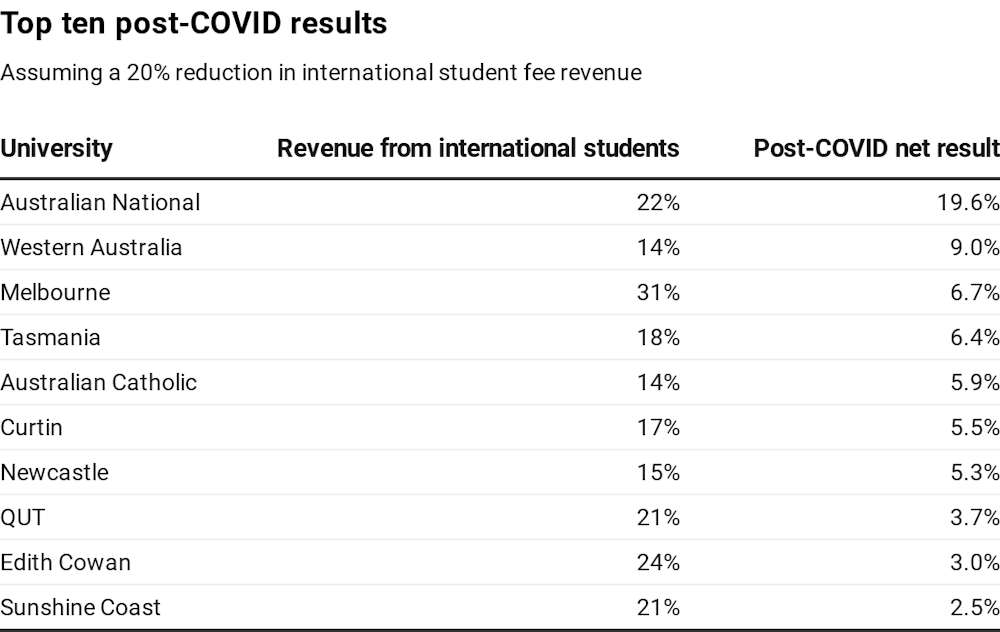
Chart showing top 10 operating results for universities assuming a 20% fall in international student fee revenue
Author analysis of modelling using data from Department of Education, Skills and Employment, Finance tables

On average, the above top ten universities generate 20% of their revenue from international student fees. The sector average is 24%.

The University of Melbourne gets 31% of its revenue from international student fees. That’s higher than the average, but its very healthy pre-COVID operating result of 13.9% provides breathing space.

Newcastle, QUT, Edith Cowan and the Sunshine Coast are in the top ten universities, but under this model have a potential post-COVID result of less than the sector average of 5.6%. Their risk exposure to international student fee revenue is still average or lower.

How should universities respond?

Three main conclusions can be drawn.

First, to underpin their financial sustainability and avoid risks to quality, universities must consider not only their reliance on international student fee revenue and market concentration, but also strategies to understand and define their appetite for risk.

Second, the model for online education when travel across borders is limited could be a long-lasting effect of COVID. Long-term strategies and regulatory practices to deal with this “new normal” of global higher education will be needed, beyond temporary regulatory flexibility.

Third, disruption to higher education is here to stay. Waiting for a time when the view on the horizon is clear for all to see may be too late.

Global higher education requires a new organisational ambidexterity. That means universities must revisit core operating models, re-imagine future potential and succeed on the disruptive edge.


Note: Department of Education, Skills and Employment finance tables used for this analysis may differ from institutional reports due to various accounting methods.