Friday, July 31, 2015
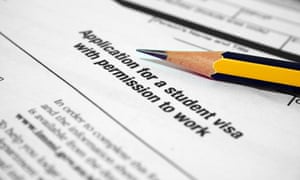
I Don't Feel Welcome in This Country as a Foreign PhD Student: The Government’s Orwellian-Style Monitoring of International Students Makes me Feel Like an Imposter
As a non-EEA (European Economic Area) migrant, if I wish to complete the most mundane paid tasks at the university - such as sealing up undergraduate exam scripts and carrying them from the examination hall to the faculty - I have to fill out seven pages of paperwork.
Each time I complete such a task, I must also fill out an online form requesting that a letter be mailed to my flat, which I then take in person back to the university offices, in order to prove my physical existence in the UK and its correspondence to my address.
Such letters expire every 30 days, so I have had to apply for new ones several times. The last time I was asked to help carry exam papers I refused, on the grounds that it would take longer to fill out the paperwork than to actually do the job.
This week marks the ninth time since I arrived in the UK that I must appear in person at the university registry and display my US passport in order to “confirm my attendance”.
Apparently, it is not enough to the Home Office that I attend a university that is a “highly trusted” sponsor. Or that as a postgraduate tutor I must, ironically, take attendance records of students who attend my classes, as part of the university’s own self-monitoring practices established to retain its “highly trusted” status. Or that I paid several hundred pounds to obtain my Tier 4 visa and residence permit. Or that UK Border Control can track each time I enter and exit the country. Or that I possess a national insurance number and am registered with an NHS surgery. Or that I meet regularly with my supervisors.
In a visa provision that may be eliminated for future international students, I am allowed to work 20 hours a week. I am banned, however, from working as a private tutor. Why? I suppose because some students came to do a course like mine and decided they would set up a tutoring business instead, and were actually quite good at it. So the Home Office says, no more tutoring for you lot. They introduce a blanket policy.
If student migration abuse is a problem, then the Home Office is like a repairman who, when called to fix a hole in the wall, decides to burn down the house.
With the ever-changing goalposts for post-study work visas, we international students find ourselves wondering: even if we got a job offer, would be able to stay in this country? Would we even want to? The idea of deporting students upon graduation, and then inviting them to apply for a job from abroad and re-migrate, is simply laughable as a method to attract the “best and brightest”. As a general principle, the more the rules change, the more trust is eroded.
The Home Office’s continued threats towards international students have created an Orwellian monitoring system that shreds the peace of mind and the sense of stability necessary for critical reflection and groundbreaking research.
Such meddling undermines the mental wellbeing of young persons and mocks the vocation of people who came to this country to use its libraries and laboratories, and to learn.
Here's Why There's No Such Thing as Free Public Education Anymore: The Cost of Classroom Supplies and Mandatory Activity Fees is Soaring Out of Control, and Low-Income Kids are Hurt the Most
| (Photo: BSIP/Getty) |
Staff Writer Liz Dwyer has written about race, parenting, and social justice for several national publications. She was previously education editor at Good.
It’s nearly back-to-school time, which means parents and kids will soon be heading to stores to stock up on all the supplies needed to complete classroom assignments and homework.
But according to the annual Backpack Index from California-based Huntington Bank, the expense of pens and pencils, along with required public school activity fees for the 2015-2016 school year, is increasingly out of reach for cash-strapped families.
The bank crunched the numbers on the cost of supplies and required fees from a representative cross-section of schools in the six states it serves.
According to this year’s index, the parents of an elementary school-age child can expect to fork over $649, a 1% jump since 2014, and a middle-schooler’s family will shell out about $941, up 2.5%. But the moms and dads of high-schoolers will feel the pain in their wallets the most. Supplies and fees for those students will be $1,402, an increase of 9%. Families with a kid in each age bracket can expect to shell out nearly $3,000. That’s a big chunk of change for low- and moderate-income households.
Indeed, a study released last year by the Southern Education Foundation revealed that 51% of public school students are living below the poverty line, which, for a family of four, is $24,250 per year.
Kids whose families are bringing home a little more cash aren’t much better off. A report released by UNICEF last fall found that in 2012, about 32% of children in the United States were living in a home with an income below $31,000. Expecting their parents to fork over 10% or more of their already limited income for public school supplies and fees is just unrealistic.
Thanks to the era of draconian public education budget cuts ushered in by the Great Recession, over the past few years schools have simply passed costs on to families. Since the first Backpack Index was produced in 2007, “the cost of supplies and extracurricular activities has increased 85% for elementary school students, 78% for middle school students and 57% for high school students,” according to the bank.
Indeed, public school parents are no longer being asked to purchase a few notebooks or a $2 box of pencils. Nowadays there are textbook, physical education, and science lab fees. If a family doesn’t pay, the child isn’t prepared to complete assignments and gets a failing grade.
There might be fees to ride the school bus, fees to play on a sports team, or fees for art and music electives. Or if a high school student wants to get on the college track and take an Advanced Placement class, the school might tack on an extra fee to pay for the AP curriculum. Oh, and then there are graduation fees to cover the costs of the commencement ceremony too.
The problem is so out of hand that in 2013 California passed a law prohibiting schools from charging families for supplies, equipment, books, and uniforms. But in the 2014-2015 school year, some parents in the Golden State complained that they were still being charged.
“And this is where I argue that public education is not free,” Nicole Wesley, the principal of Redondo High School in Redondo Beach, California, told KPCC. “We’re not given the amount of funding needed to truly cover all aspects of a high school experience for our students."
If a kid who is already struggling with the effects of poverty and is behind academically is confronted with paying such high costs for school supplies and mandatory fees, that might make dropping out more likely. “We work closely with and in public schools and see that many students cannot afford a backpack or the list of supplies they need to learn," Communities in Schools President Dan Cardinali said in a statement about the Backpack Index.
The nonprofit, which works to combat the dropout rate, is just one organization that holds school supply drives to help eliminate that hurdle for struggling students. "While teachers and many school districts do what they can to help students obtain supplies, we need to do more," said Cardinali.
Communities in Schools affiliates hope to collect enough supplies to meet the needs of 1.5 million public school students. But unless states get serious about funding public education, the problem of districts passing costs on to parents in the form mandatory fees doesn't seem likely to disappear anytime soon.
Subscribe to:
Posts (Atom)