 |
| Source: Google images approved for reuse |
by Peter Gray Ph.D.
Freedom to Learn, Psychology Today: https://www.psychologytoday.com/blog/freedom-learn/201509/declining-student-resilience-serious-problem-colleges
A year ago I received an invitation from the head of Counseling
Services at a major university to join faculty and administrators
for discussions about how to deal with the decline in resilience
among students.
At the first meeting, we learned that emergency calls
to Counseling had more than doubled over the past five years. Students
are increasingly seeking help for, and apparently having emotional
crises over, problems of everyday life.
Recent
examples mentioned included a student who felt traumatized because her
roommate had called her a “bitch” and two students who had sought
counseling because they had seen a mouse in their off-campus
apartment. The latter two also called the police, who kindly arrived and
set a mousetrap for them.
Faculty at the meetings noted that students’ emotional fragility has become a serious problem when it comes to grading. Some said they had grown afraid to give low grades for poor performance, because of the subsequent emotional crises they would have to deal with in their offices.
Many students, they said, now view a C, or sometimes even a B, as failure, and they interpret such “failure” as the end of the world. Faculty also noted an increased tendency for students to blame them (the faculty) for low grades - they weren’t explicit enough in telling the students just what the test would cover or just what would distinguish a good paper from a bad one. They described an increased tendency to see a poor grade as reason to complain rather than as reason to study more, or more effectively.
Much of the discussions had to do with the amount of hand-holding faculty should do versus the degree to which the response should be something like, “Buck up, this is college.” Does the first response simply play into and perpetuate students’ neediness and unwillingness to take responsibility? Does the second response create the possibility of serious emotional breakdown, or, who knows, maybe even suicide?
Two weeks ago, that head of Counseling sent us all a follow-up email, announcing a new set of meetings. His email included this sobering paragraph:
“I have done a considerable amount of reading and research in recent months on the topic of resilience in college students. Our students are no different from what is being reported across the country on the state of late adolescence/early adulthood. There has been an increase in diagnosable mental health problems, but there has also been a decrease in the ability of many young people to manage the everyday bumps in the road of life. Whether we want it or not, these students are bringing their struggles to their teachers and others on campus who deal with students on a day-to-day basis. The lack of resilience is interfering with the academic mission of the University and is thwarting the emotional and personal development of students.”He also sent us a summary of themes that emerged in the series of meetings, which included the following bullets:
- Less resilient and needy students have shaped the landscape for faculty in that they are expected to do more hand-holding, lower their academic standards, and not challenge students too much.
- There is a sense of helplessness among the faculty. Many faculty members expressed their frustration with the current situation. There were few ideas about what we could do as an institution to address the issue.
- Students are afraid to fail; they do not take risks; they need to be certain about things. For many of them, failure is seen as catastrophic and unacceptable. External measures of success are more important than learning and autonomous development.
- Faculty, particularly young faculty members, feel pressured to accede to student wishes lest they get low teacher ratings from their students. Students email about trivial things and expect prompt replies.
- Failure and struggle need to be normalized. Students are very uncomfortable in not being right. They want to re-do papers to undo their earlier mistakes. We have to normalize being wrong and learning from one’s errors.
- Faculty members, individually and as a group, are conflicted about how much “handholding” they should be doing.
- Growth is achieved by striking the right balance between support and challenge. We need to reset the balance point. We have become a “helicopter institution.”
Colleges and universities have traditionally been centers for higher academic education, where the expectation is that the students are adults, capable of taking care of their own everyday life problems. Increasingly, students and their parents are asking the personnel at such institutions to be substitute parents. There is also the ever-present threat and reality of lawsuits. When a suicide occurs, or a serious mental breakdown occurs, the institution is often held responsible.
On the basis of her interviews with heads of counseling offices at various colleges and universities, Wilson wrote:
“Families often expect campuses to provide immediate, sophisticated, and sustained mental-health care. After all, most parents are still adjusting to the idea that their children no longer come home every night, and many want colleges to keep an eye on their kids, just as they did. Students, too, want colleges to give them the help they need, when they need it. And they need a lot. Rates of anxiety and depression among American college students have soared in the last decade, and many more students than in the past come to campus already on medication for such illnesses. The number of students with suicidal thoughts has risen as well. Some are dealing with serious issues, such as psychosis, which typically presents itself in young adulthood, just when students are going off to college. Many others, though, are struggling with what campus counselors say are the usual stresses of college life: bad grades, breakups, being on their own for the first time. And they are putting a strain on counseling centers.”In previous posts (for example, here and here), I have described the dramatic decline, over the past few decades, in children’s opportunities to play, explore, and pursue their own interests away from adults.
Among the consequences, I have argued, are well-documented increases in anxiety and depression, and decreases in the sense of control of their own lives. We have raised a generation of young people who have not been given the opportunity to learn how to solve their own problems. They have not been given the opportunity to get into trouble and find their own way out, to experience failure and realize they can survive it, to be called bad names by others and learn how to respond without adult intervention.
So now, here’s what we have: Young people, 18 years and older, going to college still unable or unwilling to take responsibility for themselves, still feeling that if a problem arises they need an adult to solve it.
Dan Jones, past president of the Association for University and College Counseling Center Directors, seems to agree with this assessment. In an interview for the Chronicle article, he said:
“[Students] haven’t developed skills in how to soothe themselves, because their parents have solved all their problems and removed the obstacles. They don’t seem to have as much grit as previous generations.”In my next post I’ll examine the research evidence suggesting that so-called “helicopter parenting” really is at the core of the problem. But I don’t blame parents, or certainly not just parents.
Parents are in some ways victims of larger forces in society - victims of the continuous exhortations from “experts” about the dangers of letting kids be, victims of the increased power of the school system and the schooling mentality that says kids develop best when carefully guided and supervised by adults, and victims of increased legal and social sanctions for allowing kids into public spaces without adult accompaniment. We have become, unfortunately, a “helicopter society.”
If we want to prepare our kids for college - or for anything else in life! - we have to counter these social forces. We have to give our children the freedom, which children have always enjoyed in the past, to get away from adults so they can practice being adults - that is, practice taking responsibility for themselves.
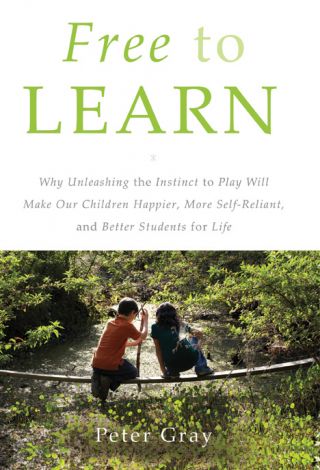
Source: Basic Books, with permission
And now, what do you think?
Have you witnessed in any way the kinds of changes in young adults described here and that seem to be plaguing colleges and universities? How have you, as a parent, negotiated the line between protecting your children and giving them the freedom they need for psychological growth? Do you have any suggestions for college counselors and professors about how to deal with these problems they are struggling with?
I invite you to share your stories, thoughts, and questions in the comments section below. This blog is, among other things, a forum for discussion. As always, I prefer if you post your comments and questions here rather than send them to me by private email. By putting them here, you share with other readers, not just with me. I read all comments and try to respond to all serious questions if I think I have something worth saying. Of course, if you have something to say that applies only to you and me, then send me an email.
See also: Free to Learn (link is external) and alternativestoschool.com (link is external), and join me on Facebook (link is external).
Facebook image: wavebreakmedia/Shutterstock


