Monday, August 31, 2020

4 out of 5 international students are still in Australia – how we treat them will have consequences

by Angela Lehmann and Aasha Sriram, The Conversation:  https://theconversation.com/4-out-of-5-international-students-are-still-in-australia-how-we-treat-them-will-have-consequences-145099

COVID-19 has not stopped international education. As of August 24, 524,000 international students were living among us in Australian cities and communities. They represent 78% of all student visa holders, according to data the Department of Home Affairs provided to us.

These students are potential ambassadors for Australia and our institutions. They could help shape our country’s reputation as a safe and welcoming destination in the post-pandemic world – but only if we look after them.
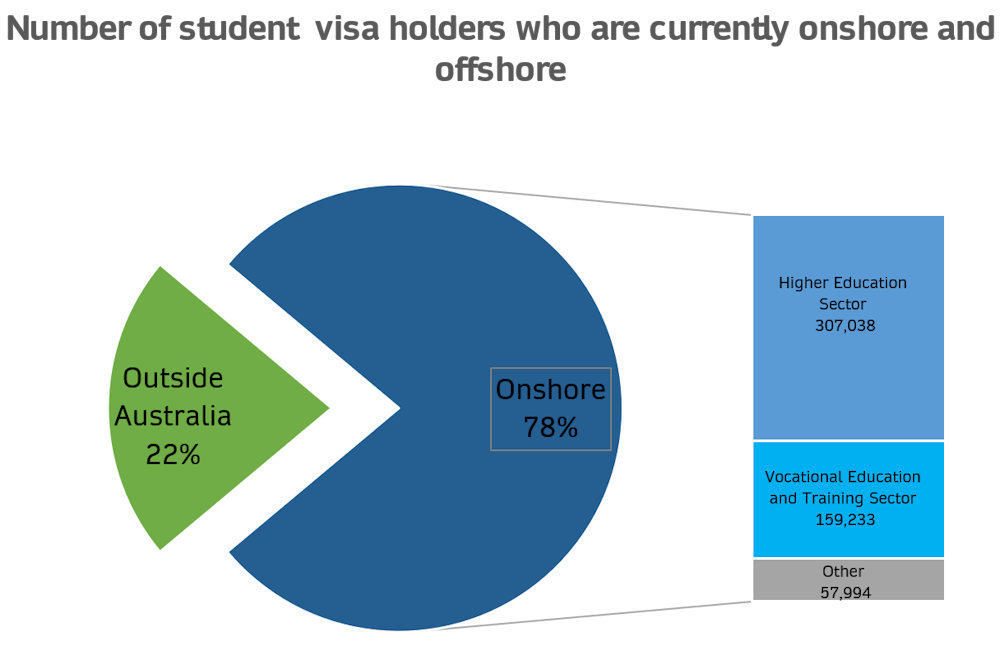
Pie chart and table showing numbers of international students in Australia and offshore
Data as of August 24 2020 provided by Department of Home AffairsAuthor provided

The numbers of students now in Australia vary across sectors. Currently, 73% of our international higher education students and 78% of postgraduate research students are here. The vast majority — 78% — of our international secondary school students are still here too.

The percentage is even higher for vocational education and training (VET): 91% of the sector’s international students are here, 159,233 in all.

Non-award programs (shorter courses that don’t lead to a degree or diploma) and English language programs (ELICOS) have the largest percentages of students now offshore.
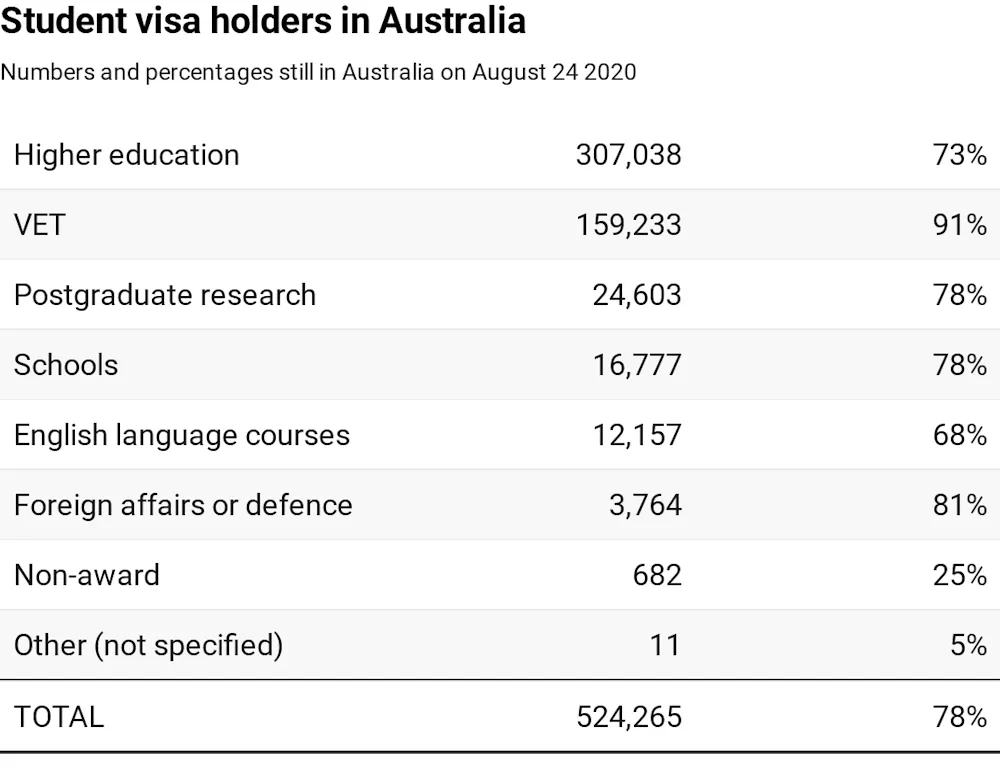
Table showing numbers and percentages of student visa holders still in Australia
Data provided by Department of Home Affairs at authors' requestAuthor provided

The experiences these large numbers of students are having now will have a direct impact on their decisions and patterns of mobility once borders reopen.

However, institutions and government agencies continue to focus on outward-looking approaches to recovery, such as offshore recruitment and delivery, negotiating pilot safety corridors, and scenario planning for the reopening of borders. The onshore response to international education risks being severely neglected.

Students are comparing countries’ responses

International students in Australian cities and communities are of course talking about their situation. They are using social media, creating blogs and interacting constantly with families and friends back home and around the world.

During the pandemic, this peer-to-peer form of marketing is heightened in its global reach. Our students are constantly comparing their lives with students in both their home countries and Australia’s major competitor destinations.

As a result, the crisis of international student social support is the subject of global comparisons. Students and their families are weighing up what they are going through “here” compared to what others are going through “there”.

A life transformed in Melbourne

Arya is a full-time postgraduate student from India who is staying in Melbourne. We spoke with Arya as a part of a series of interviews with international students during COVID-19.

Her dream of studying in Australia was made possible through a combination of a student loan, borrowing from family, and savings after working for two years as a journalist. Prior to COVID-19, she relied on part-time jobs to support herself. This income was essential to her financial survival in Melbourne.

The first lockdown meant she lost both her jobs — one in hospitality and one at her university. As these sectors are struggling in this crisis, her prospect of finding a new job is bleak.

Arya is not eligible for federal government support such as  JobSeeker. But she might be able to get Victorian government support, including a voucher to buy groceries and a one-off payment of A$1,100. She can also apply for a modest grant from her university to cover some bills.

She has struggled to pay rent, but the moratorium on evictions has prevented her from becoming homeless. Her university and local community groups in Melbourne have also provided food hampers.

Arya’s goal was to study in Australia at a world-class institution and solidify her status within the upwardly mobile middle classes in India. Her life has been transformed into a struggle to eat, pay rent and avoid homelessness while keeping her grades up. Arya observes:

It is becoming more than an education. The question is shifting to how students live and survive in a global city midst a pandemic.

It’s even harder in the US

Arya is in contact with friends and fellow Indian students studying overseas. While her situation in Melbourne is dire, her friends in the US are struggling every day. Arya introduced us to Dhanya.

Dhanya, who moved to New York in 2017 to study, says she is struggling “despite doing everything right”. After recently graduating and finding a job, Dhanya lost her H1B sponsored visa for skilled workers as a result of the Trump administration’s recent freeze on visas. “The US government has not considered that we can’t get home,” Dhanya says.

She reports that she and many of her friends in similar situations have been told they can choose to work as unpaid interns.

US President Donald Trump sitting at desk in White House
President Donald Trump has frozen visas permitting foreign students to work in the United States. Kevin Lamarque/Reuters/AAP

Many American states enacted a patchwork of temporary eviction moratoriums and the federal government issued a partial ban on evictions. These moratoriums have now largely expired, forcing students to rely on the discretion of landlords. As a non-citizen, Dhanya cannot receive unemployment benefits or a stimulus cheque.

Dhanya is unaware of any non-monetary support from her university or the government for international students. There are no free meal plans, grocery vouchers, or community-based food schemes.

Despite our Melbourne-based student living with the daily anxiety about her finances, she is comparing her experience relatively positively to her friends in the US.

Some countries are enhancing reputations

Students are paying attention to countries that are including international students and temporary migrants in their social policy response to COVID-19. Arya says:

The way countries handle this now is definitely going to impact how students see your country as a destination in the future.

Arya and her friends are keeping a keen eye on European destinations such as Germany and Sweden. They have also been impressed by Canada’s timely support for international students during this crisis.

It is not enough for Australia to rely on other nations doing badly on social welfare and support. We need to do more than aim to receive a comparatively “good” score on poverty, exploitation and vulnerability based on others doing worse.

Australia urgently needs to actively reshape international education market perceptions by demonstrating that we offer not only world-class education, but also world-class student support. And that starts with helping the cohort of more than half-a-million international students who currently call Australia home.

Sunday, August 23, 2020

The PhD: Personalising your revision practice

by Rachael Cayley, Explorations of Style:  https://explorationsofstyle.com/2020/08/20/personalizing-your-revision-practice/

Image: sustainablewriter.com

One of my favourite bits of revision advice is that writers should learn about their own writing habits. To revise your writing effectively, you should know what words or phrases you overuse or what rules you tend to misunderstand. Bringing to bear your accumulated understanding of your own writing habits will definitely improve your revision process. While working on my book manuscript this summer, I encountered a situation that deepened my appreciation for efficacy of this type of self-knowledge.

As I was struggling through the middle section of the book, I realized that the structure really wasn't working. I had tried out many different things and had ended up equally unhappy with all my attempts. With the help of many reverse outlines (and the incisive advice of a good friend), I realized that I was indecisively flip-flopping between two different structural arrangements:

  1. Having three separate chapters of writing principles, followed by a single chapter of revision strategies
  2. Dividing up the revision strategies and interspersing them throughout the three chapters of writing principles

This type of structural choice probably seems pretty familiar; most of us have had the experience of confronting such a choice in our academic writing. To take a simple example, let's say you've got eighteen participants, each of whom was asked six interview questions. Should you give each participant's answers to all six questions before going on to the next participant? Or should you give all eighteen participants' answers to question one before going on to give all the answers to question two, and so on. The best answer to such structural questions will always be determined by context. Do you want to reflect on the implications of the totality of each participant's responses? Or do you want to draw connections between the varied responses of different participants to each question? Given whatever it is that you're trying to accomplish with your writing, one of these options is surely preferable for your eventual reader. The problem can be, however, that you might genuinely not know what your reader needs in this instance. I was definitely trying to meet the needs of my future reader, but that commitment alone didn't solve my problem: I was still able to make a sound case for either approach.

I eventually came to a resolution by reflecting more deeply on my own tendencies as an academic writer. I often—without even knowing that I'm doing so—shy away from being concrete. My readers have long told me that my academic writing would benefit from more detail, more elaborations, more examples. Recognizing that I generally err on the side of offering concepts without concrete application, I decided that the right solution was probably the one where I pushed myself to be more concrete. Rather than asking my reader to work through three chapters of writing principles before giving them a strategies chapter, I would make each chapter a blend of principles and strategies. Carving up a chapter and integrating its parts into three other existing chapters wasn't easy, but I'm provisionally happy with the results. 

What makes my experience potentially relevant for others is the general notion that self-knowledge can help with decision making in academic writing. When you are confronting a structural dilemma, try thinking about the needs of the reader. If that intervention doesn't magically clear everything up, try reflecting on the ways in which you may typically struggle to meet the needs of the reader. This strategy is helpful because it forces you to think about how your inclinations may not reliably serve the needs of your reader. Different writers will obviously have different writerly inclinations. I revel in creating systematic principles without sufficient attention to concrete applications; others may excel at detailed explication but may be stingy when to it comes to the higher order unification of their ideas. General revision principles—like understanding the needs of your reader—are great, but your revision practices also need to be grounded in a deepening grasp of your persistent habits. Overcoming the gap between how we tend to express ourselves and how the reader wants the material to be expressed is the goal of all revision. We can each give that process a boost by personalizing our revision practices with a growing awareness of what we do well when we write and where we consistently fall short. 

♦

This post is the fifth in a series of book reflections posts. As I go through the writing process, I'm pausing to talk about my progress and my thoughts on the writing process itself. The progress reports are really just for me: I’m using the public nature of the blog to keep me accountable. The actual point of these posts will be to reflect on what I’m learning about writing and how these insights connect to the topics covered here on the blog.

Status Update: In the spirit of public transparency about my book writing process, I’m going to conclude each of these book reflections posts with a status update. Needless to say, the complexity of life over the past five months has made writing extra challenging. I have now finished my provisional revision of Parts One and Two, which puts me on schedule, at least according to the revised schedule I created in June. That means that I'll try to write Chapter Seven in August (somewhat realistic) and Chapter Eight in September–October (less realistic) and Chapter Nine in November (who knows what will be going on by then!). But by the end of year, I should have a full draft ready for extensive revision.